Carl Sagan
1
Books ReviewedAsk LuvemBooks about Carl Sagan
- Where should I start?
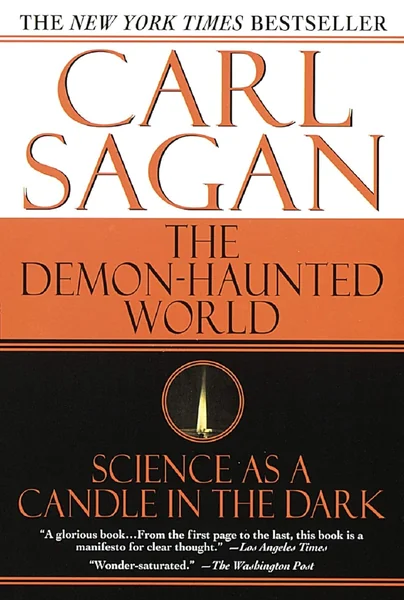
- The Demon-Haunted World: Science as a Candle in the Dark is the natural starting point among the titles LuvemBooks has reviewed, and it works well as an introduction to Sagan's thinking even for readers new to popular science. Rather than covering any single scientific discipline, it lays out how scientific reasoning itself operates and why that matters — making it broadly relevant regardless of your background. Its 4.7-star Amazon reader rating across more than 7,600 ratings suggests it has held up well with a wide audience long after its 1995 publication.
- What's their writing style?
- Sagan writes with a tone that is patient and genuinely curious rather than combative, even when his subject is the debunking of popular myths. He tends to build arguments incrementally, anticipating the reader's objections and addressing them before moving on — a style closer to careful persuasion than to lecture. His prose draws on history, philosophy, and personal anecdote alongside scientific explanation, which gives his books a wider intellectual frame than straightforward science writing typically carries. In The Demon-Haunted World specifically, he pairs an accessible voice with a serious underlying claim: that scientific illiteracy has real political and social consequences.
- Books we've reviewed
- LuvemBooks has reviewed one Carl Sagan title so far. The Demon-Haunted World: Science as a Candle in the Dark (Science & Nature) — Sagan's case for scientific skepticism as a necessary tool for citizens, not just scientists, carrying a 4.7-star reader rating from over 7,600 Amazon reviewers.
- What genre does Carl Sagan write?
- Sagan's work falls primarily under popular science and science communication, with a strong thread of philosophy of science running through most of it. The Demon-Haunted World, the title LuvemBooks has reviewed, sits firmly in Science & Nature — but it also crosses into social criticism and epistemology in ways that give it a broader appeal than a conventional science survey. He also wrote fiction: his 1985 novel Contact explores first contact with extraterrestrial intelligence and was later adapted into a feature film.
- What should I read after The Demon-Haunted World?
- If The Demon-Haunted World resonated, Sagan's own Pale Blue Dot (1994) is the most natural next step — it applies a similar reflective, humanist lens to humanity's place in the universe, grounded in the famous photograph of Earth taken by Voyager 1. For readers drawn specifically to the skepticism and epistemology thread, Michael Shermer's Why People Believe Weird Things covers adjacent territory with a similar commitment to evidence-based reasoning. If the broader cultural argument appealed, James Randi's Flim-Flam! offers a more hands-on investigation of the same pseudoscientific phenomena Sagan discusses.
Who is Carl Sagan?
Follow up
Synthesized from verified book data & published reviews · How we review
Press Enter to ask. Answers come from our editorial Q&A — start typing to see related questions.
Authors Like Carl Sagan
James Madison
James Madison, the pen name of Charles Aronstein (August 27, 1870 – March 27, 1943), was an American theatre manager, writer, and publisher, best known for writing and publishing the periodical *Madison's Budget*.
1 book reviewed

David Graeber
David Rolfe Graeber was an American anthropologist and anarchist social and political activist.
1 book reviewed

Jared Diamond
Jared Mason Diamond is an American scientist, historian, and author.
1 book reviewed
Alexander Hamilton
Alexander Hamilton was one of the Founding Fathers of the United States, an instrumental promoter of the U.S. Constitution, and founder of the nation's financial system. He co-wrote the 85 Federalist Papers essays (under the pseudonym "Publius") with James Madison and John Jay between October 1787 and May 1788, and published early political writings including *A Full Vindication of the Measures of Congress* and *The Farmer Refuted*.
1 book reviewedJohn Jay
John Jay (1745–1829) was a co-author of *The Federalist Papers* alongside Alexander Hamilton and James Madison, contributing five of the collection's eighty-five essays written under the pseudonym "Publius" to promote ratification of the U.S. Constitution. A proponent of strong, centralized government, he worked to ratify the Constitution in New York in 1788 and was recognized for his courage, zeal, and abilities as a writer.
1 book reviewedaa