
8 min read
Share This Review
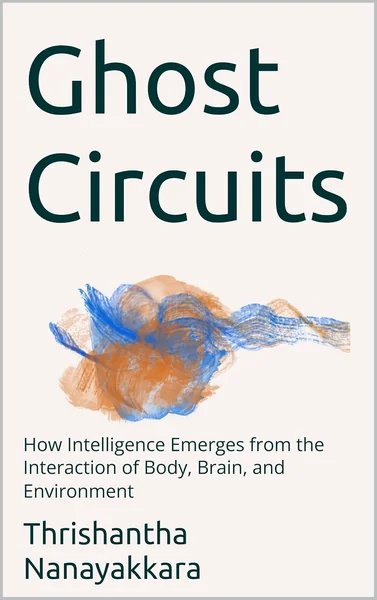
Ghost Circuits: How Intelligence Emerges from the Interaction of Body, Brain, and Environment by Thrishantha Nanayakkara Review: A Rigorous, Research-Rooted Challenge to Brain-Centric Intelligence
Drawing on more than 25 years of research and over 20 doctoral projects conducted at his Morph Lab at Imperial College London, robotics professor Thrishantha Nanayakkara argues in Ghost Circuits that intelligence is not a fixed property residing in the brain alone, but a temporary perception that arises when bodies, brains, and environments interact in dynamic, self-organising formations — a compelling and technically grounded contribution to the science of embodied cognition.
LuvemBooks Verdict
Best for
Researchers, graduate students, and technically literate readers working at the intersection of robotics, cognitive science, neuroscience, or philosophy of mind who want a research-grounded alternative to brain-centric models of intelligence.
Worth it if
You're willing to engage with a deliberately unsettling, relational conception of intelligence — one built on more than 25 years of original research and over 20 PhD projects — rather than seeking a neat, operationalisable definition.
Skip if
Readers looking for a breezy popular-science introduction to AI or brain science, or those who need clean, conventional definitions they can immediately operationalise, will find the book's epistemological ambiguity and specialist depth a significant barrier.
What readers & critics say
The Imperial College Morph Lab page describes the book's central argument directly, noting that ghost circuits "come together on their own, continue their dynamic interactions on their own, dissolve on their own, and evolve on their own," and that the assessment of their intelligence "remains subjective, contingent upon the intricacies perceived by a conscious observer — a judgment that resists replication in identical form, as the observer becomes an integral part of the circuit" (imperial.ac.uk). On LinkedIn, Nanayakkara's own profile records a reader response reporting that encountering the book's ideas produced "a slightly full-circle moment," connecting fragmented life experiences into a unified meaning (linkedin.com).
Sources: Imperial College London – Morph Lab, LinkedIn – Thrishantha NanayakkaraAge & Reading Level
Recommended age
Adult
Reading level
Adult
Skip if you want a breezy popular-science introduction to AI or a clean, operationalisable definition of intelligence.
In This Review
- What Works & What Doesn't
- What the Book Actually Argues
- The Research Foundation Behind the Framework
- Robotics as Experimental Lens
- The Philosophical Stakes and Their Complexity
- Who This Book Is For
What Works & What Doesn't
What Works
- Grounded in over 25 years of original research and more than 20 PhD projects, giving the central framework exceptional empirical depth
- The ghost circuit concept — intelligence as a temporary, relational perception across body, brain, and environment — offers a genuinely distinctive alternative to brain-centric models
- Robotics is used as a bidirectional experimental lens, yielding insights for both engineering and the understanding of natural biological systems
- The book traces ghost circuits across concrete biological examples, from cochlear mechanics to joint stabilisation, anchoring abstract theory in real phenomena
What Doesn't
- The book's insistence that intelligence assessments are inherently subjective and observer-dependent makes it deliberately resistant to readers seeking clean, operationalisable definitions
- Structured around decades of specialist laboratory research, the book is demanding for readers without a background in robotics, cognitive science, or embodied cognition
What the Book Actually Argues
The Research Foundation Behind the Framework
Robotics as Experimental Lens
The Philosophical Stakes and Their Complexity
Who This Book Is For
Frequently Asked Questions
Sources & Further Reading
The key facts and claims in this review are grounded in the retrieved, verified sources listed below.
- 1
imperial.ac.uk
- 2
Related Reviews
Reviews of books we picked for readers who enjoyed Ghost Circuits.


Reader Comments
No comments yet
Be the first to share your thoughts!