BOOKS
Published

Read Time

9 min read

Reader rating

4.5

· 1,793 Amazon ratings
reader ratings, not a LuvemBooks score
Curated & edited by

LuvemBooks Editorial

How we create our reviews →
Share This Review

The Light Eaters by Zoë Schlanger Review: A Revelatory Reckoning with Plant Intelligence

Zoë Schlanger's The Light Eaters is a popular science and natural history study of botany that chronicles a field in the midst of a potentially radical transformation, tracing how researchers studying plant communication, electrical signaling, and adaptive behavior are challenging long-entrenched orthodoxies — and the professional costs that come with that.

LuvemBooks Verdict

Best for

Curious general readers who want a narrative-driven tour of cutting-edge botany — especially those interested in the sociology and politics of science, and in the philosophical questions that arise when biology pushes at the edges of what we call a "mind."

Worth it if

You're drawn to popular science that weaves researchers' human stories through the empirical findings, and you're comfortable sitting with unresolved questions rather than expecting clean, consensus-backed conclusions.

Skip if

Readers who want settled scientific answers and clear-cut conclusions will likely find the book's willingness to dwell in disciplinary uncertainty and contested vocabulary more frustrating than illuminating.

Bookmarks.Reviews aggregates an overall "Rave" rating from five critics, with the book praised as "involving, vibrant, and affecting" for its dispatch from the vanguard of plant research. Kirkus Reviews calls it hard to imagine "a more thorough introduction or a writer more dedicated to her subject and provocative in the questions she asks," while The New Yorker published a full under-review piece framing the book as a window into "the messiness of scientific change" in botany.

Hard to imagine a more thorough introduction or a writer more dedicated to her subject and provocative in the questions she asks.

Kirkus Reviews
Sources: Bookmarks.Reviews, Kirkus Reviews, The New Yorker, Wild Ones, California Review of Books, Slate, Reformed Journal
4.5from 1,793 Amazon ratings— reader ratings, not a LuvemBooks score

Age & Reading Level

Recommended age

Adult

Reading level

Adult

Skip if you want popular science that delivers settled, consensus-backed conclusions rather than a front-row seat to an unresolved disciplinary debate.

In This Review
  • What Works & What Doesn't
  • What the Book Actually Is and Argues
  • The Shadow of *The Secret Life of Plants* and Why It Matters
  • Strengths: Reporting, Enthusiasm, and the Human Drama of Science
  • Complexity and Controversy Within the Science
  • Who This Book Is For — and Where It Tests Patience

What Works & What Doesn't

What Works
  • Named one of Smithsonian magazine's Ten Best Science Books of 2024, with strong praise from Scientific American, Orion, Book Riot, and The New Yorker
  • Contextualizes contemporary botanical research within a clear and compelling institutional history, specifically the long shadow of The Secret Life of Plants
  • Profiles the real human drama of researchers like Monica Gagliano navigating professional risk and academic politics
  • Scientific American highlights Schlanger's 'well-crafted descriptions' and 'infectious enthusiasm' as distinctive strengths
  • Written by a working science journalist at The Atlantic, grounding the reporting in direct access to practicing botanists
What Doesn't
  • Readers seeking settled scientific conclusions may find the book's comfort with unresolved questions about plant consciousness and agency frustrating
  • The contested nature of the science means the book operates in a space of active disciplinary debate rather than established consensus, which not all popular science readers will find satisfying
This review covers the book's content and published reception; it does not reflect hands-on application or testing.
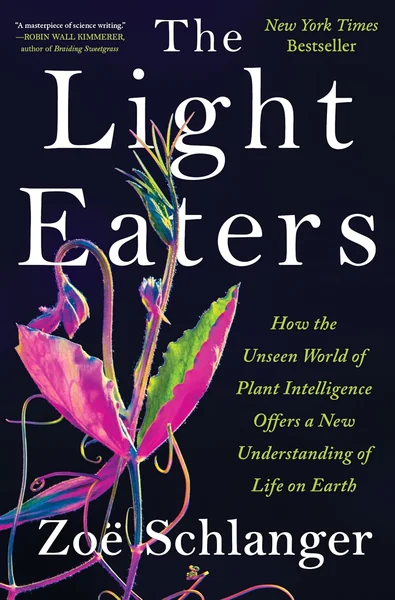
The Light Eaters: How the Unseen World of Plant Intelligence Offers a New Understanding of Life on Earth – A Popular Science and Natural History Study of Botany by Zoë Schlanger front cover

What the Book Actually Is and Argues

Published by Harper in May 2024, The Light Eaters is a popular science and natural history study of botany by Zoë Schlanger, a staff writer at The Atlantic who covers climate change. The book's central argument is that botany is undergoing a potentially radical transformation: scientists are now seriously studying how plants change their shape in response to stimuli, use electricity to convey information internally, respond to sound, and send one another chemical signals — capacities that, taken together, raise contested but increasingly hard-to-dismiss questions about plant agency and intelligence. Schlanger's own position is clear. As quoted in a California Review of Books piece, she writes: "I believe we are standing on the precipice of a new understanding of plant life. Science can feel like a monolith; what it says to be true now will always be true." The book is built around field reporting — Schlanger embeds herself with working botanists — and functions as both a survey of contemporary botanical research and, in her own framing, a kind of anthropology of the scientists pursuing it.
the scientific community's dispute about how to classify the new evidence concerning what seems to be plant communication and adaptability

The Shadow of *The Secret Life of Plants* and Why It Matters

One of the book's most distinctive structural moves is its reckoning with a specific piece of scientific history. A 1973 popular title called The Secret Life of Plants — which Schlanger characterizes as "a mix of real science, flimsy experiments, and unscientific projections" — was eventually exposed as pseudoscience when its experiments could not be replicated. The fallout, as the Wild Ones review notes, was severe and long-lasting: for decades, any researcher who appeared to posit plant intelligence or agency risked ridicule and professional ostracism. Schlanger's book treats this overcorrection as a central problem — an institutional scar that has actively suppressed legitimate inquiry. By naming this dynamic explicitly, The Light Eaters gives readers a framework for understanding why so many of the scientists it profiles work with a certain defensiveness, and why the field's internal debates are so charged.

Strengths: Reporting, Enthusiasm, and the Human Drama of Science

The book's reception from major outlets has been strong. Scientific American stated that Schlanger's work "will transform how you see not only plants but the nature of all life," while Smithsonian magazine named it one of its Ten Best Science Books of 2024, writing that Schlanger "looks beyond the leaves and branches to how our verdant neighbors perceive our world" and that the book "shines." Orion called it "a fascinating journey through contemporary botanical research," and Book Riot noted that Schlanger "illustrates what humanity can learn from the never-ending wisdom of plants." Critics reviewed the book and observed that Schlanger functions as "a sort of anthropologist of botanists" — a description the book itself appears to anticipate, since it includes an actual anthropologist, Kristi Onzik, who studies the culture of plant behavior researchers. Scientific American also praised Schlanger's "well-crafted descriptions" for providing "a rare and welcome glimpse into the humanity and dedication of botanists," and noted that "The Light Eaters overflows with the author's infectious enthusiasm."

Complexity and Controversy Within the Science

The book does not flatten the field's disputes. One of its recurring tensions concerns researcher Monica Gagliano, who is described in the Wild Ones review as being "pilloried as too mystical by many of her colleagues" because she shared spiritual and religious viewpoints about plants in her memoirs — a detail that illustrates how questions of epistemology, not just data, shape the politics of this science. The California Review of Books notes that a central theme of the book is "the scientific community's dispute about how to classify the new evidence concerning what seems to be plant communication and adaptability," with some researchers deeply resistant to the language of intelligence. Schlanger, as that review observes, understands the equivocation of many in the field even as she argues that a paradigm shift is coming. Readers seeking settled consensus will find instead a field actively negotiating its own vocabulary and limits.

Who This Book Is For — and Where It Tests Patience

The Light Eaters is designed for general readers curious about the natural world, the history and culture of science, and the philosophical questions that cutting-edge biology raises about what counts as a mind. Readers drawn to narrative science writing — where the human stories of researchers are woven through the empirical findings — will find this structure well-suited to their interests. The California Review of Books does surface one point of friction: a reader focused primarily on the data may find the book's conceptual ambitions — its willingness to sit with unresolved questions about consciousness and agency — less satisfying than its empirical tour. That is a genuine limitation for readers who want clean conclusions. For those comfortable with science at the edge of its own definitions, however, the book's refusal to oversimplify is precisely the point.

Sources & Further Reading

The key facts and claims in this review are grounded in the retrieved, verified sources listed below.

  1. Cited in this review
  2. 1
  3. 2
  4. Further reading
  5. 3
  6. 4
  7. 5
  8. 6
  9. 7
Related Reviews

Reviews of books we picked for readers who enjoyed The Light Eaters.