BOOKS
Published

Read Time

3 min read

Curated & edited by

LuvemBooks Editorial

How we create our reviews →
Share This Review

The Principles of Creation by Tejas Hiremani Review: A Genre-Defying Spiritual Framework for Life

The Principles of Creation by Tejas Hiremani is a self-published work of spiritual non-fiction that organizes life's guiding forces into seven timeless principles — spirit, freedom, karma, dharma, purpose, mortality, and truth — and frames them as the underlying architecture of human progress from genesis to the space age. Receiving a 4 out of 5 stars from OnlineBookClub.org and described by Independent Book Review as an "experiential book that defies genre," it is an ambitious, eclectic effort from a successful investor-turned-author that will resonate most with readers drawn to integrative, philosophically wide-ranging spiritual inquiry.

LuvemBooks Verdict

Best for

Readers drawn to integrative spiritual philosophy who want a named, navigable framework — spirit, freedom, karma, dharma, purpose, mortality, truth — and are comfortable with a genre-defying mix of philosophical discourse and narrative fiction.

Worth it if

The civilizational ambition appeals to you: you want a unified lens on love, conflict, peace, and human purpose rather than a targeted self-help prescription, and you're willing to follow an eclectic, cross-domain argument across multiple registers.

Skip if

You prefer a single, disciplined mode — rigorous philosophical argument, evidence-based wellness guidance, or step-by-step actionable instruction — or you're skeptical that a 170-page self-published volume can fully substantiate claims spanning the entire arc of human civilization.

What readers & critics say

Independent Book Review describes the book as "an experiential book that defies genre," noting that the shift from philosophical discourse into fiction can feel jarring without a clear narrative thread. OnlineBookClub.org awarded it 4 out of 5 stars, with a reviewer praising its synthesis of philosophy, science, storytelling, and spirituality around seven core principles that explore life's most existential questions.

Sources: Independent Book Review, OnlineBookClub.org
4.3from 83 Amazon ratings— reader ratings, not a LuvemBooks score
In This Review
  • What Works & What Doesn't
  • What the Book Actually Is and Argues
  • Structure and Form: A Book That Defies Genre
  • Significance and Ambition
  • Genuine Strengths
  • Limitations and Who May Struggle

What Works & What Doesn't

What Works
  • Organizes its spiritual philosophy into seven explicitly named principles — spirit, freedom, karma, dharma, purpose, mortality, and truth — giving readers a clear, navigable framework
  • Tackles ambitious, substantive questions including the origins of love and conflict and the conditions for lasting peace, rather than retreating to generalities
  • Received 4 out of 5 stars from OnlineBookClub.org, indicating strong reader resonance among its target audience
  • Unique structural approach — philosophical discourse bookended by narrative stories — distinguishes it from conventional spiritual non-fiction
  • Integrates a wide range of domains (emotions, community, environment, diet, civilization) into a unified framework, appealing to readers who want holistic rather than siloed guidance
What Doesn't
  • The deliberately genre-defying, eclectic form may frustrate readers who prefer a consistent mode — whether rigorous argument, personal memoir, or prescriptive self-help
  • The civilizational sweep of its claims (genesis to the space age) may feel insufficiently substantiated to analytically minded or skeptical readers within a 170-page volume
  • Self-published without a major imprint's editorial infrastructure, which some readers factor into their assessment of works advancing large philosophical arguments
A self-published work of spiritual philosophy that resists easy classification, The Principles of Creation positions itself at the intersection of ancient wisdom, existential inquiry, and contemporary purpose-seeking.

What the Book Actually Is and Argues

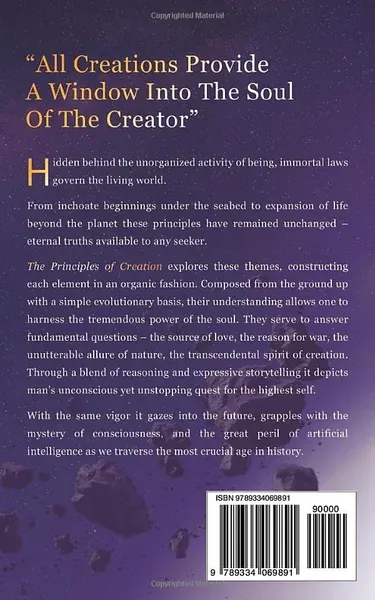
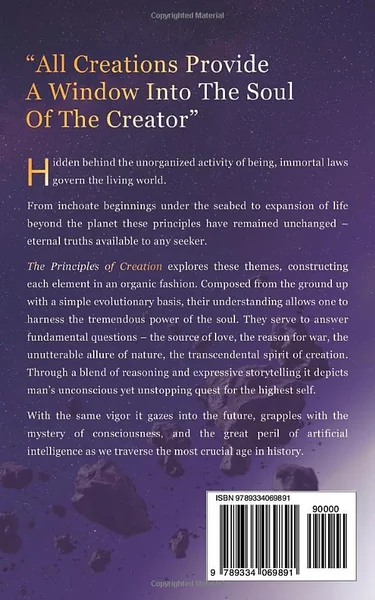
Back cover with quote, synopsis, and ISBN barcode on purple starry background.
The Principles of Creation: The Underlying Spiritual Forces to Guide Life, from Genesis to the Space Age is a work of spiritual non-fiction in which author Tejas Hiremani — described in the book's promotional materials as a successful investor — sets out to identify seven core principles that have, as the publisher's description states, "directed life since time immemorial." Those seven principles are named explicitly: spirit, freedom, karma, dharma, purpose, mortality, and truth. The book's central premise, drawn directly from its own framing, is that understanding the universe and understanding oneself are inseparable endeavors. Hiremani uses these seven principles as a lens through which to examine emotions as energy, the origins of conflict and the conditions for lasting peace, and the interplay of community, environment, and diet in a life well-lived. In essence, the book contrasts the boundless possibilities of technological and spiritual advancement against the danger of human decline, and presents the current age as a decisive choice between triumph and despair.

Structure and Form: A Book That Defies Genre

One of the more distinctive aspects of The Principles of Creation is its deliberate resistance to a single form. Independent Book Review describes it as "an experiential book that defies genre exploring life through an eclectic discourse bookended by a pair of strange wondrous stories." This structural choice — grounding a philosophical argument within narrative framing — sets it apart from straightforward self-help or academic spiritual writing. The seven-principle framework provides an organizing spine, but the discourse around it is described as eclectic, pulling from a wide range of domains. The book addresses questions as sweeping as the nature of love and its origins, the reason for war, and how emotions can be transmuted into purposeful action. This breadth is by design: Hiremani is reaching for a unified theory of human life rather than a targeted prescription for a single domain.

Significance and Ambition

The book's subtitle — from Genesis to the Space Age — signals just how expansively Hiremani conceives his subject. Rather than limiting the principles to personal development or spiritual practice, the framework is meant to account for the entire arc of human civilization. This is an ambitious intellectual stance, and the book's reception at OnlineBookClub.org, which awarded it 4 out of 5 stars, suggests that at least a portion of its readership finds the ambition rewarding rather than overreaching. The work participates in a long tradition of integrative spiritual writing that attempts to synthesize ethics, cosmology, and practical wisdom — a tradition with a large and devoted readership. Hiremani's background as an investor rather than a theologian or academic philosopher is itself a distinguishing element: the book brings a practitioner's perspective to timeless questions.

Genuine Strengths

The seven-principle structure gives the book a concrete, navigable framework that more diffuse spiritual texts often lack. Readers looking for organized, named categories — spirit, freedom, karma, dharma, purpose, mortality, truth — can engage with each as a discrete lens, which supports both sequential reading and selective reference. The book also takes on substantive, difficult terrain: the origins of conflict, the conditions for peace, the question of what love fundamentally is. These are not soft or evasive topics, and the publisher's description positions the treatment as direct and framework-driven. The inclusion of narrative stories as bookends, per Independent Book Review, adds a dimension that pure philosophical exposition would not, giving the ideas an experiential texture consistent with the book's stated intent.

Limitations and Who May Struggle

The same eclecticism that makes The Principles of Creation distinctive may frustrate readers who prefer a single, disciplined mode — whether that is rigorous philosophical argument, evidence-based wellness guidance, or straightforward narrative. A book described as defying genre makes an implicit demand on the reader to follow across multiple registers. Additionally, the scope of the book's claims — encompassing civilization's entire trajectory from genesis to the space age — may strike more skeptical or analytically minded readers as exceeding what 170 pages can fully substantiate. Those expecting granular, step-by-step practical instruction may find the book operates more at the level of principle and orientation than actionable technique. The work is self-published, which means it arrives without the editorial scaffolding of a major imprint, a factor some readers weigh when assessing works making large philosophical claims.

Sources & Further Reading

The key facts and claims in this review are grounded in the retrieved, verified sources listed below.

  1. Cited in this review
  2. 1
  3. 2
  4. 3
  5. Further reading
  6. 4
  7. 5
  8. 6
  9. 7