
8 min read
4.6
· 4,992 Amazon ratingsShare This Review
The Doors of Perception and Heaven and Hell by Aldous Huxley Review: Landmark Essays on Consciousness and Mescaline
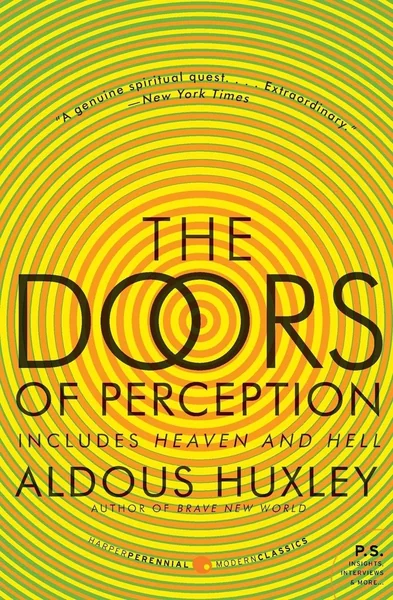
Aldous Huxley's paired essays — The Doors of Perception and Heaven and Hell — remain essential documents in the literature of consciousness, philosophy of mind, and the cultural history of psychedelics, offering a uniquely erudite account of one writer's mescaline experience and its far-reaching implications.
LuvemBooks Verdict
Best for
Readers drawn to philosophy of mind, the cultural history of psychedelics, or the intellectual biography of Huxley who want to engage with the foundational primary text that reframed what altered states of consciousness could mean — philosophically, spiritually, and culturally.
Worth it if
You approach it as a rigorous, cross-disciplinary work of humanistic philosophy — one that synthesises art history, theology, and phenomenology — rather than as a clinical or representative account of what mescaline does.
Skip if
You're seeking empirically grounded, peer-reviewed accounts of psychedelic pharmacology, or a universal phenomenology of altered states — Huxley's singular, extraordinarily cultivated intellect shapes every observation, and the essays resist use as a general guide.
What readers & critics say
Wikipedia's reception summary records psychologist Roland Fisher's pointed observation that the book contained "99 percent Aldous Huxley and only one half gram mescaline," capturing the longstanding critical concern that Huxley's pre-existing intellectual framework colours every claim. Across decades of commentary, as reflected in sources including berniegourley.com and newbookrecommendation.com, readers have consistently praised the essays' philosophical depth and cross-disciplinary fluency while noting that the density of reference can be demanding for those without a grounding in art history or theology.
Sources: Wikipedia – The Doors of Perception, berniegourley.com, newbookrecommendation.comAsk LuvemBooks
Was this helpful?
- Is it worth reading?
- For readers interested in the philosophy of mind, the history of psychedelics, or the intellectual biography of Huxley, this volume is widely regarded as an indispensable primary source. Its documented influence across science, literature, and counterculture — including directly inspiring the name of The Doors — confirms its standing as a landmark of twentieth-century thought. The main caveat is that the essays reflect Huxley's singular and highly cultivated intellect rather than a general phenomenology of mescaline, as psychologist Roland Fisher pointedly observed; readers seeking empirical or representative accounts will need to look elsewhere.
- Similar books
- Readers who appreciate Huxley's cross-disciplinary approach to consciousness and mysticism may also find his The Perennial Philosophy: A Study of Universal Mystical Philosophy (Harper Perennial) rewarding, as it extends his engagement with spiritual and philosophical traditions. His novel Brave New World offers a fictional counterpoint — a dystopian extrapolation of ideas about consciousness, control, and human potential that illuminates the same preoccupations from a different angle. Both are available in the LuvemBooks catalogue.
- Who should read this?
- This volume is essential for readers interested in the philosophy of mind, the history and cultural impact of psychedelics, and the intellectual roots of the 1960s counterculture. It is equally valuable as a document in Huxley's intellectual biography for admirers of Brave New World who want to understand the full range of his thought. Readers who prefer empirically grounded, peer-reviewed accounts of psychedelic pharmacology will want to supplement these essays with more recent scientific literature, as Huxley's method is interpretive and humanistic rather than clinical.
- About Aldous Huxley
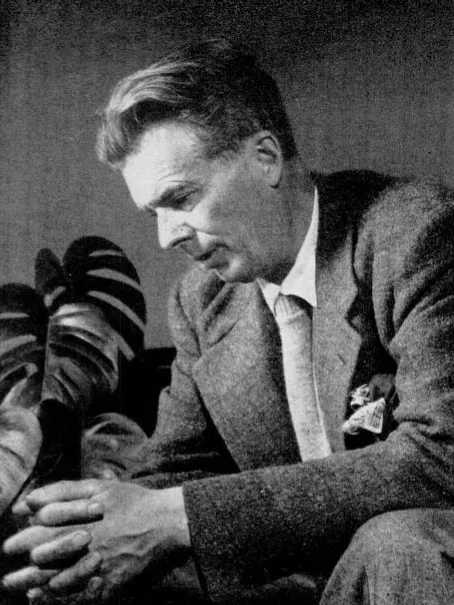
- Aldous Leonard Huxley was an English writer and philosopher.
- What are the main criticisms?
- The most substantive criticism is that the essays reflect Huxley's singular and pre-existing intellectual framework far more than a general or repeatable phenomenology of mescaline. Psychologist Roland Fisher captured this memorably by noting the book contained "99 percent Aldous Huxley and only one half gram mescaline." Joost A. M. Meerloo raised a related concern, observing that Huxley's reactions were "not necessarily the same as other people's experiences." Both critics point to the same structural limitation: a single, exceptional consciousness does not yield a universal account.
- What was this book's cultural impact?
- Few short works have exerted as wide an influence as these paired essays. Huxley's reframing of mescaline as a potential gateway to mystical enlightenment — rather than a psychosis simulator — shifted the intellectual terms of an entire era's conversation about altered states and directly seeded the countercultural movements of the 1960s. Most iconically, the book's title inspired the name of The Doors, one of rock history's most celebrated bands. The publisher's characterisation of the volume as "the most profound and influential explorations of mind-expanding psychedelic drugs ever written" is consistent with the essays' documented reception across decades of commentary.
- How does this compare to Huxley's other work?
- Where Brave New World is a dystopian novel that extrapolates Huxley's anxieties about consciousness, social control, and human potential into fiction, The Doors of Perception and Heaven and Hell are non-fiction essays in which those same preoccupations are explored directly and autobiographically. The Perennial Philosophy similarly engages Huxley's lifelong interest in mysticism and cross-cultural spiritual traditions, but as a scholarly anthology rather than a first-person account. The two essays reviewed here are unique in Huxley's output for grounding his philosophical argument in a specific personal experience.
Summarize this book
Follow up
Synthesized from verified book data & published reviews · How we review
Press Enter to ask. Answers come from our editorial Q&A — start typing to see related questions.
Age & Reading Level
Recommended age
Adult
Reading level
Adult
2 content notes · who it suits
Content to know about
Best for: Adults — the essays engage complex philosophical, phenomenological, and theological ideas and include detailed discussion of psychedelic drug experience.
Skip if you want an empirically grounded, peer-reviewed account of psychedelic pharmacology rather than a philosophical and autobiographical essay.
Our Review
What the Book Actually Contains
Significance and Cultural Reach
Genuine Strengths
Real Limitations and Points of Contention
Who This Edition Is For
Sources & Further Reading
The key facts and claims in this review are grounded in the retrieved, verified sources listed below.
- Cited in this review
- 1
en.wikipedia.org
- Further reading
- 2
Aldous Huxley, Wikipedia
- 3
parnassusbooks.net
- 4
newbookrecommendation.com
- 5
- 6
- 7
- 8
- 9
- 10
- 11
Related reading
Adjacent titles worth exploring. We haven't reviewed these yet, so they link out to Amazon.