9 min read
Share This Review
Our review
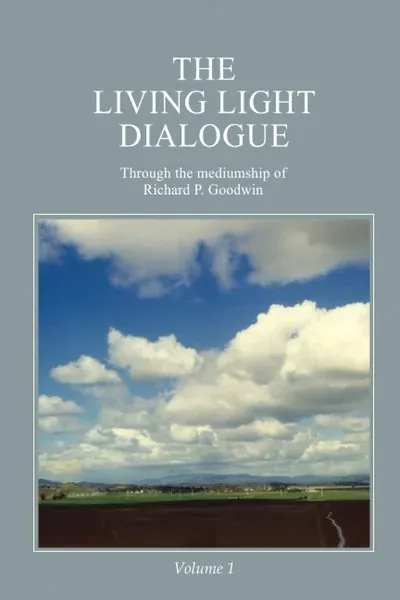
The Living Light Dialogue Volume 1 by Mr. Richard P. Goodwin Review: A Channeled Spiritual Philosophy in Depth
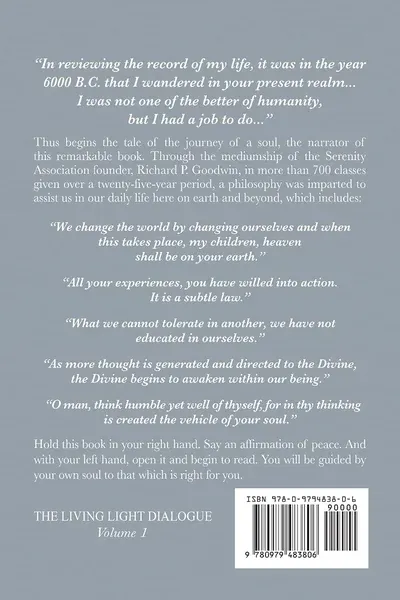
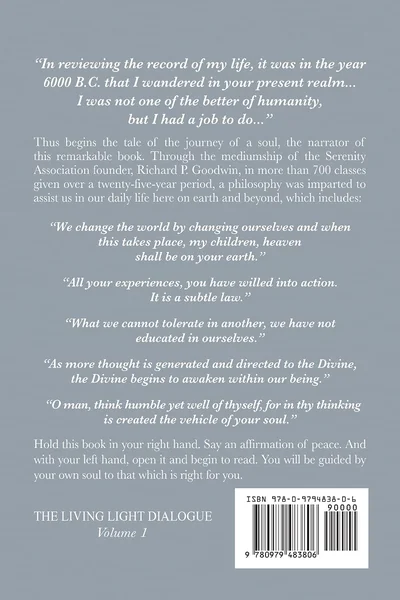
The Living Light Dialogue Volume 1 is a substantial collection of channeled spiritual teachings — comprising 65 Discourses, 2 Seminars, and 21 spiritual awareness classes — delivered through the mediumship of Mr. Richard P. Goodwin, founder of the Serenity Association, and organized under the banner of the Living Light Philosophy. This review is based on the book's contents and available published sources, not hands-on use or application of its teachings.
 Tap to enlarge
LuvemBooks Verdict
Best for
Readers already drawn to channeled spiritual teachings or New Thought traditions who want a structured, course-style introduction to the Living Light Philosophy's emphasis on personal responsibility and inner transformation.
Worth it if
You are committed to sequential, cumulative spiritual study and are open to engaging with channeled mediumship material on its own terms — willing to invest in a dense, 600-plus-page program designed for depth over speed.
Skip if
You approach channeled or spiritualist frameworks with scepticism, prefer empirically grounded self-development, or are looking for a concise primer rather than an immersive, repetition-heavy course of study.
What readers & critics say
BooksRun aggregates a 3.6-star overall rating for the 2017 paperback edition, placing it in the Spirituality category at the intersection of philosophy and religion. No substantial critical reviews from established literary or spiritual-press outlets appear in the published record, leaving the reception picture limited to general reader aggregation.
“Lessons often employ allegory and paradox, with recurring spiritual themes revisited in varied ways to foster understanding.”
— phoebetoft.comAsk LuvemBooks
Was this helpful?
- Is it worth reading?
- For readers already drawn to channeled spiritual teachings, New Thought traditions, or philosophies centered on metaphysical personal responsibility and self-authorship, The Living Light Dialogue Volume 1 offers substantial breadth — a single volume covering the neutrality of God, soul faculties, evolutionary incarnation, and the mechanics of universal law across 65 Discourses, 2 Seminars, and 21 awareness classes. The cumulative, repetition-based pedagogy is designed for depth rather than efficiency, making it a genuine course of study rather than a casual read. Those who approach channeled mediumship with skepticism, or who want an empirically grounded self-development resource or a concise primer, are unlikely to find the volume persuasive on its own terms. No in-depth critical reviews from established literary or spiritual-press outlets are available, so the broader reception picture is limited to general reader aggregates.
- Similar books
- Readers drawn to The Living Light Dialogue Volume 1 are likely to find common ground with other works in the channeled spiritual teachings and New Thought traditions. Seth Speaks by Jane Roberts is a foundational channeled text presenting teachings on consciousness and reality creation through a non-physical entity. A Course in Miracles offers a similarly structured, cumulative spiritual curriculum emphasizing inner transformation and self-authorship. The Law of One series (The Ra Material) by Don Elkins, Carla Rueckert, and Jim McCarty presents channeled metaphysical philosophy covering universal laws and soul evolution in a dialogue format. Conversations with God by Neale Donald Walsch takes a dialogue-based approach to spiritual philosophy centered on personal responsibility and the nature of divinity. All four share the Living Light Philosophy's emphasis on inner work, fixed universal laws, and a non-dogmatic, self-directed path to spiritual growth.
- Who should read this?
- The Living Light Dialogue Volume 1 is best suited to readers already oriented toward channeled spiritual teachings, New Thought traditions, or metaphysical philosophies that emphasize self-authorship and personal responsibility. Those drawn to structured, course-style spiritual study — who are willing to work through 65 Discourses, 2 Seminars, and 21 awareness classes in a cumulative, sequential manner — are the audience the volume's structure is clearly designed to serve. Readers who prefer narrative memoir, doctrinal theology, or empirically grounded self-development resources are less likely to find this volume engaging. The publisher's materials assert daily practical guidance as a design intent, but whether the teachings translate into that function is something individual readers will assess based on their own engagement.
- What are the key teachings?
- The Living Light Philosophy centers on the Law of Personal Responsibility — the premise that individuals create their own experiences through thoughts, words, and acts, and that self-awareness and individual accountability are the primary tools for spiritual growth. The Teacher presents universal laws as fixed and immovable, described as 'beyond the possibility of being changed, suspended, transcended or destroyed,' yet frames them as tools available to humanity rather than constraints upon it. A recurring theme is the distinction between power over external circumstances and power over the self: 'Not power of men's minds and circumstances, but power over whatever is selfish and imperfect in ourselves is the way up the eternal ladder of progression.' Other subjects addressed include the neutrality of God, evolutionary incarnation, soul faculties, and the power of peace.
- Does it offer practical guidance?
- The publisher's materials assert practical daily guidance as a design intent of the Living Light teachings, and the reader-facing instruction preserved in the Internet Archive encourages moving beyond the literal text: 'Go beyond the words into feeling, into the immediate meanings for you.' However, the editorial assessment notes that whether the teachings translate into practical daily guidance is something individual readers will assess based on their own engagement with the text and philosophy — a determination LuvemBooks cannot make on a reader's behalf. The structure is pedagogical rather than prescriptive, functioning more as a course of progressive study than a step-by-step practical manual.
- Where does this fit in the series?
- The Living Light Dialogue Volume 1 is the first in The Living Light Dialogue series, making it the natural starting point for readers new to the Living Light Philosophy. The volume's cumulative, sequential structure — in which lessons build on one another and themes are revisited progressively — is explicitly designed to be worked through in order, reinforcing that Volume 1 serves as the foundation for subsequent volumes. Additional volumes are described as part of the broader series, though specifics of the full series scope are not detailed in the available published sources.
Summarize this book
Follow up
Synthesized from verified book data & published reviews · How we review
Press Enter to ask. Answers come from our editorial Q&A — start typing to see related questions.
Age & Reading Level
Recommended age
Adult
Reading level
Adult
who it suits
Skip if you're skeptical of channeled mediumship or prefer empirically grounded self-development resources.
Our Review

What This Book Is and Contains
The Philosophy's Core Argument
Structure and Teaching Method
Reception and Intended Audience
Scope and Limitations for the Reader
Sources & Further Reading
The key facts and claims in this review are grounded in the retrieved, verified sources listed below.
- 1
- 2
- 3
- 4
- 5
- 6
barnesandnoble.com
- 7
Books like The Living Light Dialogue Volume 1
Curated picks for readers who enjoyed The Living Light Dialogue Volume 1, with our reasoning for each match.
If you liked The Living Light Dialogue Volume 1