BOOKS
Published

Read Time

3 min read

Curated & edited by

LuvemBooks Editorial

How we create our reviews →
Share This Review

No-Drama Discipline by Daniel J. Siegel & Tina Payne Bryson Review: Brain-Science Parenting That Reframes Discipline

No-Drama Discipline is a New York Times bestseller that brings together child neuroscience and compassionate parenting practice, giving caregivers a research-grounded framework for turning meltdowns into moments of connection and growth rather than cycles of punishment.

LuvemBooks Verdict

Best for

Parents of young children who want a neuroscience-grounded alternative to punishment-based discipline and are open to rethinking their instinctive reactions to tantrums and misbehavior.

Worth it if

You're ready to move away from consequence-and-punishment reflexes and want a practical, brain-development-based framework — complete with real scenarios, twenty common mistakes to avoid, and downloadable everyday reference materials — to guide calmer, more connected responses to your child's behavior.

Skip if

You're deeply committed to traditional authority-based or consequence-first discipline models, or you're primarily parenting older children and teenagers, as the connect-then-redirect scenarios are most fully developed around younger children and tantrum-age behavior.

What readers & critics say

PsychiatryResource.com rates it 9 out of 10, calling it "the best parenting book released since 1998" and praising its "wonderful mixture of neuroscience, general approaches and specific recommendations." The magazine Parents, as quoted on Barnes & Noble, describes it as offering "a lot of fascinating insights" and calls it "an eye-opener worth reading."

The best parenting book released since 1998 — a wonderful mixture of neuroscience, general approaches and specific recommendations.

PsychiatryResource.com

A lot of fascinating insights… an eye-opener worth reading.

Parents magazine (via Barnes & Noble)

This book grabbed me from the very first page and did not let go… punishment is a dead-end strategy.

Lawrence J. Cohen, Ph.D., author of The Opposite of Worry (via Barnes & Noble)
Sources: PsychiatryResource.com, Barnes & Noble
4.7from 5,503 Amazon ratings— reader ratings, not a LuvemBooks score

Look inside the book

Preview the actual pages, via Google Books
In This Review
  • What Works & What Doesn't
  • What the Book Is and What It Argues
  • Scope and Structure
  • Reception and Significance
  • Genuine Strengths
  • Limitations and Who May Find It Challenging

What Works & What Doesn't

What Works
  • New York Times bestseller co-written by a UCLA clinical psychiatry professor and a proven parenting author, lending the approach strong credentials
  • Reframes discipline around child brain development, offering a concrete connect-then-redirect framework backed by neuroscience
  • Publishers Weekly praises the 'lucid, engaging prose' that makes complex brain science accessible to a general parenting audience
  • Covers a wide practical range: age-appropriate strategies, twenty common discipline mistakes, and tantrum navigation techniques
  • Includes downloadable companion materials (a Refrigerator Sheet and caregiver note) designed to extend the book's guidance into everyday moments
What Doesn't
  • Requires a significant mindset shift away from traditional consequence-and-punishment models, which may be a steep ask for parents deeply invested in those approaches
  • The connect-first, brain-based scenarios are most fully developed around younger children and tantrums; parents of older kids or teenagers may find the direct applicability thinner
No-Drama Discipline is a New York Times bestseller that reframes how parents think about children's behavior — not as defiance to be punished, but as an opportunity for the developing brain to learn.

What the Book Is and What It Argues

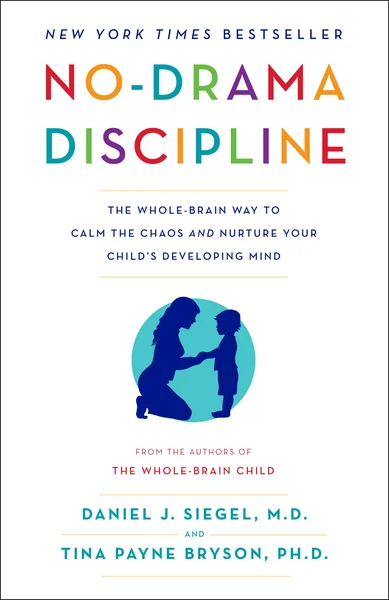
No-Drama Discipline: The Whole-Brain Way to Calm the Chaos and Nurture Your Child's Developing Mind by Daniel J. Siegel M.D., Tina Payne Bryson front cover
Written by Daniel J. Siegel, M.D., clinical professor of psychiatry at UCLA, and Tina Payne Bryson, co-authors of The Whole-Brain Child and The Yes Brain, No-Drama Discipline opens by reclaiming the word "discipline" itself. As the publisher explains, the authors define it in its original sense — to instruct — rather than as a synonym for shouting or reprimand. The central argument is that a child's neurological development is directly linked to how a parent responds to misbehavior, and that reacting in ways that overwhelm a child's developing brain undermines the very lesson a parent is trying to teach. The book's proposed alternative is a two-step approach: connect with the child first, then redirect behavior — working with the brain rather than against it.

Scope and Structure

The book covers substantial practical and conceptual ground. Readers will find strategies for identifying their own discipline philosophy and communicating it effectively; an explanation of child brain development keyed to age and developmental stage; techniques for calmly connecting with a child even in the middle of extreme behavior while maintaining clear and consistent limits; and guidance for navigating tantrums toward insight, empathy, and repair. A particularly concrete feature is a catalog of twenty discipline mistakes that even well-intentioned parents make, paired with whole-brain alternatives. The book also includes candid parenting stories and cartoon illustrations, which, according to Publishers Weekly, help Siegel and Bryson "help parents teach and communicate more effectively."

Reception and Significance

The book arrives with genuine credibility and documented enthusiasm. It is a New York Times bestseller and draws praise from across the parenting and psychology communities. The magazine Parents called it "an eye-opener worth reading" with "a lot of fascinating insights." Lawrence J. Cohen, Ph.D., author of The Opposite of Worry, wrote that the book "grabbed me from the very first page and did not let go." Examiner.com noted the book's potential relevance beyond parenting, observing that the "mindsight skills" Siegel and Bryson describe could be valuable for teachers and anyone seeking to navigate conflict more effectively. That breadth of endorsement reflects the book's positioning: it draws on clinical neuroscience but is written for a general audience, not an academic one.

Genuine Strengths

Two strengths stand out in the sourced record. First, the authors are exceptionally well-credentialed: Siegel is a practicing clinical psychiatrist and researcher; Bryson is a co-author with a track record in the same neuroscience-meets-parenting space. Their collaboration means the book can reference cutting-edge brain science without becoming inaccessible. Publishers Weekly specifically highlights the "lucid, engaging prose" as the vehicle that makes the science usable for parents. Second, the book is designed for real-world application — downloadable companion materials (including a "Refrigerator Sheet" summary and a caregiver note) extend the book's reach beyond its pages, acknowledging that discipline moments happen in kitchens, not armchairs.

Limitations and Who May Find It Challenging

The book's philosophy is coherent and internally consistent, which also means it asks parents to make a meaningful shift in mindset — away from consequence-and-punishment models that remain widely practiced and culturally ingrained. Readers who are deeply committed to more traditional, authority-based discipline frameworks will likely find the whole-brain approach a significant departure rather than a refinement of what they already do. Additionally, while the book covers all ages and stages, its emphasis on connection-first strategies is most fully developed for younger children navigating tantrums; parents of older children or teenagers may find some scenarios less directly applicable to their situations. These are matters of fit, not of quality — but they are worth naming for a prospective reader calibrating their expectations.

Sources & Further Reading

The key facts and claims in this review are grounded in the retrieved, verified sources listed below.

  1. Cited in this review
  2. 1
  3. 2
  4. 3
  5. Further reading
  6. 4
  7. 5
  8. 6
  9. 7