BOOKS
Published

Read Time

3 min read

Curated & edited by

LuvemBooks Editorial

How we create our reviews →
Share This Review

How to Talk So Kids Will Listen & Listen So Kids Will Talk by Adele Faber & Elaine Mazlish Review: A Decades-Spanning Parenting Communication Classic

A landmark parenting guide by #1 New York Times bestselling authors Adele Faber and Elaine Mazlish, How to Talk So Kids Will Listen & Listen So Kids Will Talk has sold more than five million copies and been translated into over thirty languages, earning its reputation as the "parenting bible" — a practical, method-driven handbook designed to transform the way parents and children communicate. This review is based on published sources and the book's record; it does not reflect hands-on use.

LuvemBooks Verdict

Best for

Parents and caregivers of school-aged children who want a structured, repeatable communication toolkit for reducing everyday conflict — and educators or parent-group facilitators looking for a workshop-compatible training resource.

Worth it if

You want concrete, step-by-step techniques you can apply immediately — not a philosophy lecture — and you're willing to practise the methods consistently rather than skim once and shelve.

Skip if

You prefer a philosophy-first or exploratory approach to parenting, or you need explicit guidance for contemporary contexts such as neurodivergent children, blended families, or digital-era stressors — areas where the book's framework may require adaptation beyond what the text provides.

What readers & critics say

Psychiatryresource.com rates the book 10 out of 10, calling it "an excellent book about parenting through empathy and effective communication." The book is described by simonandschuster.com as the ultimate "parenting bible" (a designation attributed there to The Boston Globe), with its updated 2012 edition praised for incorporating fresh insights alongside time-tested methods.

Sources: psychiatryresource.com, simonandschuster.com
4.7from 12,342 Amazon ratings— reader ratings, not a LuvemBooks score

Look inside the book

Preview the actual pages, via Google Books
In This Review
  • What Works & What Doesn't
  • What the Book Actually Is and Does
  • The Authors' Authority and the Book's Standing
  • Core Strengths: Structure, Scope, and Accessibility
  • Genuine Limitations and Who May Be Frustrated
  • Who This Book Is For

What Works & What Doesn't

What Works
  • #1 New York Times bestselling authors with a combined body of work exceeding five million copies sold across thirty-plus languages
  • Concrete, step-by-step communication techniques designed for direct application — not just theory
  • Covers a wide range of common parenting friction points, from managing negative emotions to setting limits while preserving goodwill
  • Contrast-based structure shows both the recommended approach and typical default responses side by side, making the methods easy to understand
  • Endorsed as the 'parenting bible' by The Boston Globe, with documented adoption by thousands of parent and teacher groups worldwide
What Doesn't
  • Highly prescriptive structure may feel formulaic to parents who prefer a philosophy-first or exploratory approach
  • Some contemporary contexts — neurodivergent children, blended families, digital-era dynamics — may require adaptation beyond what the text explicitly addresses
A book that The Boston Globe called the ultimate "parenting bible," this guide by Adele Faber and Elaine Mazlish has earned that designation across decades and millions of households worldwide.

What the Book Actually Is and Does

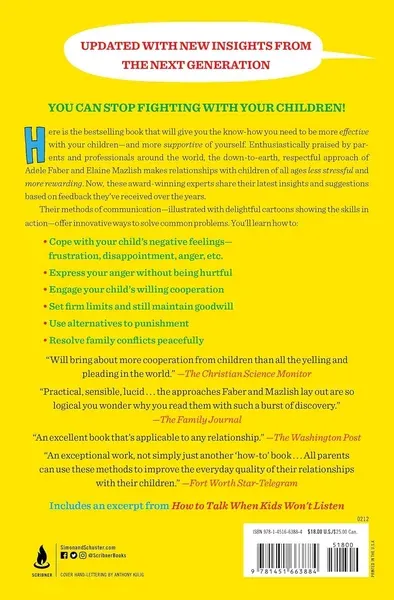
Back cover with synopsis, bullet-pointed communication strategies, and review quotes praising the parenting approach.
How to Talk So Kids Will Listen & Listen So Kids Will Talk is a parenting communication guide built around concrete, teachable methods for improving dialogue between adults and children. First published decades before its 2012 updated Scribner edition, the book is structured as a practical handbook — not a memoir or theoretical text — covering a defined set of challenges that most parents face: coping with a child's negative feelings such as frustration, anger, and disappointment; expressing strong parental feelings without being hurtful; engaging a child's willing cooperation; setting firm limits while maintaining goodwill; and using alternatives to punishment that promote self-discipline. The book presents these not as abstract ideals but as step-by-step strategies, illustrated through contrast — showing, as the text itself lays out, the difference between common default responses and the methods Faber and Mazlish advocate. One passage organizing the core approach reads: "Acknowledge their feelings with a word — 'Oh'... 'Mmm'... 'I see.'" followed by naming the feeling and offering the wish in fantasy — a sequence that demonstrates how deliberately simple and replicable the techniques are designed to be.

The Authors' Authority and the Book's Standing

Adele Faber (1928–2024) and Elaine Mazlish were both #1 New York Times bestselling and award-winning authors, and their combined body of work — of which this title is the flagship — has sold more than five million copies in over thirty languages. Their group workshop programs and videos have been used by thousands of parent and teacher groups around the world, according to Simon & Schuster. That reach is not merely commercial: it signals that the book's framework has been adopted as a training resource in institutional as well as home settings. The Boston Globe's designation of the book as the ultimate "parenting bible" captures a reception that has remained durable across multiple generations of readers. The 2012 Scribner edition is an updated version of the original, incorporating fresh insights and suggestions alongside the authors' established methods, making it both a continuation and a refinement of a long-standing resource.

Core Strengths: Structure, Scope, and Accessibility

The book's principal design strength is its commitment to actionable specificity. Rather than offering general encouragement toward empathetic parenting, Faber and Mazlish break communication down into discrete moves — acknowledging feelings, naming emotions, giving children their wishes in fantasy when the real thing isn't possible — and then show those moves side by side with the responses parents typically default to. This contrast-based structure is a teaching mechanism built into the text itself, not layered on as an afterthought. The guide also addresses the full arc of common parenting friction points, from managing a child's negative emotions to building foundations for lasting relationships, giving it a breadth that has allowed it to function as a starting point rather than a supplement for many readers. Simon & Schuster describes the updated edition as including "fresh insights and suggestions" alongside time-tested methods, signaling that the revision took evolving family dynamics into account without discarding the framework that drove the original's reach.

Genuine Limitations and Who May Be Frustrated

No parenting guide with this scope is without friction for some readers. The book's methods are specific and prescriptive, which is a feature for parents who want a clear script — but can feel formulaic to those who prefer a more exploratory or philosophy-first approach to parenting. Some readers drawn to the title's sweeping promise may find that the techniques require sustained practice and repetition to integrate, meaning the book functions as a course rather than a quick reference once mastered. Additionally, because the book was originally written well before the 2012 update, some of the scenarios and language reflect an earlier cultural moment; the updated edition addresses this in part, but parents navigating contemporary contexts — blended families, digital-era stressors, neurodivergent children — may find the framework requires adaptation beyond what the text explicitly provides. These are structural characteristics of the guide's design rather than failures of craft, and they are worth naming honestly for readers calibrating their expectations.

Who This Book Is For

How to Talk So Kids Will Listen & Listen So Kids Will Talk is most directly suited to parents and caregivers of school-aged children who want a structured, repeatable toolkit for reducing conflict and deepening connection in everyday conversation. Its workshop-compatible format also makes it a fit for educators, pediatric professionals, and facilitators running parent education programs — a use case the authors explicitly supported through their own group programs. Readers who have encountered adjacent titles in the communication-and-parenting space and found them too abstract will find that Faber and Mazlish's approach is unusually concrete. Those looking for developmental psychology theory or academic grounding may want to supplement it with other resources, as the book is oriented toward application rather than explanation of underlying science. Across all audiences, the book's enduring sales record and institutional adoption are a reliable signal that its methods have resonated for a reason — though, as with any functional guide, its value scales with the commitment brought to practicing what it teaches.

Sources & Further Reading

The key facts and claims in this review are grounded in the retrieved, verified sources listed below.

  1. 1

    Adele Faber, Elaine Mazlish, Wikipedia

  2. 2
  3. 3
  4. 4
  5. 5