
8 min read
4.3
· 80 Amazon ratingsShare This Review

Finding Home: From Cairo to New York by Djenane Nakhle Review: A Cross-Continental Memoir of Resilience and Reinvention
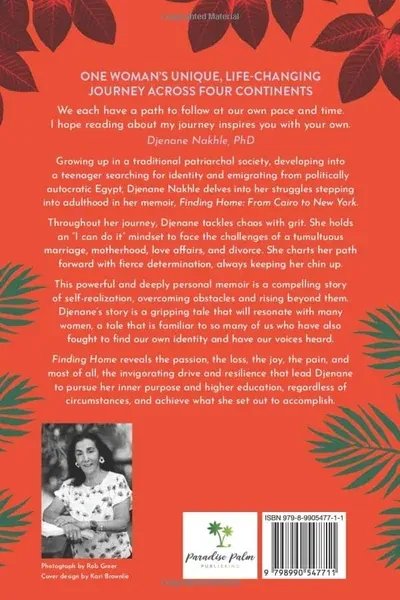
Finding Home: From Cairo to New York is a memoir by Lebanese-American psychologist Dr. Djenane Nakhle, published by Paradise Palm Publishing in December 2024, tracing her journey from a childhood in politically turbulent Egypt through migration across four continents to her eventual life as an established academic in New York. This review draws on the book's content and available published commentary; it does not represent hands-on use or a personal read.
 Tap to enlarge
LuvemBooks Verdict
Best for
Readers drawn to literary memoir and immigrant narratives who want a candid, psychologically self-aware account of cross-cultural reinvention rooted in the specific historical realities of mid-twentieth-century revolutionary Egypt.
Worth it if
You bring patience for a full-life, 352-page account and are interested in the intersection of personal identity, migration, and the political upheaval of 1950s–60s Egypt — particularly if the psychological dimensions of belonging and cultural dislocation resonate with you.
Skip if
You are looking for a tightly focused narrative or a quick read, or you want either pure historical depth or pure psychological analysis rather than a memoir that weaves both together across a sweeping cross-continental scope.
What readers & critics say
Readers' Favorite highlights the memoir's blend of personal and historical experience, singling out Nakhle's candid recounting of cultural dislocation and her search for stability as a core narrative strength. The book's own framing, as captured in the Google Books synopsis, positions it as an inspirational account of one woman tackling chaos across four continents — from politically autocratic Egypt through to an established life in New York.
Sources: Readers' Favorite, Google BooksAsk LuvemBooks
Was this helpful?
- Is it worth reading?
- For readers drawn to literary memoir, immigrant narratives, and cross-cultural stories of reinvention, Finding Home delivers an unusually broad sweep — from revolutionary Cairo to New York — enriched by Nakhle's candid recounting of cultural dislocation and her psychologist's capacity for self-examination. Readers' Favorite commentary highlights that candor as a core strength, noting that Nakhle does not soften the difficulties of fitting into new environments or pursuing professional footing in the United States. The main caveat is scope: at 352 pages, the full-life account demands patience, and readers seeking a tightly focused narrative or an exclusively deep dive into either history or psychology may wish for a narrower lens.
- Similar books
- Readers who connect with Finding Home are likely to find similar rewards in Tara Westover's Educated, which traces a woman's self-determined path out of a constrained upbringing toward intellectual identity, and Jeannette Walls' The Glass Castle, another memoir defined by resilience and the question of what home really means. Paul Kalanithi's When Breath Becomes Air shares the quality of a professional with deep analytical training turning inward to examine life's largest questions. For the multi-continent geographic sweep, Jennifer Baggett's The Lost Girls — four continents, unconventional reinvention — echoes Nakhle's cross-cultural breadth. J. D. Vance's Hillbilly Elegy and Cheryl Strayed's Wild round out the shelf for readers drawn to memoir as a vehicle for exploring cultural identity and the cost of starting over.
- Who should read this?
- Finding Home is positioned for adult readers drawn to literary memoir, immigrant narratives, and first-person accounts of cross-cultural reinvention. Readers who have personally experienced migration, cultural between-ness, or the search for professional identity in an adopted country will find the book's central questions — what does it mean to belong somewhere, and what does it cost to leave the familiar behind — carry immediate personal weight. Those with an interest in mid-twentieth-century Egyptian and Middle Eastern history, or in the psychology of identity formation and cultural adaptation, will find Nakhle's dual perspective as both subject and trained psychologist adds a dimension less common in standard memoir.
- Are there difficult themes to be aware of?
- Finding Home engages candidly with the difficulties of cultural dislocation, life in a patriarchal society, and the psychological weight of migration and starting over — themes that are substantive but treated with a reflective, analytical voice consistent with Nakhle's clinical background. The memoir is written for an adult audience and carries the gravity of a full-life account shaped by political upheaval, displacement, and the ongoing pursuit of belonging. Readers sensitive to narratives of systemic patriarchal constraint or the emotional toll of repeated uprooting should be aware these are central, not peripheral, to the book's story.
- How is the memoir structured?
- Finding Home follows a broadly chronological arc, beginning with Nakhle's childhood and adolescence in 1950s–60s Cairo and tracking her migration across four continents before arriving at her established life in New York. Rather than treating its organizing preoccupations — home, identity, and belonging — as problems solved upon arrival, the memoir presents them as questions that accompany Nakhle throughout the entire journey. At 352 pages, published by Paradise Palm Publishing in December 2024, it carries the weight of a full-life account rather than a focused episode.
- Is this a good book club pick?
- Finding Home offers strong book club potential for groups interested in immigrant narratives, mid-twentieth-century Egyptian history, or the psychology of cultural adaptation and identity. The memoir's dual ambition — functioning as both an intimate coming-of-age story and a broader reflection on home and belonging — gives a group multiple entry points for discussion, from the historical specificity of revolutionary Cairo to the universal questions of what it costs to leave the familiar behind. The one practical note is length: at 352 pages, groups should allow adequate reading time to engage with the full-life scope.
Summarize this book
Follow up
Synthesized from verified book data & published reviews · How we review
Press Enter to ask. Answers come from our editorial Q&A — start typing to see related questions.
Age & Reading Level
Recommended age
Adult
Reading level
Adult
3 content notes · who it suits
Content to know about
Skip if You're looking for a tightly focused narrative or an in-depth treatment of either Egyptian political history or clinical psychology rather than a broad, full-life memoir that blends both.
Our Review
What the Memoir Actually Covers
The Intersection of Personal Story and Historical Context
Candor as a Narrative Strength

Themes of Home, Identity, and Belonging
Who This Book Is For
Sources & Further Reading
The key facts and claims in this review are grounded in the retrieved, verified sources listed below.
- Cited in this review
- 1
- 2
- Further reading
- 3
Related reading
Adjacent titles worth exploring. We haven't reviewed these yet, so they link out to Amazon.