7 min read
4.2
· 397 Amazon ratingsShare This Review
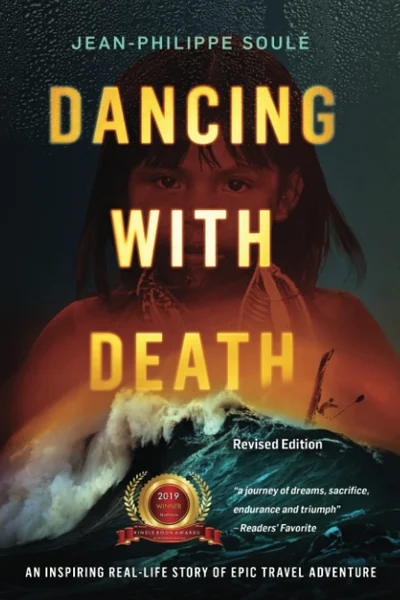
Dancing with Death by Jean-Philippe Soulé Review: A Gripping Real-Life Kayak Epic
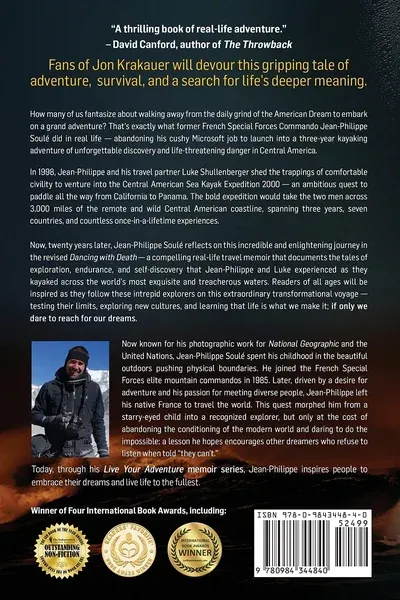
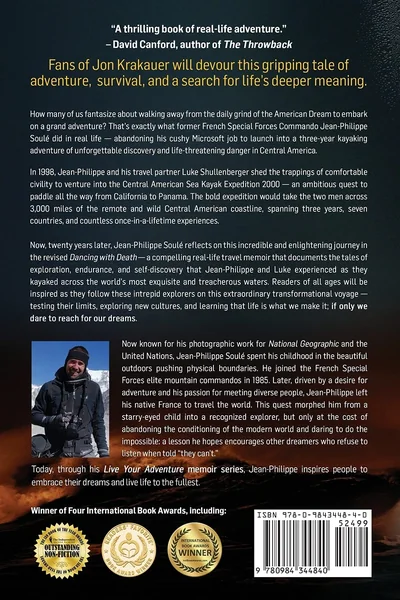
Dancing with Death is a travel adventure memoir by Jean-Philippe Soulé chronicling the Central American Sea Kayak Expedition 2000, in which Soulé and his partner Luke Shullenberger paddled roughly 3,000 miles from Baja California to Panama across three years and seven countries — a journey the author describes as his most epic expedition and one he is fortunate to have survived.
 Tap to enlarge
LuvemBooks Verdict
Best for
Readers who love long-form human-powered expedition narratives and want an immersive, emotionally honest account of an extraordinary journey through Central America's diverse cultures and coastlines.
Worth it if
You're drawn to the messy, human reality of epic adventure — two men pushing far beyond careful preparation across 3,000 miles and seven countries — and value cultural richness and physical ordeal over tidy heroics or instructional guidance.
Skip if
You expect your adventure protagonists to model expert-level risk management and meticulous planning — the duo's acknowledged naivety and repeated unpreparedness may frustrate rather than inspire.
What readers & critics say
Readers' Favorite calls it "one of the most amazing travel and adventure books," praising its epic scope while noting that much of the peril stems from the authors' own "naïve, some might say foolish, risks of unpreparedness." Book Review Directory echoes the praise, describing the account as "inspiring, emotional, and empowering," highlighting the cultural richness woven throughout the expedition narrative.
Sources: Readers' Favorite, Book Review DirectoryAsk LuvemBooks
Was this helpful?
- Is it worth reading?
- For readers drawn to long-form human-powered expedition narrative, Dancing with Death delivers an unusually broad geographic and temporal canvas — two men, three years, seven countries, thousands of miles — that is rare in the genre. The hybrid structure of narrative and field journals, supported by award-winning photographs, gives the account both emotional depth and on-the-ground authenticity. The key caveat, as the Readers' Favorite review notes, is that much of the peril stems from 'naïve, some might say foolish, risks of unpreparedness' — readers who expect meticulous planning and professional-grade expedition management may find this frustrating rather than inspiring.
- Similar books
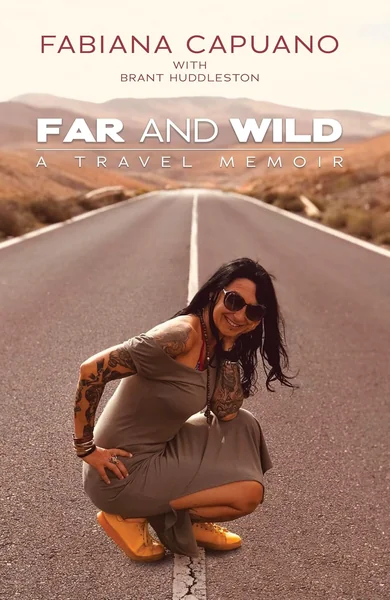
- Readers who connect with Dancing with Death's spirit of ambitious, human-powered exploration and cultural immersion may want to explore Far and Wild: A Travel Memoir by Fabiana Capuano and Brant Huddleston, and The Lost Girls: Three Friends. Four Continents. One Unconventional Detour Around the World by Jennifer Baggett, both of which blend adventure travel with personal reflection across multiple countries. For a solo-travel perspective with literary depth, Without Reservations: The Travels of an Independent Woman by Alice Steinbach offers a complementary tone. Those drawn to the memoir's themes of survival and human endurance may also find resonance in Carried Away: A Memoir of Rescue by Ross Meador and, for a broader endurance-of-spirit narrative, Educated: A Memoir by Tara Westover.
- Who should read this?
- Dancing with Death is positioned by the publisher for lovers of travel, outdoor adventure, cultural exploration, and what they call 'dreamers who refuse to accept limitations.' It will particularly resonate with fans of long-form human-powered expedition narrative who value both the physical ordeal and the interior journey that accompanies it. Readers with an interest in Central America's ecology and diversity of cultures — from Baja California through Panama — will find the geographic scope a distinctive draw. Those who want tidily heroic, expertly planned adventure stories may be less satisfied; the book is, in the publisher's own framing, a 'wonderful story about the human spirit' rather than a showcase of technical mastery.
- What are the main themes?
- At its core, Dancing with Death explores endurance, the cost of dreaming beyond preparation, and the tension between ambition and survival. Readers' Favorite identifies athleticism, boldness, curiosity, and 'endless buckets of uncanny luck' as central qualities driving the narrative — with encounters such as confronting crocodiles illustrating the relentless physical stakes. The publisher frames the emotional register as equally important as the physical drama, describing the book as 'illuminating and powerful' and 'a wonderful story about the human spirit.' Cultural richness runs as a parallel thread, with the diversity of peoples, landscapes, and traditions across seven Central American nations woven throughout the account.
- What role do the photos play?
- The expedition photographs are described by the publisher as award-winning, and they function as an integral documentary layer of the memoir rather than simple illustration. According to the Readers' Favorite review, the book blends narrative, journal entries, photographs, and ecological observations gathered along the route — meaning the visual material contributes to the account's simultaneous role as personal memoir, travel document, and nature record of the Central American coastline.
- How has the book been received?
- The most cited review in the editorial record comes from Readers' Favorite, which describes Dancing with Death as 'one of the most amazing travel and adventure books' and characterises it as 'a journey of dreams, sacrifice, endurance and triumph' that transports readers to places they could only dream of. The publisher's own framing — 'evocative,' 'gripping,' 'illuminating and powerful' — aligns with that assessment. The Readers' Favorite review also raises a pointed critical note, flagging that the peril in the memoir frequently stems from the duo's 'naïve, some might say foolish, risks of unpreparedness,' which tempers the heroic reading.
Summarize this book
Follow up
Synthesized from verified book data & published reviews · How we review
Press Enter to ask. Answers come from our editorial Q&A — start typing to see related questions.
Age & Reading Level
Recommended age
Adult
Reading level
Adult
2 content notes · who it suits
Content to know about
Skip if you expect adventure protagonists to model meticulous planning and expert-level risk management — much of the peril here arises from the duo's own acknowledged unpreparedness.
Our Review
What the Book Actually Is
Scope and Structure
Strengths: Danger, Character, and Cultural Richness
An Honest Limitation: Naïveté as a Double-Edged Sword
Who This Book Is For
Sources & Further Reading
The key facts and claims in this review are grounded in the retrieved, verified sources listed below.
- Cited in this review
- 1
amazon.ca
- 2
jeanphilippesoule.com
- Further reading
- 3
- 4
bookreviewdirectory.com
Books like Dancing with Death
Curated picks for readers who enjoyed Dancing with Death, with our reasoning for each match.
If you liked Dancing with Death