7 min read
4.2
· 839 Amazon ratingsShare This Review
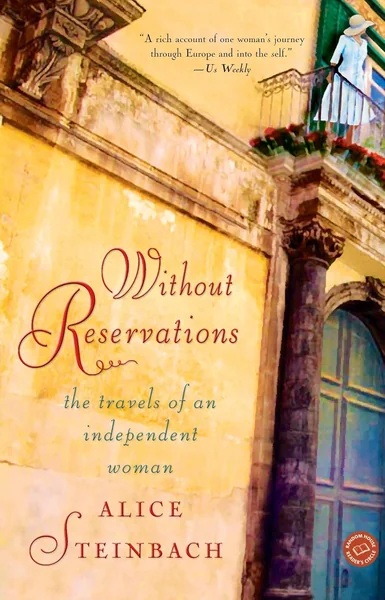
Without Reservations: The Travels of an Independent Woman by Alice Steinbach Review: A Warm, Introspective European Travel Memoir
Alice Steinbach's travel memoir follows a Pulitzer Prize–winning journalist who takes a sabbatical from the Baltimore Sun to travel through France, England, and Italy in search of a self no longer defined by her roles and routines — a journey praised by the Chicago Tribune as "a lovely travelogue" and by the Des Moines Register as "a feast" for the soul.
LuvemBooks Verdict
Best for
Readers drawn to reflective, character-driven travel memoirs about reinvention and independence — particularly those interested in stories of a woman traveling alone through Europe and finding herself in the process.
Worth it if
You arrive for the interior journey — Steinbach's emotional authenticity, her reporter's gift for human connection, and the warmth of her prose — rather than for immersive geographical reportage.
Skip if
You're seeking richly detailed, place-driven travel writing in the tradition of rigorous European reportage; Publishers Weekly's assessment that the locale descriptions are thin and the external obstacles largely minor is likely to disappoint you.
What readers & critics say
Publishers Weekly found the writing "generally optimistic, warm and genuine" while identifying a clear limitation: the descriptions of each European locale are thin, and more finely observed detail "might have made this a richer book." The New York Times noted that the book carries "a rainy-day feel — comfortable but sorrowful," rooted in Steinbach's own reflection that "we are shaped... By our sorrows," and Kirkus Reviews characterised it as "not a major work, perhaps, but if a minor one, then well done."
“Not a major work, perhaps, but if a minor one, then well done.”
— Kirkus Reviews“The book has a rainy-day feel — comfortable but sorrowful.”
— nytimes.com“The obstacles Steinbach faces on her journeys seem minor — the descriptions of each locale are thin.”
— Publishers WeeklyAsk LuvemBooks
Was this helpful?
- Is it worth reading?
- For readers drawn to reflective, interior-focused travel writing, Without Reservations delivers on its core promise: Dominick Dunne called it 'a rare, wonderful adventure, an escape into discovering herself and some of the truly magical places in this world,' and the St. Petersburg Times recommended it be 'taken in slowly and savored all the way.' The caveat, clearly identified by Publishers Weekly, is that the descriptions of each European locale are thin — this is not immersive geographical reportage, and the external obstacles Steinbach faces, save a near-mugging in Milan, are relatively minor. Readers who arrive for the quality of Steinbach's prose and her emotional authenticity will be rewarded; those seeking narrative tension or richly detailed place-writing may be less satisfied.
- Similar books
- Readers who connect with Steinbach's blend of solo travel and self-discovery will find kindred reading in the curated titles below. Far and Wild: A Travel Memoir by Fabiana Capuano and Brant Huddleston shares the spirit of travel as personal revelation, while The Lost Girls: Three Friends. Four Continents. One Unconventional Detour Around the World by Jennifer Baggett similarly centers women stepping away from established lives to travel on their own terms. For a memoir that foregrounds identity and inner reckoning alongside exterior adventure, The Tell: A Memoir by Linda I. Meyers offers comparable emotional depth, and Dancing with Death: An Inspiring Real-Life Story of Epic Travel Adventure by Jean-Philippe Soulé provides a higher-stakes counterpoint for readers who wish Without Reservations had more external drama.
- Who should read this?
- Without Reservations is best suited to readers who value reflective, character-driven narratives about reinvention and independence — particularly those drawn to stories of a woman traveling alone through Europe. Fans of literary memoir who appreciate a reporter's gift for capturing human connection, and readers who enjoy what the Des Moines Register called 'a book about love, and longing, and the passage of time,' will find Steinbach's voice a reliable and engaging companion. Readers seeking rigorous, detail-rich travel reportage — immersive portraits of Parisian streets or Oxfordshire countryside — may find the book's interior focus less satisfying, as Publishers Weekly noted the locale descriptions are thin.
- About Alice Steinbach
- Alice C. Steinbach is the author of Without Reservations: The Travels of an Independent Woman. Beyond this, LuvemBooks' verified author information for Alice Steinbach is limited to her name as it appears on the book.
- What are the main themes?
- The memoir's central preoccupation is identity: Steinbach sets out to discover who she is away from the roles and expectations that had defined her, framing the trip as an attempt to 'take chances, to have adventures, and to see if I could still hack it on my own, away from the security of work, friends and an established identity.' Woven through that quest are the closely related themes of love, longing, and the passage of time — the Des Moines Register's description of the book — as well as solitude, the self-reclamation available in travel, and the way memory and sorrow shape a life. The book's 'rainy-day feel — comfortable but sorrowful' captures how these themes coexist: the journey is hopeful, but it is undertaken in full awareness of what has been lost or left behind.
- How good is the writing?
- The writing is the book's most consistently praised element across all reviews. The St. Petersburg Times called it 'beautifully written, clear, insightful, thoughtful' and advised that it 'should be taken in slowly and savored all the way.' Publishers Weekly, even while noting the thinness of the locale descriptions, characterized the prose as 'generally optimistic, warm and genuine,' and Dominick Dunne described the book as 'a rare, wonderful adventure.' Steinbach brings a Pulitzer Prize–winning journalist's precision and her reporter's gift for human connection to the memoir's interior focus — qualities that define the book's reputation and make its voice the primary reason to read it.
Summarize this book
Follow up
Synthesized from verified book data & published reviews · How we review
Press Enter to ask. Answers come from our editorial Q&A — start typing to see related questions.
Age & Reading Level
Recommended age
Adult
Reading level
Adult
who it suits
Skip if you want richly detailed, immersive European travel reportage with strong narrative tension and dramatic external obstacles.
Our Review
What the Book Is and What It Argues
The Central Journey: Paris, Oxford, and Italy
Steinbach's Voice and the Book's Real Strengths
A Real Limitation: Thin Locale Portraits
Who This Book Is For
Sources & Further Reading
The key facts and claims in this review are grounded in the retrieved, verified sources listed below.
- Cited in this review
- 1
publishersweekly.com
- 2
- Further reading
- 3
Alice Steinbach, Wikipedia
- 4
- 5
- 6
newbookrecommendation.com
- 7
coconutlands.com
- 8
theroamingreader.com
- 9
app.thestorygraph.com
- 10
januarymagazine.com
- 11
penguinrandomhouse.com
Books like Without Reservations
Curated picks for readers who enjoyed Without Reservations, with our reasoning for each match.
If you liked Without Reservations