BOOKS
Published

Read Time

3 min read

Reader rating

4.2

· 397 Amazon ratings
reader ratings, not a LuvemBooks score
Curated & edited by

LuvemBooks Editorial

How we create our reviews →
Share This Review

Dancing with Death by Jean-Philippe Soulé Review: A Gripping Real-Life Kayak Epic

Dancing with Death is a travel adventure memoir by Jean-Philippe Soulé chronicling the Central American Sea Kayak Expedition 2000, in which Soulé and his partner Luke Shullenberger paddled roughly 3,000 miles from Baja California to Panama across three years and seven countries — a journey the author describes as his most epic expedition and one he is fortunate to have survived.
LuvemBooks Verdict

Best for

Readers who love long-form human-powered expedition narratives and want an immersive, emotionally honest account of an extraordinary journey through Central America's diverse cultures and coastlines.

Worth it if

You're drawn to the messy, human reality of epic adventure — two men pushing far beyond careful preparation across 3,000 miles and seven countries — and value cultural richness and physical ordeal over tidy heroics or instructional guidance.

Skip if

You expect your adventure protagonists to model expert-level risk management and meticulous planning — the duo's acknowledged naivety and repeated unpreparedness may frustrate rather than inspire.

Readers' Favorite calls it "one of the most amazing travel and adventure books," praising its epic scope while noting that much of the peril stems from the authors' own "naïve, some might say foolish, risks of unpreparedness." Book Review Directory echoes the praise, describing the account as "inspiring, emotional, and empowering," highlighting the cultural richness woven throughout the expedition narrative.

Sources: Readers' Favorite, Book Review Directory
4.2from 397 Amazon ratings— reader ratings, not a LuvemBooks score
In This Review
  • What Works & What Doesn't
  • What the Book Actually Is
  • Scope and Structure
  • Strengths: Danger, Character, and Cultural Richness
  • An Honest Limitation: Naïveté as a Double-Edged Sword
  • Who This Book Is For

What Works & What Doesn't

What Works
  • Chronicles an extraordinarily ambitious expedition — roughly 3,000 miles across seven countries over three years — giving the memoir an epic scope rare in the genre
  • Structured as a blend of recreated narrative and original field journal entries, providing both retrospective depth and on-the-ground immediacy
  • Encompasses cultural richness alongside physical adventure, covering the diverse peoples, landscapes, and traditions of Central America from Baja California to Panama
  • Accompanied by award-winning expedition photographs that document the journey visually alongside the written account
  • Readers' Favorite describes the book as 'a journey of dreams, sacrifice, endurance and triumph' that takes readers to places they could only dream of
What Doesn't
  • As a Readers' Favorite reviewer notes, much of the peril in the expedition stems from the duo's own 'naïve, some might say foolish, risks of unpreparedness,' which may frustrate readers who expect disciplined, expert-level adventure protagonists
  • The memoir's focus is firmly personal and experiential rather than instructional — readers seeking strategic guidance on sea kayaking or expedition planning will not find it here
A remarkable feat of endurance literature, Dancing with Death earns its subtitle through sheer accumulation of documented risk.

What the Book Actually Is

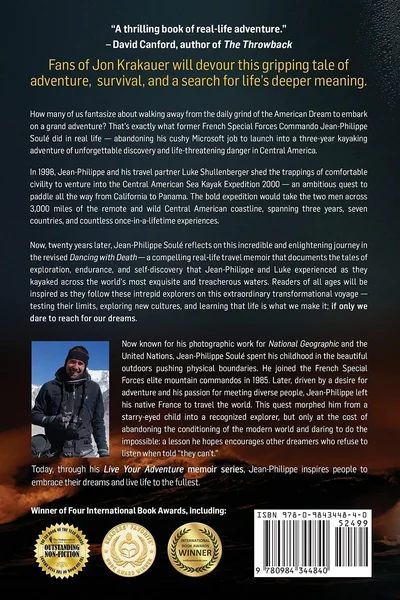
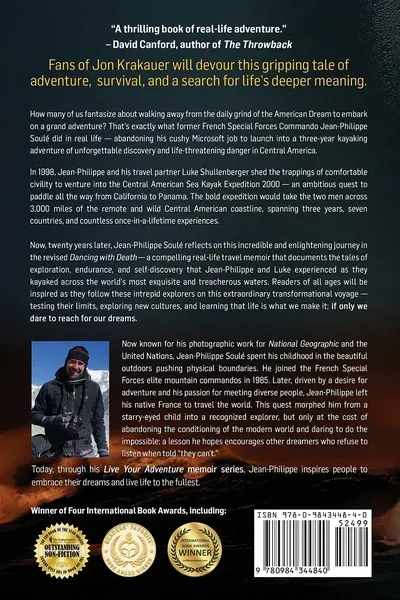
Back cover with synopsis, author biography, review quotes, and award seals.
Dancing with Death is a travel adventure memoir published by Native Planet Adventures, part of the Thirst for Life: Epic Inspirational Adventure Memoirs series. It recounts the Central American Sea Kayak Expedition 2000, a multi-year undertaking in which Jean-Philippe Soulé and his traveling partner Luke Shullenberger paddled approximately 3,000 miles from Baja California to Panama — crossing seven countries over the course of three years. Soulé, a Frenchman who left his home country to travel the world and was inspired by figures such as Jacques Cousteau, frames the expedition as the culmination of a lifelong drive toward exploration, cultural discovery, and physical challenge. The book is written in a recreated narrative voice by Soulé, but is also grounded in journal entries made during the expedition itself, giving the account both retrospective shape and present-tense immediacy.
often naïve, some might say foolish, risks of unpreparedness

Scope and Structure

One of the memoir's most notable structural qualities is its hybrid construction. According to a Readers' Favorite review, the text blends Soulé's recreated narrative with journal entries written in the field, as well as photographs and ecological observations gathered along the route. This layering means the book functions simultaneously as a personal memoir, a travel document, and a nature record of the Central American coastline. The expedition photographs are described by the publisher as award-winning. The scale of the undertaking — two men, three years, seven countries, thousands of miles — gives the memoir an unusually broad geographic and temporal canvas compared with most single-expedition travel accounts.

Strengths: Danger, Character, and Cultural Richness

The Readers' Favorite review singles out the range of survival qualities the two men display — athleticism, boldness, curiosity, and what the reviewer calls "endless buckets of uncanny luck" — as central to the book's narrative drive, noting that encounters such as confronting crocodiles illustrate just how relentless the physical stakes are. The publisher's own description positions the memoir as relevant not only to adventure readers but also to those drawn to cultural exploration, emphasizing the diversity of people, food, and traditions Soulé and Shullenberger encountered across seven nations. Readers' Favorite further describes the book as "a journey of dreams, sacrifice, endurance and triumph" that transports readers to places they are unlikely to encounter elsewhere. The publisher characterizes the narrative as "evocative" and "gripping," targeting readers who love travel, outdoor adventure, and the spirit of dreamers who refuse to accept limitations.

An Honest Limitation: Naïveté as a Double-Edged Sword

The Readers' Favorite review raises a pointed critique worth considering: the danger in the memoir stems not only from external hazards but also, in the reviewer's words, from "often naïve, some might say foolish, risks of unpreparedness" taken by the two expeditioners. For readers who expect their adventure protagonists to model meticulous planning and professional-grade risk management, this aspect of the journey may create moments of frustration rather than admiration. The same quality that makes the expedition feel genuinely spontaneous and human also means the book does not read as a manual for aspiring kayakers or a study in expert wilderness strategy — it is the story of two men who pushed further than preparation strictly warranted, and survived.

Who This Book Is For

Dancing with Death sits squarely in the tradition of long-form human-powered expedition narrative — a genre with devoted readers who value both the physical ordeal and the interior journey that accompanies it. The publisher positions it explicitly for lovers of travel and outdoor adventure, as well as for cultural explorers and self-described dreamers. The memoir's Central American setting, spanning Baja California through Panama, gives it particular appeal for readers drawn to that region's ecology and diversity of cultures. Readers' Favorite describes it as "one of the most amazing travel and adventure books," and the publisher's framing — "illuminating and powerful," "wonderful story about the human spirit" — signals that its emotional register is as important as its physical drama. Those who come to it expecting a tidily heroic story will find instead something messier, more human, and more honest about the cost of chasing an extraordinary dream.

Sources & Further Reading

The key facts and claims in this review are grounded in the retrieved, verified sources listed below.

  1. Cited in this review
  2. 1

    amazon.ca

  3. 2
  4. Further reading
  5. 3
  6. 4