
8 min read
4.6
· 56 Amazon ratingsShare This Review
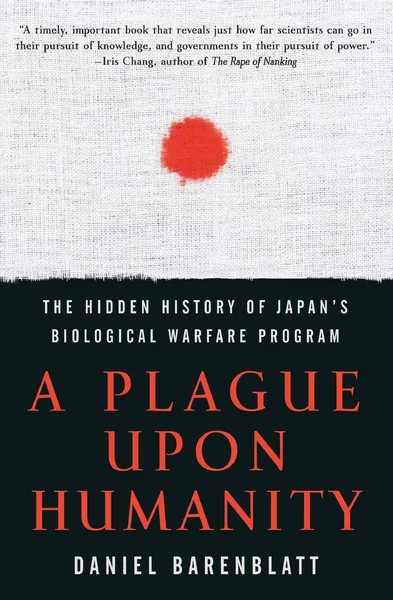
A Plague upon Humanity by Daniel Barenblatt Review: A Haunting, Meticulously Documented Historical Exposé
Daniel Barenblatt's A Plague upon Humanity is a rigorous work of historical research that brings the full, devastating scope of Imperial Japan's biological warfare program — and the postwar cover-up that buried it — into sharp relief, drawing on firsthand accounts from both perpetrators and survivors to chronicle one of the twentieth century's least-prosecuted atrocities.
LuvemBooks Verdict
Best for
Readers with a serious interest in World War II history, war crimes accountability, or the intersection of science and state violence who want an unflinching, evidence-rich English-language account of Unit 731 and the postwar American cover-up that shielded its perpetrators.
Worth it if
You want primary-sourced, morally unflinching history that assigns culpability not only to Imperial Japan's military scientists but also to the American Cold War officials who chose intelligence gains over justice — and you're willing to work through demanding, densely documented prose to get it.
Skip if
You're looking for a fast-moving narrative history; Kirkus's verdict of "surprisingly tortuous" is a fair warning that the book's evidentiary density and multi-front scope — military history, medical ethics, Cold War politics — can exhaust readers expecting a streamlined story.
What readers & critics say
Kirkus Reviews called it "a surprisingly tortuous study" while crediting Barenblatt's decade of reporting with surfacing "hard-won facts" not widely available in prior English-language treatments. Publishers Weekly recognised it as a "useful overview" that provides historical context for the gruesome human experimentation at the program's core.
“A surprisingly tortuous study of Imperial Japan's biological warfare program — but Barenblatt uncovers some hard-won facts.”
— Kirkus Reviews“A useful overview of the history of biological warfare, providing historical context for the gruesome experiments on humans.”
— Publishers WeeklyAsk LuvemBooks
Was this helpful?
- Is it worth reading?
- For readers with a genuine interest in World War II history, war crimes accountability, or the intersection of science and state violence, A Plague upon Humanity offers a depth of primary sourcing — firsthand testimony, newly surfaced evidence — that prior English-language accounts largely lacked. Barenblatt's willingness to assign moral culpability not only to the Japanese military but to American Cold War decision-makers gives the book an unusual and unflinching analytical edge. Kirkus Reviews' note that it is 'surprisingly tortuous' is a candid signal: the book's evidentiary density can be demanding, and readers expecting a fluid narrative may find the accumulated documented detail challenging to absorb. Those with an academic background in Pacific War history or war crimes trials will find the approach well-matched to the gravity of the subject.
- Similar books
- Readers drawn to A Plague upon Humanity are likely to find strong resonance with other works that confront suppressed wartime atrocities and postwar accountability failures. Sheldon H. Harris's Factories of Death is the foundational English-language scholarly treatment of Unit 731. Hal Gold's Unit 731 Testimony provides a survivor-testimony-focused companion. For the broader context of Japanese wartime conduct, Iris Chang's The Rape of Nanking offers a similarly unflinching, rigorously researched account. Readers interested in the Cold War calculus behind postwar impunity may also find parallels in Annie Jacobsen's Operation Paperclip, which chronicles the U.S. government's parallel decision to recruit Nazi scientists rather than prosecute them.
- Who should read this?
- A Plague upon Humanity is aimed at general readers with a serious interest in World War II history, war crimes accountability, and the intersection of science and state violence. It works both as an introduction to Unit 731 for those encountering the subject for the first time in depth and as a contribution to ongoing scholarly debates about postwar justice and American Cold War foreign policy in the Pacific. Readers drawn to works that confront the political dimensions of historical memory — particularly as they relate to decisions made under General Douglas MacArthur's Occupation — will find Barenblatt's argument directly and unflinchingly stated. Those seeking a light or narrative-driven read should be aware of the book's documented density.
- What was the postwar cover-up?
- Barenblatt documents that U.S. Occupation forces under General Douglas MacArthur struck a deal with the doctors of Unit 731 that shielded them from prosecution for their wartime atrocities — a deliberate contrast to the accountability applied at the Nuremberg trials. Pentagon officials chose to absorb Japan's biological warfare data rather than pursue criminal charges, a Cold War calculation that Barenblatt establishes the Allied powers had been positioned to make since at least 1939, when they first acquired knowledge of Unit 731's program. This Cold War calculus forms the moral and political backbone of the book's second half, and Barenblatt is careful to assign culpability not only to the Japanese military but to American decision-makers who engineered the impunity.
- What are the main themes?
- The book's core themes are state-sanctioned atrocity, postwar accountability, and the moral compromises of Cold War geopolitics. Barenblatt interrogates how a sophisticated military-scientific apparatus — Unit 731 — carried out human experimentation and mass biological warfare, while simultaneously examining how that program was deliberately buried by American officials who valued its data over justice. A secondary but significant theme is historical memory: Barenblatt situates Unit 731 within the full arc of Imperial Japan's military aggression, from the staged Mukden Incident of 1931 through wartime Manchuria, arguing that Western historical consciousness has long obscured these events. The firsthand accounts from both perpetrators and survivors give the book an additional human dimension that purely archival treatments tend to lack.
- How does the book portray Shiro Ishii?
- Barenblatt characterizes Lieutenant General Shiro Ishii — the commanding scientist of Unit 731 — in strikingly psychological terms, describing him as 'the archetype of a highly functioning sociopath, playing the dramatic role of the unstable "mad doctor" with flourish.' Rather than treating Ishii as an inexplicable anomaly, Barenblatt situates him within the institutional structures of Imperial Japan's military, showing how the state enabled and empowered his program of human experimentation and biological weapons development. The portrayal is damning but grounded in documented evidence from Barenblatt's decade of research.
Summarize this book
Follow up
Synthesized from verified book data & published reviews · How we review
Press Enter to ask. Answers come from our editorial Q&A — start typing to see related questions.
Age & Reading Level
Recommended age
Adult
Reading level
Adult
4 content notes · who it suits
Content to know about
Best for: Adults — harrowing documentation of human experimentation, biological warfare atrocities, and Cold War moral compromise is not appropriate for younger readers, and the scholarly density requires a mature, committed adult readership.
Skip if you want a fast-paced, narrative-driven account rather than a densely evidenced historical study.
Our Review
What the Book Documents
The Postwar Cover-Up
Significance and Scholarly Contribution
Strengths and Limitations of the Approach
Who This Book Is For
Related reading
Adjacent titles worth exploring. We haven't reviewed these yet, so they link out to Amazon.