BOOKS
Published

Read Time

3 min read

Curated & edited by

LuvemBooks Editorial

How we create our reviews →
Share This Review

The New Rules of Lifting: Six Basic Moves for Maximum Muscle by Lou Schuler & Alwyn Cosgrove Review: Science-Backed Strength Training Done Right

The New Rules of Lifting by Lou Schuler and Alwyn Cosgrove is a comprehensive fitness book that distills current research on weight training into a structured program built around six fundamental movement patterns, designed to help both men and women build muscle, debunk pervasive gym myths, and train in alignment with how the body naturally moves.

LuvemBooks Verdict

Best for

Intermediate and motivated beginner lifters — men and women equally — who want a coherent, research-supported strength program built around compound movements and are willing to engage with the science behind it, not just follow the workout tables.

Worth it if

You're ready to move past fragmented, magazine-style routines and want a structured system grounded in peer-reviewed research, delivered in writing that is candid, occasionally funny, and notably free of fitness-world hype.

Skip if

You train primarily for endurance sports or want a hybrid strength-and-cardio program — Schuler and Cosgrove's critique of high-volume aerobic work is presented in strong terms, and the book offers limited support for any goals outside strength and hypertrophy.

What readers & critics say

Reviewer sites including strength-basics.blogspot.com and news.runtowin.com call it a genuinely good workout book, praising its research foundation and accessible program design. Reader voices at raisedbyturtles.org and thriftbooks.com consistently highlight Schuler's engaging, often funny writing as a standout quality rare in the fitness genre.

Sources: strength-basics.blogspot.com, news.runtowin.com, raisedbyturtles.org, thriftbooks.com
4.5from 365 Amazon ratings— reader ratings, not a LuvemBooks score

Look inside the book

Preview the actual pages, via Google Books
In This Review
  • What Works & What Doesn't
  • What the Book Is and What It Contains
  • Its Place in the Strength-Training Genre
  • Strengths: Voice, Accessibility, and Research Integration
  • Genuine Limitations and Who May Struggle
  • Who This Book Is For

What Works & What Doesn't

What Works
  • Structured around six compound, research-supported movement patterns that reflect how the body naturally functions
  • Lou Schuler's writing voice is widely noted as engaging, direct, and genuinely readable — rare in the fitness genre
  • Directly addresses and debunks common weightlifting myths, including the claim that resistance training causes bulk
  • Integrates scientific research on hypertrophy, metabolism, and core training into the program rationale, not just the workout tables
  • Designed with realistic time constraints in mind, making the program accessible to non-competitive lifters
What Doesn't
  • The critique of endurance and aerobic training is presented in fairly strong terms, which may alienate readers who train for or enjoy endurance sports
  • The program is unapologetically focused on strength and hypertrophy — those seeking a hybrid training approach will find limited support for it here
  • Beginners entirely new to barbell and free-weight movements may benefit from in-person coaching that the written format cannot replace
The New Rules of Lifting is a genuinely useful, research-grounded fitness book from two authors with serious credentials — and that combination is rarer than the crowded strength-training shelf might suggest.

What the Book Is and What It Contains

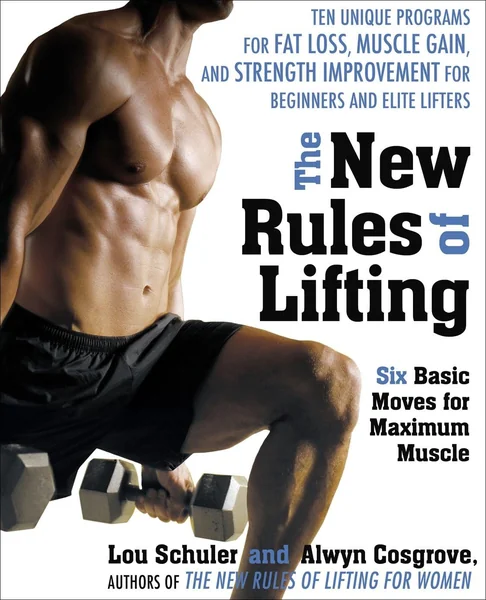
The New Rules of Lifting: Six Basic Moves for Maximum Muscle by Lou Schuler, Alwyn Cosgrove front cover
Published by Penguin Publishing Group, The New Rules of Lifting is a fitness book co-authored by Lou Schuler — a National Magazine Award–winning journalist, certified strength and conditioning specialist, and editorial director for T-Nation.com — and Alwyn Cosgrove, a strength-training expert. Together, they build a full training program structured around six fundamental movement patterns: push, pull, squat, deadlift, lunge, and bend — exercises the book frames as the movements at which the human body naturally excels. The program covers workouts at varying intensities (including a Break-In phase and progressions through Hypertrophy and Fat-Loss stages), and addresses nutrition alongside training, including guidance on protein, calories, and macronutrient targets. The result is a system designed for anyone seeking maximum muscle growth and functional strength, rather than the isolated, machine-dependent routines that dominated mainstream gym culture for decades.

Its Place in the Strength-Training Genre

When The New Rules of Lifting first appeared, it represented a meaningful departure from the bodybuilding-split orthodoxy that still filled most fitness magazines and gym floors. Schuler and Cosgrove grounded their approach in peer-reviewed research — drawing on journals covering hypertrophy, metabolism, and hormonal response — rather than the anecdote-and-celebrity-endorsement model that defined so many competitors. The book also takes explicit aim at one of the most persistent myths in fitness: the claim that weightlifting makes people, particularly women, bulky. Schuler and Cosgrove address this directly, explaining the physiological case for why resistance training produces a lean physique. That myth-busting posture, combined with a program designed to be accessible to non-competitive lifters, helped establish the book as a foundational text in the "evidence-based fitness" wave that has since become mainstream.

Strengths: Voice, Accessibility, and Research Integration

One of the book's most consistently noted qualities is Schuler's writing voice. Reader reactions cited across multiple sources describe his prose as genuinely engaging — humorous, direct, and free of the fad-chasing that inflates so many fitness titles. The program's design philosophy similarly earns praise: Schuler and Cosgrove explicitly acknowledge that most readers do not have unlimited time to train, and the workouts are structured accordingly. The scientific underpinning is woven into the text rather than relegated to an appendix — the authors explain why compound, multi-joint movements outperform isolation exercises for muscle development and metabolic effect, drawing on research in areas including core musculature, energy systems, and training frequency. This integration of reasoning with instruction is a meaningful feature for readers who want to understand the principles, not just follow a script.

Genuine Limitations and Who May Struggle

The book's treatment of endurance and cardiovascular training is a point of contention for some readers. Some note that Schuler and Cosgrove's critique of high-volume aerobic work — their argument that excessive endurance training impedes fat loss and erodes muscle — is presented in fairly absolute terms. Readers who train for endurance sports, or who simply enjoy running or cycling as a primary activity, may find the framing dismissive of their goals. The program is unapologetically centered on strength and hypertrophy, and those seeking a hybrid or endurance-inclusive approach will need to look elsewhere for balance. Additionally, while the six foundational movements are broadly accessible, lifters who are entirely new to barbells and free weights may find that some exercises require hands-on coaching that a book — by its nature — cannot fully substitute for.

Who This Book Is For

The New Rules of Lifting is best suited to intermediate and motivated beginner lifters who want a coherent, research-supported program and are willing to engage with the reasoning behind it, not just the workout tables. It speaks to men and women equally — the myth-busting sections on weightlifting and body composition are particularly relevant for women who have been steered away from the weight room by outdated advice. Readers who appreciate fitness writing that is candid, occasionally funny, and grounded in evidence rather than hype will find Schuler's authorial voice a genuine asset. For anyone looking to move past fragmented, magazine-style workouts and into a structured system built on movements that have stood up to scientific scrutiny, this book remains a clear and substantive starting point.

Sources & Further Reading

The key facts and claims in this review are grounded in the retrieved, verified sources listed below.

  1. Cited in this review
  2. 1
  3. Further reading
  4. 2
  5. 3
  6. 4
  7. 5
  8. 6
  9. 7