Practicing imperfection was harder than expected
Brown notes that over the past decade, putting the principles of her book into daily practice proved far more difficult than she anticipated, though also far more worthwhile.

9 min read
4.7
· 44,193 Amazon ratings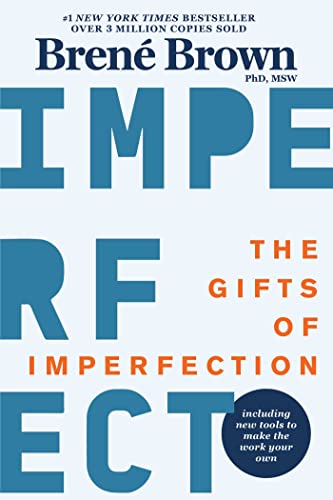
Our review
The Gifts of Imperfection by Brené Brown Review: A Foundational Guide to Wholehearted Living
Brené Brown's The Gifts of Imperfection — originally published in 2010 and reissued in a tenth-anniversary edition — is the self-help work that launched a cultural movement, arguing that courage, compassion, and connection are the daily practices required to let go of perfectionism, shame, and the need for approval and to live what Brown calls a "wholehearted" life. A New York Times bestseller that has sold more than two million copies across thirty-five languages, it remains the essential entry point into Brown's body of work and the foundation from which her subsequent books and podcasts grew.


 Tap to enlarge
Best for
Readers new to Brené Brown's work who want a compact, research-grounded introduction to wholehearted living — particularly those wrestling with perfectionism, shame, or the need for external approval — as well as book clubs seeking a structured framework for personal reflection.
Worth it if
Worth engaging with if you're drawn to self-help that bridges social science and accessible prose, and want a clear, usable framework — courage, compassion, and connection — as a starting point for Brown's broader body of work.
Skip if
Skip it if you're already well-versed in Brown's later titles (Dare to Lead, Atlas of the Heart), if you need clinical-level evidence or structured therapeutic tools, or if you're unlikely to connect with personal examples drawn heavily from parenthood and academic life.
What readers & critics say
Reader reviewers at thestorysanctuary.com describe it as a "groundbreaking work" and "motivational and inspiring guide to wholehearted living, rather than just the average self-help book," while shortform.com notes it was "an instant bestseller" following Brown's lauded 2010 TEDxHouston talk, though they add it "doesn't mean it's free from flaws." A more critical voice at shelfreflection.com calls the book "empty," arguing Brown's answers to questions of fear, identity, and worth "fall short."
Sources: The Story Sanctuary, Shortform, Shelf Reflection
Was this helpful?
Summarize this book
Follow up
Synthesized from verified book data & published reviews · How we review
Answers come from our editorial notes on this book. If we haven't covered something, we'll say so.
Readers often ask
We review the evidence: published critics, reader verdicts and BookTube reviews, gathered and weighed with AI assistance and edited by LuvemBooks, rather than one reader's first-hand take.
The key facts and claims in this review are grounded in the retrieved, verified sources listed below.
brenebrown.com
Brené Brown, LuvemBooks
forwardfitnessstl.com
readingandthinking.com
seattlechristiancounseling.com
scottholleran.substack.com
Recommended age
Adult
who it suits
Skip if you're looking for clinical-level therapeutic tools or peer-reviewed prescriptive frameworks rather than research-grounded popular psychology.
Brené Brown joins CBS This Morning to discuss the 10th anniversary edition of 'The Gifts of Imperfection' and wholehearted living.
Uploaded by CBS Mornings, 2020 · Watch on YouTube ·
Brown notes that over the past decade, putting the principles of her book into daily practice proved far more difficult than she anticipated, though also far more worthwhile.
Brown explains that intellectual knowledge is not enough to live wholehearted lives. Rather than a checklist of to-do items, it requires continuous daily practice, particularly when pushed into an emotional corner.
Brown shares that recording the audiobook for the anniversary edition was emotional because she had never read the text out loud before, recounting her past marital and parenting struggles.
Be one of the first readers to answer.
Read it? Was it right for you?
Curated picks for readers who enjoyed The Gifts of Imperfection, with our reasoning for each match.
More by Brené Brown
If you liked The Gifts of Imperfection