BOOKS
Published

Read Time

9 min read

Curated & edited by

LuvemBooks Editorial

How we create our reviews →
Share This Review

The Gifts of Imperfection by Brené Brown Review: A Foundational Guide to Wholehearted Living

Brené Brown's The Gifts of Imperfection — originally published in 2010 and reissued in a tenth-anniversary edition — is the self-help work that launched a cultural movement, arguing that courage, compassion, and connection are the daily practices required to let go of perfectionism, shame, and the need for approval and to live what Brown calls a "wholehearted" life. A New York Times bestseller that has sold more than two million copies across thirty-five languages, it remains the essential entry point into Brown's body of work and the foundation from which her subsequent books and podcasts grew.
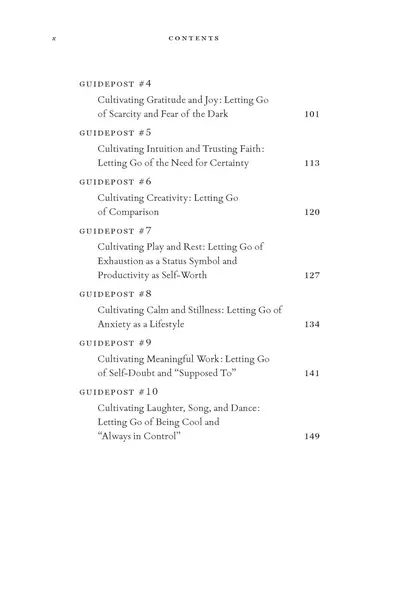
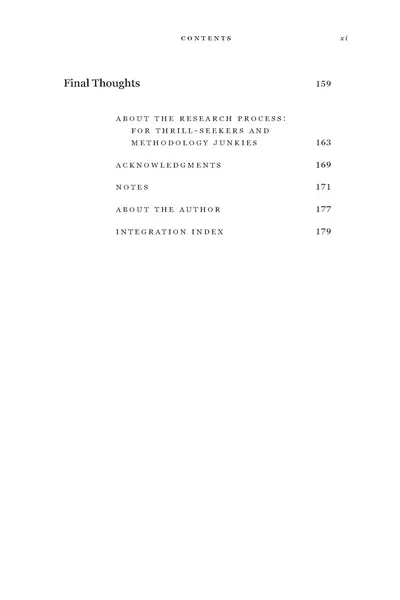
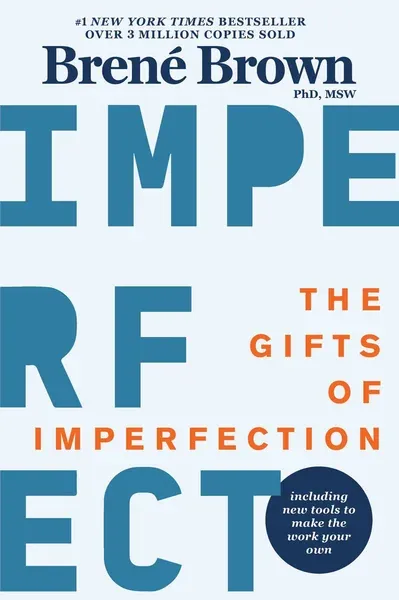
Contents page listing ten guideposts for cultivating emotional resilience and letting go of shame-based behaviors.Contents page listing final chapters on vulnerability research, acknowledgments, notes, and author information.The Gifts of Imperfection: 10th Anniversary Edition: Features a new foreword and brand-new tools by Brené Brown front coverTap to enlarge

LuvemBooks Verdict

Best for

Readers new to Brené Brown's work who want a compact, research-grounded introduction to wholehearted living — particularly those wrestling with perfectionism, shame, or the need for external approval — as well as book clubs seeking a structured framework for personal reflection.

Worth it if

Worth engaging with if you're drawn to self-help that bridges social science and accessible prose, and want a clear, usable framework — courage, compassion, and connection — as a starting point for Brown's broader body of work.

Skip if

Skip it if you're already well-versed in Brown's later titles (Dare to Lead, Atlas of the Heart), if you need clinical-level evidence or structured therapeutic tools, or if you're unlikely to connect with personal examples drawn heavily from parenthood and academic life.

Reader reviewers at thestorysanctuary.com describe it as a "groundbreaking work" and "motivational and inspiring guide to wholehearted living, rather than just the average self-help book," while shortform.com notes it was "an instant bestseller" following Brown's lauded 2010 TEDxHouston talk, though they add it "doesn't mean it's free from flaws." A more critical voice at shelfreflection.com calls the book "empty," arguing Brown's answers to questions of fear, identity, and worth "fall short."

Sources: The Story Sanctuary, Shortform, Shelf Reflection

Look inside the book

Preview the actual pages, via Google Books
In This Review
  • What Works & What Doesn't
  • What the Book Is and What It Argues
  • Cultural Significance and Reach
  • Core Strengths: Accessibility and Research-Backed Framework
  • Genuine Limitations and Likely Frustrations
  • Who This Book Is For and How It Holds Up

What Works & What Doesn't

What Works
  • Groundbreaking work that launched a cultural movement, with more than two million copies sold across thirty-five languages
  • Bridges social science research and accessible, conversational prose in a way that distinguishes it from purely anecdotal self-help
  • Organized around a clear, usable framework — courage, compassion, and connection — that gives readers practical guideposts, not just inspiration
  • The tenth-anniversary edition includes a new foreword and updated tools, adding fresh value for returning readers
  • A New York Times bestseller and the essential entry point into Brown's broader body of work
What Doesn't
  • Brown's personal illustrative examples — drawn from parenthood and academic life — may not translate equally for all readers
  • Readers seeking clinical-level evidence or structured therapeutic tools may find the framework more inspirational than prescriptive
  • Readers already familiar with Brown's later works may find this foundational text covers her core ideas at a higher level of generality
A book that sparked a cultural movement, The Gifts of Imperfection is the work that established Brené Brown as one of the defining voices in popular psychology and self-help.

What the Book Is and What It Argues

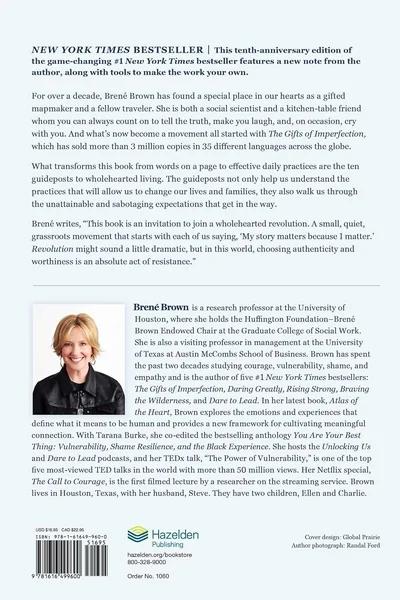
Back cover with synopsis, author biography, publisher details, and barcode.
The Gifts of Imperfection is a self-help book grounded in Brown's background as a social scientist. Its central argument is that wholehearted living — Brown's term for a life of genuine engagement and authenticity — requires letting go of perfectionism, shame, and the constant pursuit of external approval. In their place, Brown proposes three daily practices: courage, compassion, and connection. The book frames these not as destinations but as an ongoing journey; as one passage from the book's own framing makes clear, wholehearted living is "not a one-time choice." Brown positions the book explicitly as an invitation, describing it on her own platform as "an invitation to join a wholehearted revolution. A small, quiet grassroots movement that starts with each of us saying, 'My story matters because I matter.'" The structure walks readers through the specific guideposts Brown identifies for abandoning the exhausting performance of perfection and stepping into a more honest, self-defined life.

Cultural Significance and Reach

Few self-help titles of the past two decades have had a trajectory quite like this one. Originally published in 2010, the book quietly built an audience before becoming the launchpad for everything that followed in Brown's career — including five additional New York Times bestsellers, two award-winning podcasts (Unlocking Us and Dare to Lead), and a Netflix special. According to Simon & Schuster's own description of the tenth-anniversary edition, the book has sold more than two million copies and has been translated into thirty-five languages. That scale of readership, sustained over more than a decade, speaks to how deeply the book's core message resonated across cultures and demographics. The anniversary edition, which includes a new foreword and updated tools, signals that the publisher and author regard it not as a period document but as a living resource. Brown herself has described it as the work that started what became a movement.
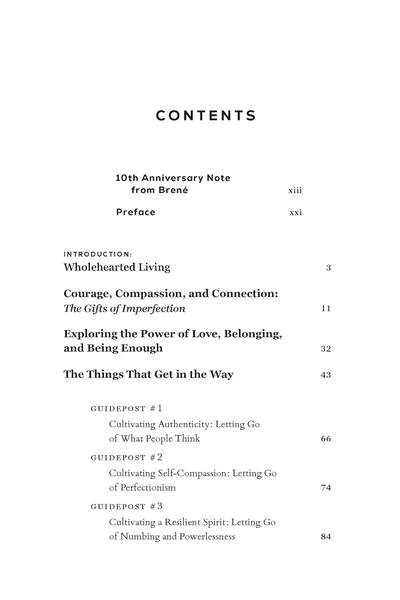
Contents page listing introduction on wholehearted living and three guideposts on vulnerability, authenticity, and resilience.

Core Strengths: Accessibility and Research-Backed Framework

One of the book's most frequently noted qualities is its ability to bridge academic research and intimate, conversational prose. Brown is trained as a social scientist, and the book draws on her research into shame, vulnerability, and human connection — yet it is written, as Simon & Schuster describes, in the voice of "a kitchen-table friend." This dual register — empirical grounding delivered with warmth and candor — distinguishes it from purely anecdotal self-help on one end and dry academic literature on the other. Readers across a wide range of contexts, from personal reading to structured book clubs, have engaged with its framework of courage, compassion, and connection as a practical lens for examining their own lives. The guideposts Brown lays out give the book a usable architecture rather than leaving readers with inspiration alone.

Genuine Limitations and Likely Frustrations

Honest assessment of the book requires noting that its resonance is not uniform. Some readers find Brown's illustrative examples — drawn heavily from her personal life as a parent and academic researcher — difficult to map onto their own circumstances. As one reader reaction notes, not everyone can relate to Brown's specific stories, even if the underlying theme of owning one's struggles lands clearly. The book is also, at its core, a work of popular psychology rather than clinical prescription; readers seeking structured therapeutic tools or clinical evidence at the level of peer-reviewed citation may find the framework more inspirational than actionable. Additionally, readers already well-versed in Brown's later, more expansive works such as Dare to Lead or Atlas of the Heart may find that The Gifts of Imperfection, as the earliest major statement of her ideas, covers familiar ground at a higher level of generality than those subsequent titles.

Who This Book Is For and How It Holds Up

More than a decade after its original publication, The Gifts of Imperfection continues to function as the clearest, most concentrated expression of Brown's core thesis. For readers encountering Brown's work for the first time, it remains the logical starting point — compact, direct, and organized around a framework that her entire body of work elaborates on. It is well suited to individual reflection, book club discussion, or pairing with Brown's own podcast series, Unlocking Us, in which she and her sisters revisited the book's themes in depth. The tenth-anniversary edition, with its new foreword and supplemental tools, offers returning readers fresh material rather than a simple repackage. Whether one arrives skeptical of the self-help genre or already inclined toward Brown's approach, the book's argument — that vulnerability and authenticity are forms of strength, not weakness — is made with enough grounding and specificity to merit serious engagement.

Sources & Further Reading

The key facts and claims in this review are grounded in the retrieved, verified sources listed below.

  1. Cited in this review
  2. 1
  3. 2
  4. Further reading
  5. 3
    Brené Brown — author profileHigh-authority source

    Brené Brown, Wikipedia

  6. 4
  7. 5
  8. 6
  9. 7
  10. 8
  11. 9
  12. 10