
9 min read
4.7
· 640,078 Amazon ratingsFeatured In
Share This Review
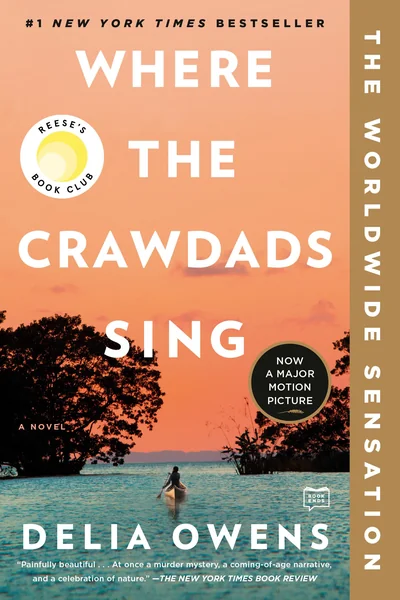
Where the Crawdads Sing by Delia Owens Review: A Lyrical Debut That Captivated Millions
Where the Crawdads Sing is Delia Owens's debut novel — a coming-of-age murder mystery set in the marshes of North Carolina that has sold over 18 million copies since its original publication by G.P. Putnam's Sons in 2018, powered by lyrical nature writing, an emotionally gripping protagonist, and a closing twist that Kirkus Reviews called the novel's "most memorable oddity."
LuvemBooks Verdict
Best for
Readers who love immersive sense-of-place fiction and want a cross-genre story that blends survival, romance, and courtroom mystery — especially those drawn to the natural world and emotionally resonant coming-of-age narratives.
Worth it if
You're willing to surrender to a sentimental, atmospheric story where the evocative North Carolina marshland and a propulsive dual-timeline structure matter more to you than psychological nuance in the supporting cast.
Skip if
You prefer psychologically complex supporting characters and a protagonist's arc grounded in realism rather than an emotionally satisfying — and increasingly implausible — transformation into published writer, artist, and poet.
What readers & critics say
Kirkus Reviews awarded it a "Get It" verdict, praising Owens's lyrical nature writing while noting the narrative grows "less magical, more predictable" as Kya ages and that supporting characters suffer from monochromatic good-versus-bad rendering. The Guardian's review, retrieved directly, describes Kya as a vivid character who uses "calculation and instinct" to navigate her circumstances, situating the novel within a tradition of nature-as-metaphor storytelling.
“Despite some distractions, there's an irresistible charm to Owens' first foray into nature-infused romantic fiction.”
— Kirkus Reviews“Owens is at her best reflecting Kya's fascination with the birds, insects, dappled light, and shifting tides of the marshes.”
— Kirkus Reviews“That trope — nature commentary ironing over human drama — is spectacularly extended in this debut novel by an American wildlife scientist.”
— The GuardianAge & Reading Level
Recommended age
Ages 16+
Reading level
Adult
3 content notes · who it suits
Content to know about
Best for: Adults / mature 16+ — themes of parental abandonment, domestic violence, and sexual exploitation
Skip if you want psychologically complex supporting characters and a realistically grounded protagonist arc
Where the Crawdads Sing by Delia Owens is Trending
Where the Crawdads Sing Is Having a BookTok Moment Again
TikTok readers are buzzing about Where the Crawdads Sing all over again, with fresh BookTok reviews, plot discussions, and reading challenge posts keeping Delia Owens's marshland mystery in the conversation heading into fall.
BookTok has a long memory, and right now it's circling back to Where the Crawdads Sing in a big way. TikTok is full of fresh content around the book — from reading challenge updates to deep dives into the story's central mystery (namely, what actually happened to Chase Adams). It's the kind of organic, reader-driven chatter that has kept this novel on bestseller lists years after its 2018 debut.
This isn't the first time the book has had a TikTok revival, and it probably won't be the last. Where the Crawdads Sing has that rare combination — an emotionally gripping story, a satisfying twist, and gorgeous nature writing — that makes readers want to talk about it. The 2022 film adaptation starring Daisy Edgar-Jones introduced a new wave of fans, many of whom are still making their way to the original book and sharing their reactions online.
If you haven't read it yet, this is as good a time as any to pick it up. With over 18 million copies sold, there's a massive community of readers to discuss it with — and if BookTok is any indication, that conversation is very much still going.
In This Review
- What Works & What Doesn't
- What the Novel Is and What It Contains
- The Role of Nature and Owens's Scientific Background
- Cultural Reach and Critical Standing
- Genuine Strengths and What Makes It Work
- Limitations Worth Knowing
What Works & What Doesn't
What Works
- Kirkus Reviews praised the nature writing as lyrical and evocative, calling Owens's depictions of the North Carolina marshes her strongest work
- A propulsive dual-timeline structure blends coming-of-age, romance, and murder mystery into a story with cross-genre appeal
- Owens's background in zoology and animal behavior gives the novel's natural world a grounded authenticity, with the marsh functioning as both setting and thematic foundation
- A New York Times bestseller and IndieBound bestseller that was selected for Reese Witherspoon's book club, reflecting exceptionally broad readership
- A closing twist that Kirkus Reviews called the novel's 'most memorable oddity,' providing a genuinely surprising final turn
What Doesn't
- Kirkus Reviews notes that supporting characters suffer from monochromatic characterization, with Tate and Chase rendered in broadly good-versus-bad strokes
- As the story moves past Kya's early childhood, Kirkus Reviews observes the narrative becomes 'less magical, more predictable,' and strains credibility as Kya becomes a published writer, artist, and poet
What the Novel Is and What It Contains
The Role of Nature and Owens's Scientific Background
Cultural Reach and Critical Standing
Genuine Strengths and What Makes It Work
Limitations Worth Knowing
Frequently Asked Questions
Sources & Further Reading
The key facts and claims in this review are grounded in the retrieved, verified sources listed below.
- Cited in this review
- 1
reesesbookclub.com
- Further reading
- 2
Delia Owens, Wikipedia
- 3
en.wikipedia.org
- 4
kirkusreviews.com
- 5
- 6
- 7
createdtoread.com
- 8
readingonastar.ca
- 9
- 10
Related Reviews
Reviews of books we picked for readers who enjoyed Where the Crawdads Sing.
Reader Comments
No comments yet
Be the first to share your thoughts!