BOOKS
Published

Read Time

3 min read

Curated & edited by

LuvemBooks Editorial

How we create our reviews →
Share This Review

Ordinary Grace by William Kent Krueger Review: A Quiet Masterwork of Mystery and Grief

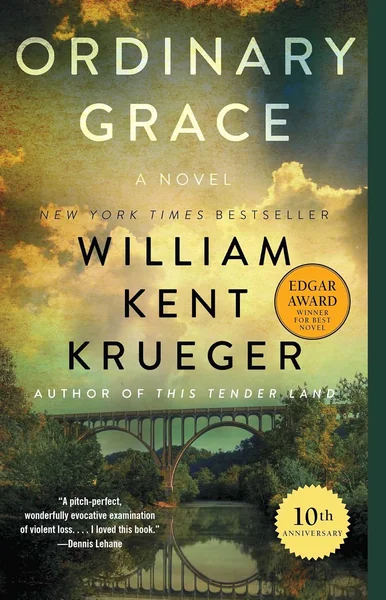
Ordinary Grace is a stand-alone literary mystery and coming-of-age novel set in the small town of New Bremen, Minnesota, in the summer of 1961. Narrated by thirteen-year-old Frank Drum — looking back from four decades later — it follows a summer in which four deaths shatter Frank's family and community, forcing him to reckon with faith, loss, and the limits of what any witness to tragedy can truly know. First published in 2013, it won the 2014 Edgar Award for Best Novel and is a New York Times bestseller. Kirkus Reviews called it "a novel that transforms narrator and reader alike," and the book has drawn comparisons to To Kill a Mockingbird for its combination of dread and nostalgia.

LuvemBooks Verdict

Best for

Readers who love literary mysteries in which atmosphere, moral inquiry, and family psychology take precedence over procedural plotting — particularly those drawn to coming-of-age narratives set against mid-century America and open to serious engagement with faith and grief.

Worth it if

Worth it if you want a mystery whose deepest unknowns are not whodunit but how human beings find meaning in the face of inexplicable suffering — rewarded with an Edgar Award win and comparisons to To Kill a Mockingbird for good reason.

Skip if

Skip it if you need a fast-paced thriller with clear procedural closure, or if the theological and spiritual dimensions of grief leave you cold — the novel's contemplative tempo and unresolved opening mystery are features, not flaws, but they will frustrate the wrong reader.

What readers & critics say

Kirkus Reviews awarded the novel a starred notice, declaring it "a novel that transforms narrator and reader alike" and stating that Krueger "aims higher and hits harder" than in his series work (kirkusreviews.com). Insideneworleansmagazine.com praised it as a novel that "exceeds genre," calling it "a thoughtful look" at faith and the resilience of humans facing inexplicable tragedy, while startribune.com found Krueger's evocation of the past "tinged with sadness but colored with hope."

Krueger aims higher and hits harder — a novel that transforms narrator and reader alike.

kirkusreviews.com
Sources: Kirkus Reviews, Inside New Orleans Magazine, Star Tribune
4.5from 48,272 Amazon ratings— reader ratings, not a LuvemBooks score

Look inside the book

Preview the actual pages, via Google Books
Trending Now
Award Winner/Nominee

Ordinary Grace by William Kent Krueger is Trending

Edgar Award Winner That Readers Keep Coming Back To

Ordinary Grace won the Edgar Award for Best Novel, and it's the kind of win that keeps drawing new readers years later. If you enjoy mysteries that feel more like literary fiction, this one gets recommended constantly for good reason.

Ordinary Grace took home the Edgar Award for Best Novel from the Mystery Writers of America, which is about as prestigious as it gets in the mystery world. The Edgar is a serious stamp of approval — it's not handed out for page-turning plot alone, and this book is a perfect example of why. It's a coming-of-age story set in 1960s Minnesota that happens to have a mystery at its center, but what readers remember is the emotional weight of it.

What keeps this book circulating is that it sits in a sweet spot a lot of readers are actively looking for right now — something that scratches the mystery itch without feeling like a disposable thriller. Book clubs keep picking it up, and it gets passed between friends with the kind of word-of-mouth that award stickers alone can't manufacture. The spiritual undertones and the father-son dynamic give it real staying power beyond the whodunit.

If you haven't read it yet, the good news is it stands completely alone — no series commitment required. It's a one-and-done read that tends to stick with people long after they've finished it.

Read more
Updated Jun 17, 2026
In This Review
  • What Works & What Doesn't
  • What the Novel Is and What It Argues
  • Characters, Family, and the Weight of Faith
  • Significance and Reception
  • Craft and Structure
  • Who Will Connect with This Book — and Who May Not

What Works & What Doesn't

What Works
  • Winner of the 2014 Edgar Award for Best Novel, the mystery genre's most prestigious honor
  • Kirkus Reviews called it 'a novel that transforms narrator and reader alike,' praising it as Krueger's most ambitious and hard-hitting work
  • Dual narrative perspective — Frank recounting events from forty years later — gives the story both immediacy and earned retrospective wisdom
  • Engages seriously with faith, grief, and moral uncertainty through a richly drawn family at its center
  • A New York Times bestseller that drew major critical comparisons, including to To Kill a Mockingbird
What Doesn't
  • The novel's deliberately measured, elegiac pacing may frustrate readers expecting conventional thriller momentum
  • The opening mystery of the boy found near the trestle is, by design, never fully resolved — readers seeking clear procedural closure may find this unsatisfying
  • The novel's theological and spiritual themes are central to its argument; readers with no interest in questions of faith may find the thematic core less accessible
A coming-of-age literary mystery of rare emotional weight, Ordinary Grace stands as one of William Kent Krueger's most celebrated achievements.

What the Novel Is and What It Argues

Back cover with award badge, synopsis, author photo, and review quotes praising the coming-of-age mystery.
Set in New Bremen, Minnesota, in the summer of 1961, Ordinary Grace opens with the discovery of the body of a young boy found near a train trestle at the edge of town. That death, as Kirkus Reviews notes, functions as a kind of prelude — a red herring that gives way to a series of further deaths reshaping the world of thirteen-year-old Frank Drum, the novel's narrator. Frank recounts these events from the vantage point of a middle-aged man looking back four decades, giving the narrative a dual temporal register: the raw confusion of a boy's experience alongside the weathered understanding of an adult who has had years to process what happened. The novel's central preoccupation, signaled from its epigraph onward, is the Aeschylean idea that wisdom is earned through suffering — what the text frames as the "awful grace of God," where "awful" carries its older meaning of awe-inspiring rather than terrible.

Characters, Family, and the Weight of Faith

At the heart of the novel is Frank's family. His father, Nathan Drum, is the town's pastor — a man who trained as a lawyer until his military service in World War II redirected him toward ministry. Nathan's faith is tested rather than vindicated by the summer's events. His wife, Frank's mother, chafes against the confines of a minister's life and does not share her husband's belief, and their marriage strains under the accumulation of tragedy. Frank's younger brother stutters, a detail Krueger weaves into the texture of the story. As Kirkus Reviews observes, one of the novel's central mysteries lies in the gaps between what Frank experiences, what he knows, and what he only thinks he knows — a distinction that keeps the narrative tension alive even as the plot's surface quiets. The book also engages, per web sources, with themes of racism, prejudice, mental health, suicide, and alcoholism, grounding its 1961 setting in social realities rather than nostalgia.

Significance and Reception

Originally published on March 26, 2013, and reissued in a paperback reprint edition by Atria Books on March 4, 2014, Ordinary Grace arrived as a departure from Krueger's long-running Cork O'Connor series and quickly established itself as something distinct in his catalog. Kirkus Reviews stated that with this novel Krueger "aims higher and hits harder," and awarded it a starred notice. The book went on to win the 2014 Edgar Award for Best Novel — the mystery genre's most prestigious honor — and was named a School Library Journal Best Book of 2013. It is a New York Times bestseller. The Detroit News drew a comparison to To Kill a Mockingbird for its blending of dread and nostalgia, while The Globe and Mail (Toronto) praised the novel's language, ideas, and its engagement with the Aeschylus epigram. Bookreporter.com described Krueger as having delivered his masterpiece with this title.

Craft and Structure

Krueger structures the mystery so that the initial death deliberately resists resolution, functioning as a moral and narrative frame rather than a puzzle to be solved. The choice to narrate through an older Frank looking back lends the book an elegiac, ruminative quality — the reader knows the summer will leave permanent marks before a single page is turned. The novel's Aeschylean epigraph, with its equation of suffering and wisdom, runs as a through-line connecting individual scenes to a larger argument about how communities and families metabolize grief. As Kirkus Reviews notes, the world of the novel ultimately resolves into one of "redemptive grace and mercy," even as it does not shy away from unresolvable loss. Beth Hoffman, writing via Simon & Schuster's materials, observed that Krueger "artfully layered the story with suspenseful examinations of family life, death, fury, spiritual fiber and redemption."

Who Will Connect with This Book — and Who May Not

Readers drawn to literary mysteries in which atmosphere, character psychology, and moral inquiry outweigh procedural plotting will find Ordinary Grace a deeply rewarding experience. Its pacing is deliberately measured; those seeking a fast-moving thriller with conventional genre mechanics may find the novel's contemplative tempo a mismatch with their expectations. The novel's engagement with faith — particularly its exploration of a pastor's belief under duress — is central rather than incidental, meaning readers indifferent to theological questions may find its thematic core less resonant. For readers open to those questions, however, the novel offers something rare: a mystery in which the deepest unknowns are not whodunit, but how human beings find meaning in the face of suffering they cannot explain or undo.

Sources & Further Reading

The key facts and claims in this review are grounded in the retrieved, verified sources listed below.

  1. Cited in this review
  2. 1
  3. 2
  4. Further reading
  5. 3

    William Kent Krueger, Wikipedia

  6. 4
  7. 5
  8. 6
  9. 7
  10. 8
  11. 9
  12. 10
  13. 11
  14. 12
  15. 13