
7 min read
4.5
· 405 Amazon ratingsShare This Review
The $7/Day High Protein Cookbook for Weight Loss by Heather Choate Review: Budget-Focused High-Protein Recipe Collection
Heather Choate's self-published cookbook sets out to solve three problems at once — tight grocery budgets, low-protein diets, and time-consuming meal prep — by packing 124 high-protein, low-carb recipes and a 30-day meal plan into a single, practically oriented volume. This review assesses the book's content, structure, and stated design intent from published sources, not a kitchen test.
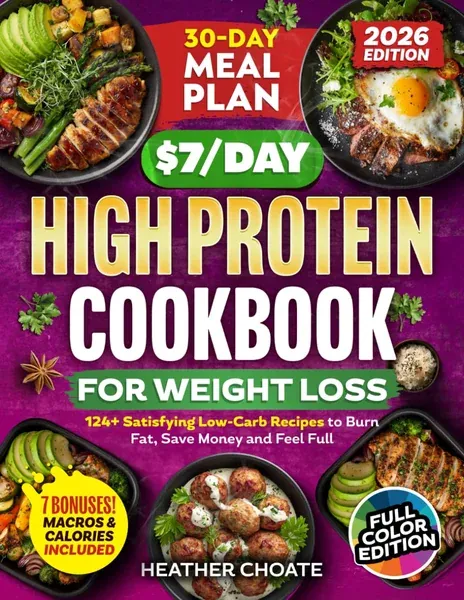 Tap to enlarge
LuvemBooks Verdict
Best for
Budget-conscious home cooks who want a structured, follow-this program — not a browsable collection — combining high-protein, low-carb eating with a hard $7/day cost ceiling and quick weeknight-friendly recipes.
Worth it if
You want a single self-contained resource that gives you 124 recipes, a 30-day meal plan, and concrete budget guardrails all in one place, and you're comfortable with the brevity that comes from a densely packed 90-page self-published format.
Skip if
You need extended technique instruction, per-recipe nutritional breakdowns, or third-party-verified recipe testing — or if your local grocery prices make a strict $7/day ceiling unrealistic.
What readers & critics say
No independent critical reviews of the book were found among retrieved sources. Promotional listings on ohfb.com and ebookfairs.com relay the publisher's own description, emphasising the book's budget-friendly, high-protein positioning and 2025 updated edition status, but neither constitutes editorial criticism.
Sources: ohfb.com, ebookfairs.comAge & Reading Level
Recommended age
Adult
Reading level
Adult
who it suits
Skip if you want detailed technique instruction, extended recipe headnotes, or independently verified nutritional data per recipe.
In This Review
- What Works & What Doesn't
- What the Book Contains and Promises
- The Core Approach: Budget Eating Without Restriction
- Significance and Market Positioning
- Strengths: Specificity and Structure
- Limitations and Honest Caveats
What Works & What Doesn't
What Works
- 124 recipes plus a 30-day structured meal plan provide a complete, program-style resource rather than a loose collection
- Explicit $7/day budget ceiling gives meal planning a concrete, trackable cost structure
- Recipes are designed for completion in under 20 minutes, targeting readers with limited kitchen time
- Seven bonus sections and dedicated meal prep guidance add practical support beyond the recipes themselves
- Compact, self-contained format makes the book accessible as a standalone starting point for high-protein, low-carb eating
What Doesn't
- At 90 pages covering 124 recipes and substantial bonus content, individual recipes and instructional detail are necessarily brief
- Self-published without a traditional publisher's editorial or recipe-testing infrastructure; no named culinary authority has independently verified recipe accuracy
- The $7/day cost target depends on regional grocery prices and store access, which will vary significantly by location
What the Book Contains and Promises

The Core Approach: Budget Eating Without Restriction
Significance and Market Positioning
Strengths: Specificity and Structure
Limitations and Honest Caveats
Frequently Asked Questions
Sources & Further Reading
The key facts and claims in this review are grounded in the retrieved, verified sources listed below.
- Cited in this review
- 1
- Further reading
- 2
ebookfairs.com
Related Reviews
Reviews of books we picked for readers who enjoyed The $7/Day High Protein Cookbook for Weight Loss.

Reader Comments
No comments yet
Be the first to share your thoughts!