9 min read
4.7
· 7,091 Amazon ratingsShare This Review
Our review
East of Eden
East of Eden by John Steinbeck Review: A Nobel Laureate's Towering Magnum Opus
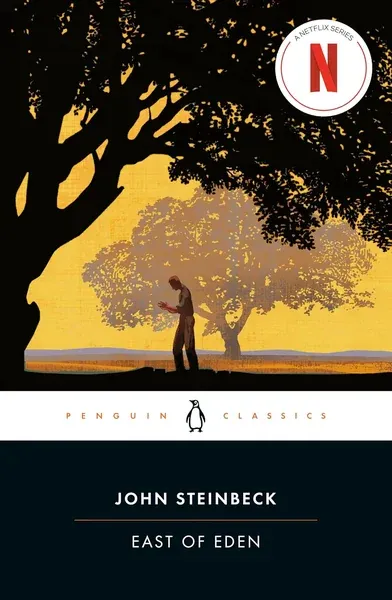
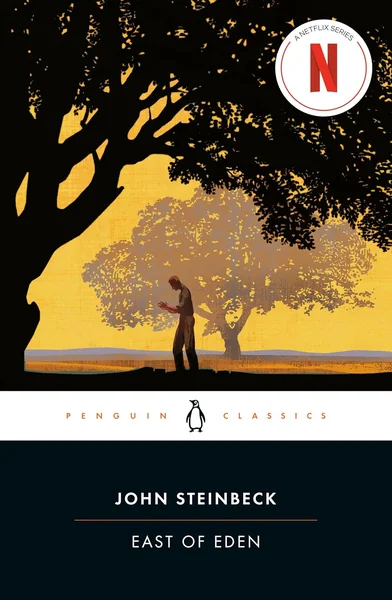
East of Eden is John Steinbeck's sweeping family saga following the Trasks and the Hamiltons across generations in California's Salinas Valley, structured as a retelling of Genesis — the Fall, Cain and Abel, and the question of whether human nature is fixed or free. Steinbeck himself called it his magnum opus, and this Penguin Classics edition, with an introduction by David Wyatt, remains the standard paperback text for general readers and students alike.
LuvemBooks Verdict
Best for
Readers drawn to sweeping, mythically ambitious American fiction who want to engage with Steinbeck's self-described life's work — particularly those interested in the interplay of Biblical allegory, family saga, and philosophical debate about human freedom.
Worth it if
Worth reading if you have the patience for a 640-page, deliberately discursive epic and are willing to meet Steinbeck on his own terms — Biblical grandeur, direct authorial address, and a moral architecture built around the question of whether human beings are condemned to sin or genuinely free to choose otherwise.
Skip if
Skip it if you prefer the lean, focused storytelling of Of Mice and Men or The Grapes of Wrath, because the novel's sprawling dual-family structure, inconsistent narrative voice, and overt moralising are features of its design, not flaws that a better edition corrects.
What readers & critics say
Wikipedia's entry on the novel notes that East of Eden became an instant bestseller and is widely regarded as Steinbeck's most ambitious work, though contemporary critics called its Biblical symbolism heavy-handed, its narrative structurally disorganised, and the character of Cathy Ames unbelievably brutal. Kirkus Reviews, whose original notice is retrievable on their site, characterised the novel as "tremendous in scope and in depth of penetration," while also acknowledging Steinbeck's overt philosophical moralising as the dominant note of the book.
“Tremendous in scope — tremendous in depth of penetration — and as different a Steinbeck as the Steinbeck of Burning Bright was from the Steinbeck of The Grapes of Wrath.”
— Kirkus ReviewsAsk LuvemBooks
Was this helpful?
- Is it worth reading?
- For readers drawn to epic, philosophically ambitious American fiction, East of Eden rewards the considerable investment it demands. Steinbeck himself called it the work into which he poured everything he had learned about his craft, and the timshel debate — a genuine argument about human freedom and moral choice — gives the novel intellectual substance that extends well beyond its narrative scale. That said, critics have consistently noted real weaknesses: heavy-handed Biblical symbolism, structural looseness from weaving two family lines, inconsistent first-person authorial intrusions, and the divisive characterisation of Cathy Ames. Readers who embrace its sprawling, maximalist design will find it among the most resonant works in the American canon; those who prefer lean, tightly unified storytelling may find the friction genuine.
- Similar books
- Readers drawn to East of Eden's epic scope and moral seriousness will find much to admire in Steinbeck's own The Grapes of Wrath, which shares the Salinas Valley milieu and a fierce reckoning with American hardship, and Of Mice and Men, a leaner but thematically connected study of dreams and failure. Gabriel García Márquez's One Hundred Years of Solitude offers a similarly multigenerational family saga with mythic underpinnings. For the novel's blend of moral philosophy and literary weight, Fyodor Dostoevsky's Crime and Punishment and Harper Lee's To Kill a Mockingbird are natural companions, as is F. Scott Fitzgerald's The Great Gatsby for its place at the heart of the twentieth-century American canon.
- Who should read this?
- East of Eden is written for patient, literary-minded adult readers who are drawn to multigenerational sagas, Biblical and mythic narrative structures, and fiction that takes moral philosophy seriously. It is particularly well suited to readers interested in American literature and California's Salinas Valley as a literary landscape, students approaching the text academically — the Penguin Classics edition with David Wyatt's introduction and the Covici correspondence selections is especially apt for that context — and anyone who wants to engage with Steinbeck's most ambitious and autobiographically charged work. Readers who prefer tight, plot-driven fiction or who found Steinbeck's shorter novels more satisfying should approach with calibrated expectations.
- About John Steinbeck
- John Ernst Steinbeck was an American writer and novelist.
- Which edition should I buy?
- The Penguin Classics edition (ASIN 0140186395), with an introduction by scholar David Wyatt, is the standard paperback text for both general readers and students and the edition on which this review is based. Its key distinguishing feature is the inclusion of selections from Journal of a Novel: The 'East of Eden' Letters — Steinbeck's correspondence with his longtime Viking editor Pascal Covici written during the novel's composition — which adds rare biographical and compositional context unavailable in bare editions. For anyone approaching the text in an academic or studious context, this edition is the clear recommendation.
- Tell me about the adaptation
- The most celebrated adaptation of East of Eden is Elia Kazan's 1955 film, starring James Dean in his first major screen role as Cal Trask — widely regarded as one of Dean's defining performances. The film focuses on the novel's final section rather than its full generational sweep, and Dean's portrayal of Cal's anguished need for his father's love became culturally iconic. The novel's full multigenerational scope has not been captured in a single definitive screen adaptation, making the film a compelling companion piece but an incomplete representation of the book's ambitions.
- How does this compare to Steinbeck's other work?
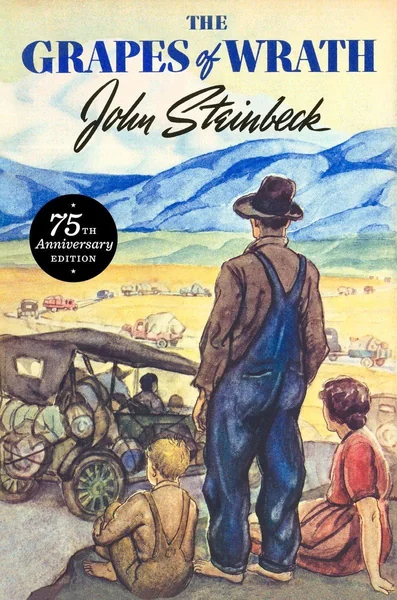
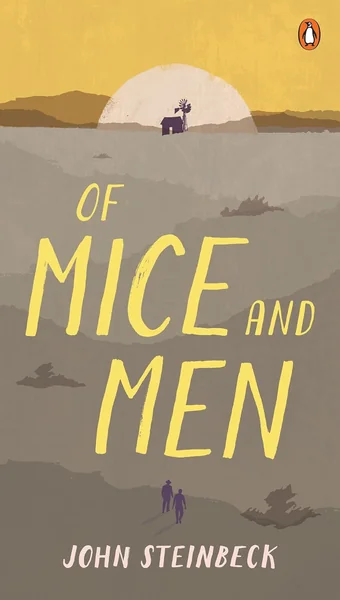
- East of Eden sits apart from Steinbeck's other major novels in scale and explicit ambition. The Grapes of Wrath — which earned Steinbeck the Pulitzer Prize — is more politically focused and structurally disciplined, following the Joad family's Dust Bowl migration with a clear social argument. Of Mice and Men is lean and concentrated, a novella built around a single relationship and a single tragedy. East of Eden, by contrast, is Steinbeck's maximalist statement: sprawling, multigenerational, autobiographically charged, and explicitly conceived as the summation of everything he had learned as a writer. He described all his previous work, in his own words, as 'in a sense, practice for this.'
Summarize this book
Follow up
Synthesized from verified book data & published reviews · How we review
Press Enter to ask. Answers come from our editorial Q&A — start typing to see related questions.
Our Review
What the Novel Actually Is
Biblical Architecture and Central Themes
Steinbeck's Own Assessment and Its Place in His Career
The Critical Fault Lines
Who This Edition Is For
Sources & Further Reading
The key facts and claims in this review are grounded in the retrieved, verified sources listed below.
- Cited in this review
- 1
hollywoodreporter.com
- 2
- 3
- 4
steinbeckintheschools.com
- Further reading
- 5
John Steinbeck, Wikipedia
- 6
penguin.co.uk
- 7
en.wikipedia.org
- 8
- 9
- 10
- 11
barnesandnoble.com
- 12
Age & Reading Level
Recommended age
Ages 16+
Reading level
Adult
Heat level
Mild · sexual menace and manipulation; no explicit scenes
Tropes
From how readers and romance sites describe it, not our own reading.
4 content notes · who it suits
Content to know about
Best for: Adults / mature 16+ — the publisher lists a reading age of 18 and above, consistent with unflinching depictions of violence, sexual menace, and Cathy Ames's portrayal as a figure of near-elemental cruelty.
Skip if you prefer tightly plotted, lean fiction and are put off by heavy Biblical allegory or discursive, maximalist storytelling.
Reader reviews
Be one of the first readers to answer.
Read it? Was it right for you?
Books like East of Eden
Curated picks for readers who enjoyed East of Eden, with our reasoning for each match.
More by John Steinbeck
If you liked East of Eden