At a glance
LuvemBooks Verdict
Best for: Professionals with some capital access who are seriously considering acquiring and operating a small-to-medium business and want a structured, step-by-step framework to move from initial conviction to closing a deal.
Worth it? Skip it? Read the full verdict →Ask LuvemBooks
Was this helpful?
- Is it worth reading?
- For prospective acquisition entrepreneurs — professionals who want to own and operate a business without the mortality risk of the startup phase — Buy Then Build functions as a structured, experience-grounded entry point into a niche that has historically lacked accessible dedicated guides. Its tactical specificity, including the opportunity profile, target statement, and seller-psychology framework, gives it practical utility that elevates it above general-principle business books. Those in a broad exploratory phase or interested in passive investment rather than owner-operated acquisition will find the prescriptive framework less immediately applicable.
- Similar books
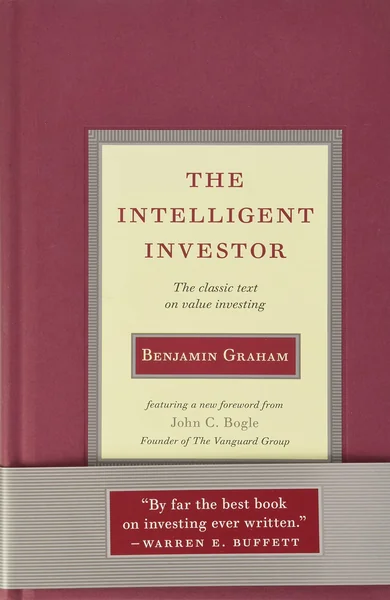
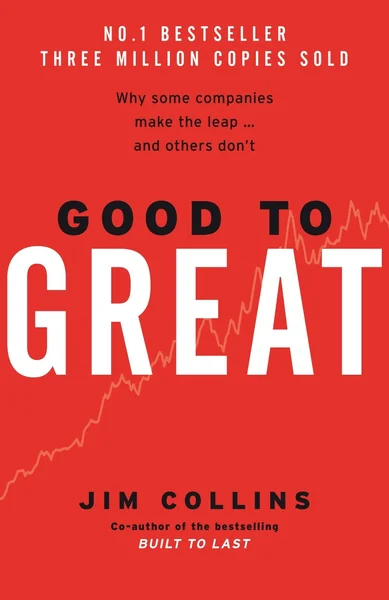
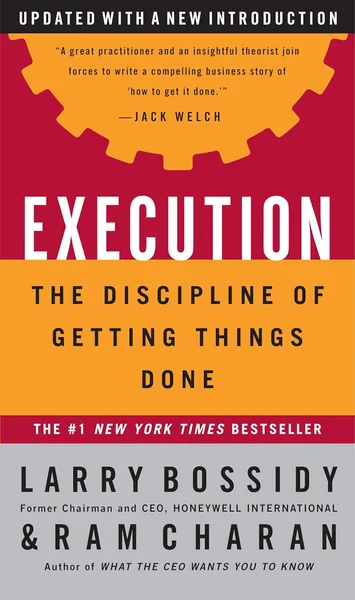
- Readers drawn to Buy Then Build may also find value in The Lean Startup by Eric Ries, which takes the opposing philosophical stance — iterative founding rather than acquisition — making the two books a productive contrast. Good to Great by Jim Collins explores what separates truly exceptional companies from merely good ones, offering complementary thinking on what makes an established business worth acquiring and growing. For the financial evaluation side of the acquisition process, The Intelligent Investor by Benjamin Graham provides foundational value-investing principles, while Execution by Larry Bossidy, Ram Charan, and Charles Burck addresses the operational discipline required once ownership changes hands. Rich Dad Poor Dad by Robert T. Kiyosaki shares Deibel's emphasis on building cash-flow-generating assets and may appeal to readers who are newly orienting toward ownership.
- Who should read this?
- Buy Then Build is written for individuals who are seriously considering acquiring a small-to-medium business — people with at least some capital access and an entrepreneurial orientation who want to own and operate a company without enduring the startup phase. It is particularly well-suited to professionals considering a career transition into business ownership, whether through a search fund, self-funded search, or direct acquisition. Those in an earlier exploratory phase, or whose interest is in broad entrepreneurship theory rather than active deal pursuit, will find the narrow scope less useful.
- About Walker Deibel
- Walker Deibel is the Wall Street Journal and USA Today bestselling author of Buy Then Build: How Acquisition Entrepreneurs Outsmart the Startup Game. An entrepreneur and investor, he has co-founded three startups, acquired seven companies outright, and consulted or participated in over 100 business transactions. Following the book's success, he launched an elite accelerator focused on acquisition entrepreneurship.
- What are the key concepts or tools in the book?
- The book introduces several concrete tactical instruments designed for active use in a real acquisition search. The opportunity profile and target statement are central tools from the Evaluation section, helping buyers define and focus their search criteria. On the financial side, Deibel walks through reading financial statements, evaluating an operating business, and arriving at a valuation. Notably, he also addresses seller psychology — examining the neurological side of transactions and offering techniques for building trust and having non-threatening, productive conversations with business owners, a dimension that purely financial acquisition guides typically omit.
- How does acquisition entrepreneurship differ from starting a business?
- Deibel's central argument is that the startup phase itself is 'a company killer' — a period of zero customers, no cash flow, and unproven infrastructure that most new ventures do not survive. Acquiring an existing business, by contrast, allows a buyer to step into an established market position with existing customers, proven revenue, and operational systems already in place. The book frames this not as a passive investment but as active operator ownership, where the buyer becomes the new owner-CEO responsible for growing a business that is already functioning.
Summarize this book
Follow up
Synthesized from verified book data & published reviews · How we review
Press Enter to ask. Answers come from our editorial Q&A — start typing to see related questions.
Age & Reading Level
Recommended age
Adult
Reading level
Adult
who it suits
Skip if you are looking for broad entrepreneurship strategy or a passive-investment playbook rather than a step-by-step guide to acquiring and operating a specific small-to-medium business.
Editorial Review
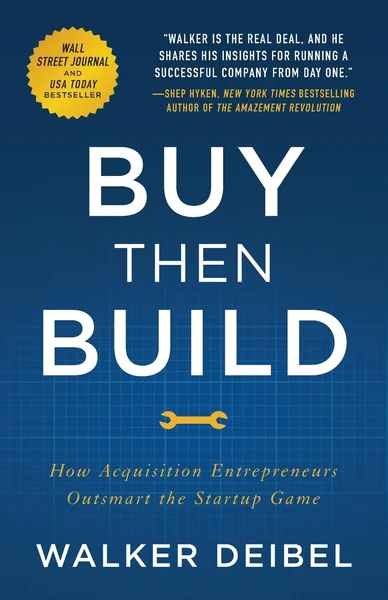
Buy Then Build: How Acquisition Entrepreneurs Outsmart the Startup Game is a 2018 finance book by Walker Deibel, published by Lioncrest Publishing, that makes a structured, experience-backed case for acquiring an existing business rather than launching one from scratch — walking prospective buyers from initial opportunity-spotting through deal execution and ownership transition.
Read the Full ReviewBooks like Buy Then Build
Curated picks for readers who enjoyed Buy Then Build, with our reasoning for each match.
If you liked Buy Then Build