BOOKS
Published

Read Time

3 min read

Curated & edited by

LuvemBooks Editorial

How we create our reviews →
Share This Review

LuvemBooks Verdict

Best for

Aspiring first-time business owners who are seriously weighing whether to launch a startup or buy an existing company and want a structured, phase-by-phase methodology to guide an actual acquisition search.

Worth it if

The reader has entrepreneurial ambitions but no prior M&A experience and wants both a strategic case for the acquisition path and concrete operational tools — from crafting a target statement to valuing a business and negotiating with sellers.

Skip if

Readers who already have professional deal-making or M&A experience, or those seeking frameworks for institutional buying, private equity, or multi-company roll-up strategies will find the scope narrower than their needs.

What readers & critics say

Kirkus Reviews awards the book its "Get It" verdict, calling it "a deftly written, exceedingly thorough, and highly informative business guide" and praising it as "a top-notch, start-to-finish, comprehensive manual" for entrepreneurs intrigued by acquisition. Ankney Law's review highlights the book's practical advice on determining whether acquisition entrepreneurship is the right fit, and on working effectively with advisors.

A deftly written, exceedingly thorough, and highly informative business guide — a top-notch, comprehensive manual.

Kirkus Reviews
Sources: Kirkus Reviews, Ankney Law
4.7from 2,258 Amazon ratings— reader ratings, not a LuvemBooks score

Look inside the book

Preview the actual pages, via Google Books

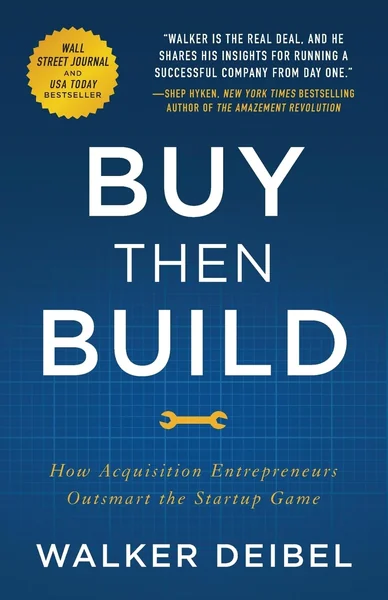
Buy Then Build by Walker Deibel Review: A Practical Blueprint for Acquisition Entrepreneurs

by Walker Deibel

·

3 min read

In This Review
  • What Works & What Doesn't
  • What the Book Is and What It Argues
  • Structure and Tactical Depth
  • The Author's Credibility and Methodology
  • Where the Book Has Clear Strengths
  • Who This Book Is For — and Its Limitations

What Works & What Doesn't

What Works
  • Divided into four clearly sequenced parts — Opportunity, Evaluation, Analysis, and Execution — that mirror the real-world acquisition process from target identification through ownership transition
  • Combines strategic argument (why acquisition outperforms the startup path) with concrete tactical tools, including the 'opportunity profile,' 'target statement,' financial statement analysis, and business valuation basics
  • Addresses the human and psychological side of deals, including seller mindset and techniques for building trust and conducting non-threatening conversations
  • Grounded in Deibel's firsthand experience co-founding seven businesses and buying and selling multiple companies, supplemented by research and interviews
  • Fills a genuine gap in mainstream entrepreneurship publishing, which has historically centered the startup narrative over the acquisition path
What Doesn't
  • Readers with existing M&A or deal-making experience will find the foundational coverage of financial analysis and deal structure covers familiar ground
  • The scope is intentionally focused on individual acquisition entrepreneurs, making it less applicable to institutional buyers, private equity professionals, or those pursuing multi-company roll-up strategies
Buy Then Build makes a direct, evidence-grounded argument: for most aspiring entrepreneurs, acquiring an existing business is a smarter path than starting one from zero.

What the Book Is and What It Argues

According to Wikipedia's entry on the title, Buy Then Build is a 2018 finance book that "serves as a guide for prospective business buyers, emphasizing the advantages of acquiring existing businesses over starting one from scratch." Deibel opens with a pointed provocation — that "the startup phase is a company killer" — and immediately proposes what he frames as a viable alternative: a path that bypasses the startup phase altogether. The central premise is that an established business already holds meaningful competitive advantages, and that by acquiring it, a buyer can eliminate a direct competitive threat while stepping into an existing market position. This is not a theory book about entrepreneurship broadly; it is a focused argument for a specific method, addressed to readers who are seriously considering business ownership.

Structure and Tactical Depth

The book is divided into four parts — Opportunity, Evaluation, Analysis, and Execution — each mapped to a concrete phase of the acquisition process: finding a company to buy, negotiating the deal, purchasing the business, and transitioning ownership. The chapter-level breakdown (drawn from the book's table of contents) is similarly specific: "Don't Start a Business," "Engineering Wealth," "The CEO Mindset," "Defining the Target," "The Search," "Deal Making," "Buy for the Future, Pay for the Past," and others. On the tactical side, as Wikipedia notes, Deibel walks readers through how to identify an "opportunity profile" and craft a "target statement" for their search, how to read and analyze financial statements, and how to value a company. This level of operational specificity — from target definition through financial due diligence — is a distinguishing feature of the book's design.

The Author's Credibility and Methodology

Deibel draws on his own track record of co-founding seven businesses, supplemented by research and interviews, to build his case. The book does not limit itself to deal mechanics; it also addresses what Wikipedia describes as "the neurological side of things" — specifically, the mindset of the seller. Deibel provides techniques designed to help buyers have non-threatening, productive conversations with sellers, recognizing that human dynamics are as central to a successful acquisition as any financial model. He also emphasizes building trust with sellers, creating solid business plans, and managing the emotional dimensions of both acquisition and ownership transition. A blurb on the book's own site notes that Deibel "bought and sold over a half dozen companies while other entrepreneurs were building from scratch," lending his prescriptions a grounding in direct experience rather than purely theoretical frameworks.

Where the Book Has Clear Strengths

The four-part structure gives the book a logical momentum that mirrors the actual sequence a buyer would follow, making it functional as both a cover-to-cover read and a reference during an active search. The combination of strategic argument (why acquisition beats startup) with step-by-step operational guidance (how to value a business, how to approach a seller) addresses the two questions most likely to face a first-time acquirer simultaneously. David Schonthal of the Kellogg School of Management is quoted on the book's site describing it as "a practical guide to cash flow investing, business, or improving financial IQ" — a characterization that aligns with its positioning as an action-oriented finance book rather than an inspirational entrepreneurship title.

Who This Book Is For — and Its Limitations

Buy Then Build is squarely aimed at prospective first-time business buyers: individuals with entrepreneurial ambitions who have not yet launched or acquired a company and are weighing their options. Readers already experienced in M&A at a professional or institutional level will find the foundational material — basic financial statement analysis, introductory deal structure — covers ground they know well. The book's focus is also explicitly on the individual acquisition entrepreneur rather than on corporate buyers, private equity firms, or larger strategic acquirers, so readers seeking frameworks for multi-company roll-ups or institutional deal-making will find the scope narrower than their needs. Within its intended audience, however, the book occupies a distinct niche: mainstream entrepreneurship publishing has historically centered on the startup path, and Buy Then Build's direct challenge to that orthodoxy — backed by a structured, phase-by-phase methodology — fills a gap that few comparable titles address with the same operational specificity.

Sources & Further Reading

The key facts and claims in this review are grounded in the retrieved, verified sources listed below.

  1. Cited in this review
  2. 1
  3. 2
  4. 3
  5. Further reading
  6. 4
  7. 5
  8. 6
  9. 7
Related Reviews

Reviews of books we picked for readers who enjoyed Buy Then Build.