At a glance
LuvemBooks Verdict
Best for: Fans of sharp comic writing who enjoy Hollywood satire delivered through a fully inhabited fictional persona — particularly readers who appreciate humor that doubles as cultural observation about early-nineties film and its audience.
Worth it? Skip it? Read the full verdict →Ask LuvemBooks
Was this helpful?
- Is it worth reading?
- For readers who enjoy satirical cultural commentary and humor writing, If You Ask Me holds up as one of the genre's most purely entertaining entries. Readers on Thriftbooks have called it 'the funniest film review collection ever written,' and the sustained enthusiasm across decades of reviews speaks to the durability of Rudnick's comic voice. The caveat is historical: readers unfamiliar with the specific films and stars of the 1987–1992 Hollywood era will find some jokes require contextual knowledge that has faded with time.
- Similar books
- Readers who enjoy If You Ask Me's brand of sharp, persona-driven cultural satire are well served by several companion titles. Fran Lebowitz's Metropolitan Life offers a similarly acerbic, singular-voice commentary on culture and society. Carrie Fisher's Wishful Drinking delivers Hollywood memoir with comparable wit and self-aware comic timing. For more Paul Rudnick, I Shudder: And Other Reactions to Life, Death, and New Jersey brings his essayistic comedy voice to a broader range of targets. Jon Stewart's Naked Pictures of Famous People shares the pop-culture satire impulse, while William J. Mann's How to Be a Movie Star: Elizabeth Taylor in Hollywood covers the same Hollywood era with serious critical depth for readers who want the analytical distance that Libby deliberately withholds.
- Who should read this?
- If You Ask Me is ideal for fans of satirical humor writing, particularly readers who enjoy pop-culture commentary delivered through a strong, fully realized comic persona. It will resonate most with anyone who has a working knowledge of 1987–1992 Hollywood — the films, the stars, the cultural conversations Libby riffs on — though Rudnick's comic architecture is broad enough that the domestic humor and character dynamics remain funny independent of era. Readers who prefer their film criticism with analytical distance should look elsewhere; the collection is unrelentingly comic by design.
- What are the main themes?
- The central satirical engine of If You Ask Me is the gap between Hollywood's fantasy-packaging and the real lives of the audience it targets: Libby's quip that 'Movies have become so much better lately, now that they've become more like car commercials on TV' functions simultaneously as a character joke and a genuine critical observation about the industry. The collection also explores domesticity as a lens for cultural criticism — Libby's relationships with her husband Josh, her friend Stacy Schiff, and her family are not mere backdrop but the mechanism through which Rudnick exposes Hollywood's condescension toward suburban women. Woven throughout is a recurring meditation on celebrity, taste, and the aspirational appeal of stardom, delivered with a range the review describes as going 'from the superficial to the profound' — often in the same paragraph.
- What was Premiere magazine?
- Premiere was one of the leading mainstream film magazines of the era, and the Libby Gelman-Waxner column ran there from 1987 to 1992 — a period when it was among the most widely read publications covering Hollywood for a broad, engaged audience. That mainstream platform shaped the columns: Rudnick wrote the humor to be inclusive rather than insider-exclusive, which is part of why the collection travels beyond a specialist film audience. The 1995 reprint by the Random House Publishing Group gathered all five years of those columns into the collected edition readers have returned to since.
- What's the reading experience like?
- Reading If You Ask Me is less like consuming a conventional book and more like spending time in a fully constructed comedic world: Libby is a consistent, fully inhabited character, and her relationships with Josh, Stacy Schiff, her mother, and her grandmother provide emotional continuity across the episodic columns. The humor is relentless — the entire collection is filtered through Libby's single voice — and the book rewards both cover-to-cover reading and casual dipping. Readers who want analytical distance in their film writing, or who expect the structure of a conventional memoir or criticism volume, will find the format is simply not built for that experience.
Summarize this book
Follow up
Synthesized from verified book data & published reviews · How we review
Press Enter to ask. Answers come from our editorial Q&A — start typing to see related questions.
Age & Reading Level
Recommended age
Adult
Reading level
Adult
who it suits
Skip if you want film criticism delivered with analytical distance and scholarly rigour rather than sustained comic exaggeration.
Editorial Review
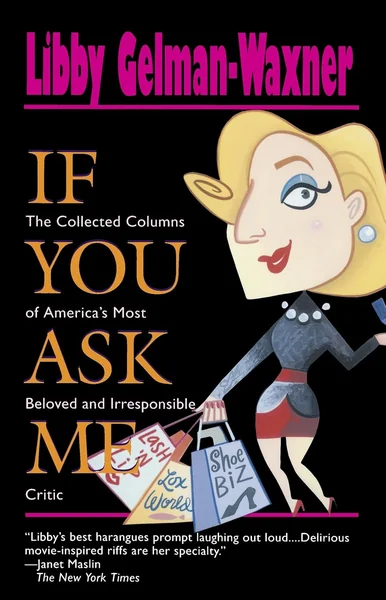
If You Ask Me: The Collected Columns of America's Most Beloved is a humor collection by the pen name Libby Gelman-Waxner — the creation of playwright and screenwriter Paul Rudnick — gathering five years of film criticism columns originally published in Premiere magazine between 1987 and 1992. The book skewers Hollywood through the voice of a delightfully suburban, pop-culture-obsessed persona, and readers who enjoy satirical cultural commentary delivered with a sharp comedic edge will find it holds up as one of the genre's most purely entertaining entries.
Read the Full Review