BOOKS
Published

Read Time

3 min read

Curated & edited by

LuvemBooks Editorial

How we create our reviews →
Share This Review

If You Ask Me: The Collected Columns of America's Most Beloved by Libby Gelman-Waxner Review: A Sharp, Hilarious Film-Criticism Persona Unmasked

If You Ask Me collects the wickedly funny Premiere magazine film columns written under the pen name Libby Gelman-Waxner — a creation of playwright and screenwriter Paul Rudnick — delivering scathing, witty takes on Hollywood through the voice of a gleefully opinionated suburban everywoman, published in this reprint edition by Random House in 1995.

LuvemBooks Verdict

Best for

Readers who love film humor, persona-driven satire, or the comedy of the early-1990s Hollywood moment — especially fans of Paul Rudnick's screenwriting work or anyone who followed Premiere magazine during its peak years.

Worth it if

You enjoy character-driven comic writing and want a collection that uses a brilliantly sustained fictional narrator to skewer real films and celebrities with wit and specificity rather than generic mockery.

Skip if

You prefer straightforward critical analysis over voice-driven satire, or have little familiarity with early-1990s Hollywood and its stars — the topical humor is tightly rooted in that specific cultural moment.

What readers & critics say

Reader accounts on ThriftBooks describe the collection as among the most re-read books in their libraries, calling for further volumes and praising Gelman-Waxner's "razor-sharp analyses." AbeBooks reviewers characterise Rudnick as "a clever, humorous and sharp-witted film critic" whose satirical persona stands as a genuine creative achievement. A BookCrossing reader similarly recalls the Premiere columns as "delightfully snarky" and sought out the collection on its first publication.

Sources: ThriftBooks, AbeBooks, BookCrossing
4.6from 24 Amazon ratings— reader ratings, not a LuvemBooks score
In This Review
  • What Works & What Doesn't
  • What the Book Actually Is
  • The Persona and Its Satirical Design
  • Reception and Standing in the Genre
  • Genuine Limitations
  • Who This Book Is For

What Works & What Doesn't

What Works
  • Paul Rudnick's Libby Gelman-Waxner persona is a genuinely original comedic creation that sustains its satirical voice across an entire collection of columns
  • The book skewers real early-1990s films and celebrities — including Demi Moore, Dennis Quaid, and Arnold Schwarzenegger — with wit and specificity rather than generic mockery
  • Reader accounts describe the collection as consistently and repeatedly funny, with enthusiastic reception noted across multiple independent sources
  • Originally published in Premiere magazine, the columns carry the credibility of a real editorial platform and a writer with a strong, established comedic voice in both theater and film
What Doesn't
  • The columns are tightly tied to early-1990s films and pop-cultural references, which may reduce immediate impact for readers unfamiliar with that specific Hollywood era
  • The humor is entirely persona-driven and character-based — readers who prefer straightforward critical analysis over satirical voice work may find the format less satisfying
A collection that weaponizes the suburban movie-fan voice against Hollywood with precision and genuine comedic force, If You Ask Me remains one of the more inventive entries in the film-criticism humor genre.

What the Book Actually Is

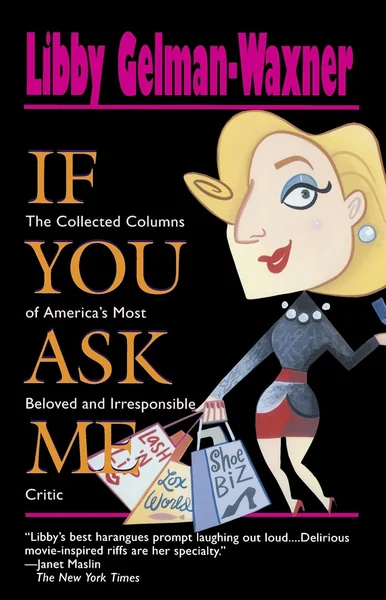
If You Ask Me: The Collected Columns of America's Most Beloved and Irresponsible Critic by Libby Gelman-Waxner front cover
If You Ask Me: The Collected Columns of America's Most Beloved gathers the film commentary columns that ran in Premiere magazine under the byline of Libby Gelman-Waxner — a fictional persona crafted by Paul Rudnick. Rudnick, widely known as a playwright and as the screenwriter behind Addams Family, Addams Family Values, The First Wives Club, and In & Out, deployed the Gelman-Waxner voice as a comedic lens through which to dissect the films and stars of the early 1990s. The columns are written in character: Libby is a wisecracking, culturally engaged woman who weighs Hollywood product against the textures of her domestic life, referencing figures like Josh, her husband, and her wider circle. Real films and real celebrities — among them Demi Moore, Dennis Quaid, Arnold Schwarzenegger, and Diane Keaton — appear throughout, subjected to Libby's cheerfully merciless scrutiny. The reprint edition was published by the Random House Publishing Group on June 13, 1995.

The Persona and Its Satirical Design

The central creative mechanism of the book is the gap between Libby's breezy, conversational register and the sharpness of the criticism she delivers. By embedding film commentary inside the voice of an opinionated suburban woman chatting with a friend, Rudnick opens up satirical angles that straight reviewing rarely reaches: the absurdity of star mythology, the gap between cinematic aspiration and actual audience experience, and the social rituals around moviegoing itself. The publisher describes the collection as "witty, wicked, and scathingly honest," and the columns bear that out through Libby's comic digressions — touching on everything from the Fisher King to Curly Sue — as they circle back to pointed observations about what Hollywood is actually selling. The persona is the argument, and the argument is sustained across the full run of columns.

Reception and Standing in the Genre

Reader response documented on bookselling platforms has been strongly enthusiastic. One reviewer on ThriftBooks called it "the funniest film review collection ever written," placing it above other humor-criticism hybrids of the era and singling out Rudnick's comic voice as "flat out hysterical." Multiple readers describe returning to the book repeatedly. That depth of affection, expressed across independent reader accounts, reflects a collection that found and held a genuine audience. Rudnick's credentials as a "clever, humorous and sharp" writer, noted by AbeBooks reviewers, align with his broader reputation: his screenwriting work spans major studio comedies, and his theatrical voice carries into the column format with evident craft. The book occupies a specific niche — comic film criticism built around a sustained fictional narrator — that few collections have attempted with comparable consistency.

Genuine Limitations

The book's greatest structural constraint is also inseparable from its design: the columns are products of a specific, early-1990s cultural moment. The films reviewed, the stars discussed, and the pop-cultural touchstones Libby invokes are rooted firmly in that window. Readers who lived through the era Rudnick is skewering will have an immediate frame of reference; readers coming to the book without familiarity with the films and figures being lampooned may find some of the satirical targets harder to locate. This is not a flaw of execution but a condition of the form — topical humor columns collected into a book always carry the timestamp of their original publication, and If You Ask Me is no exception.

Who This Book Is For

The collection is best suited to readers who enjoy film humor, persona-driven satire, or the comedy of the 1990s Hollywood moment specifically. Fans of Rudnick's screenwriting work will recognize his sensibility immediately; readers who followed Premiere magazine during its peak years will find the columns rich with context. Even those approaching without that background and possessing an appetite for sharp, character-driven comic writing will find much to appreciate in the Gelman-Waxner voice itself, which functions as a comic creation independent of any single film reference. As a piece of humor writing that uses cinema as its raw material rather than treating criticism as its ultimate purpose, If You Ask Me holds up as an example of what wit and a strong invented narrator can do within the column format.

Sources & Further Reading

The key facts and claims in this review are grounded in the retrieved, verified sources listed below.

  1. 1
  2. 2
  3. 3
  4. 4
  5. 5