8 min read
4.4
· 30 Amazon ratingsShare This Review
An Optimist's Tour of the Future by Mark Stevenson Review: A Globe-Trotting Science Travelogue Worth Reading
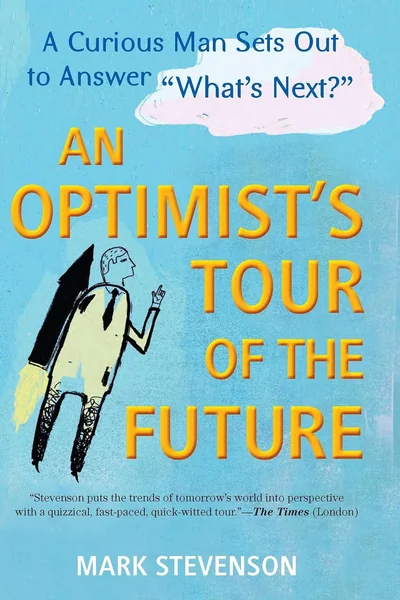
Mark Stevenson's An Optimist's Tour of the Future is a non-fiction travelogue in which the British author, comedian, and businessman travels the world to meet scientists, engineers, and innovators working at the cutting edge of medicine, computing, robotics, synthetic biology, nanotechnology, and environmental technology — making a compelling, broadly praised case that the future belongs to those willing to look at it clearly and with hope.
LuvemBooks Verdict
Best for
Curious generalists who want a broad, personality-driven tour of emerging science — synthetic biology, robotics, nanotechnology, alternative energy — without needing a technical background, written in the accessible, narrative-led tradition of Bill Bryson.
Worth it if
You enjoy popular science written with wit and a strong authorial voice, and want a coherent single narrative that ranges across nearly every frontier of human ingenuity rather than dwelling deeply on any one field.
Skip if
You're looking for rigorous technical depth or hard-edged policy analysis — critics including The Scotsman and the Financial Times found that Stevenson's comedic instincts can crowd out substance, and the 2011 publication date means some specific predictions and start-up optimism have since dated.
What readers & critics say
The book's own site (anoptimiststourofthefuture.com) collects coverage describing it as "a refreshing reminder that the future will always belong to the optimists," with praise for Stevenson's ability to sift genuine technological concerns from fear-mongering. The author's own site (markstevenson.org) records it as receiving "stellar reviews all over the place" and being "one of the most interesting science books I've read for a long time," while Barnes & Noble's page surfaces a critical coverage pull-quote praising Stevenson for weaving wide-ranging research "into one grand vision."
Sources: anoptimiststourofthefuture.com, markstevenson.org, barnesandnoble.comAsk LuvemBooks
Was this helpful?
- Is it worth reading?
- For curious generalists who want a guided tour of the scientific horizon written with personality and a clear point of view, An Optimist's Tour of the Future delivers real rewards. The Sydney Morning Herald praised Stevenson's ability to render even the most complex scientific problems understandable to a layperson, and Wired's Geek Dad called it 'a very coherent and entertaining journey through the world of future technology.' The main caveat flagged by critics is the comedic voice: Stuart Kelly in The Scotsman objected to 'inappropriate, wise-cracking levity throughout,' and the Financial Times argued that trivialities can get in the way of the important details gathered on the tour — so readers who want denser analytical treatment of the science may find the humour a structural obstacle rather than an invitation.
- Similar books
- Readers drawn to An Optimist's Tour of the Future will find natural companions in several other works that grapple with humanity's trajectory. Matt Ridley's The Rational Optimist makes a similarly evidence-based case for optimism about human progress, while Peter H. Diamandis and Steven Kotler's Abundance: The Future Is Better Than You Think covers comparable ground on technology and resource innovation with a comparable sense of possibility. For a darker counterweight, Toby Ord's The Precipice: Existential Risk and the Future of Humanity examines the same technological horizon through the lens of existential risk. Yuval Noah Harari's Homo Deus: A Brief History of Tomorrow and Siddhartha Mukherjee's The Gene: An Intimate History also share Stevenson's ambition to make frontier science legible and consequential for general readers. Note that none of these titles are currently in the LuvemBooks catalogue, so no direct links are available below.
- Who should read this?
- An Optimist's Tour of the Future is designed for the curious generalist: someone who wants a guided tour of the scientific horizon without needing a technical background to follow the argument. Its travelogue format makes it more personal and narrative-driven than a conventional science survey, and it suits readers who enjoy popular science written with personality — those drawn to the Bill Bryson end of the science-writing spectrum. Readers who prefer hard-edged policy analysis, deep technical depth, or a more sober prose register may find Stevenson's structural reliance on humour a poor fit.
- About Mark Stevenson
- Mark Stevenson is a London-based British writer, businessman, public speaker, and self-described 'reluctant' futurologist. He is also a semi-professional musician and former comedian — a background that directly shapes the comedic, accessible voice that defines An Optimist's Tour of the Future and that reviewers consistently identified as both the book's greatest strength and its most debated quality.
- What are the main themes?
- At its broadest, An Optimist's Tour of the Future is a sustained argument that clear-eyed, evidence-based hope is the most rational response to the scientific horizon — that the future belongs to those willing to look at it honestly rather than fearfully. More concretely, the book weaves together themes of human ingenuity and technological progress across synthetic biology, nanotechnology, robotics, alternative energy, space travel, and climate science, while also engaging seriously with existential anxieties: nanotech 'grey goo' scenarios, pandemic risk, and resource and population pressures all receive attention. A secondary theme is the democratisation of scientific knowledge — the book's travelogue structure and plain-language treatment reflect a conviction that these ideas belong to everyone, not just specialists.
- Is this a good book club pick?
- An Optimist's Tour of the Future works well as a book club pick for groups interested in popular non-fiction, science, and ideas about the future. Its wide sweep — from synthetic biology to space travel to climate science — provides multiple entry points for discussion, and its clearly argued optimistic thesis invites productive debate, particularly for readers who arrive with different baseline views on technology and progress. The documented critical divide over Stevenson's comedic voice is itself a rich discussion starter: reviewers at The Scotsman and the Financial Times pushed back hard on levity that others found a genuine strength.
Summarize this book
Follow up
Synthesized from verified book data & published reviews · How we review
Press Enter to ask. Answers come from our editorial Q&A — start typing to see related questions.
Age & Reading Level
Recommended age
Adult
Reading level
Adult
who it suits
Skip if you want rigorous technical depth or hard-edged policy analysis rather than an accessible, personality-driven travelogue.
Our Review
What the Book Is and What It Sets Out to Do
The Breadth and Intellectual Ambition of Its Survey
Accessibility and the Science-Communicator's Craft
Where the Tone Divides Readers
Who This Book Is For and How It Holds Up
Sources & Further Reading
The key facts and claims in this review are grounded in the retrieved, verified sources listed below.
- Cited in this review
- 1
- 2
markstevenson.org
- 3
- 4
en.wikipedia.org
- Further reading
- 5
Mark Stevenson, Wikipedia
- 6
Books like AN Optimist's Tour of the Future
Curated picks for readers who enjoyed AN Optimist's Tour of the Future, with our reasoning for each match.