
BOOKS
Published

Read Time

3 min read

Curated & edited by

LuvemBooks Editorial

How we create our reviews →
Share This Review

An Optimist's Tour of the Future by Mark Stevenson Review: A Breezy, Globe-Trotting Science Survey

Mark Stevenson's An Optimist's Tour of the Future is a wide-ranging non-fiction travelogue in which the British author, comedian, and businessman travels the world to interview thought leaders and scientists working at the cutting edge of medicine, computing, robotics, nanotechnology, biotechnology, and environmental science — structuring a genuinely hopeful survey of what may lie ahead for humanity, written in an accessible, comedian's voice that earned largely positive reviews across the UK, US, and Australian press.

LuvemBooks Verdict

Best for

Scientifically curious non-specialists — readers who want a wide-angle, humanising introduction to the technologies shaping humanity's near future, delivered through first-hand reporting and with enough wit to make nanotechnology, synthetic biology, and space exploration feel genuinely accessible.

Worth it if

You want a coherent, globe-spanning survey of cutting-edge science and technology written for the non-expert, and you appreciate popular science that wears its humour and personality openly rather than defaulting to a sober textbook register.

Skip if

You already have a solid grounding in futurism or any of the specific fields covered — the survey-level treatment and comedian's voice that win over general readers are exactly what drew pointed criticism from reviewers who felt the levity dilutes the book's most substantive reporting.

What readers & critics say

The book earned largely positive reviews across the UK, US, and Australian press, with markstevenson.org documenting praise for Stevenson's refusal to tip into cynicism and describing the book as "a refreshing reminder that the future will always belong to the optimists." The amazon.com.au reader record notes that for a book on the future over a decade old, it "holds up remarkably well."

Sources: markstevenson.org, amazon.com.au
4.4from 30 Amazon ratings— reader ratings, not a LuvemBooks score
In This Review
  • What Works & What Doesn't
  • What the Book Is and What It Sets Out to Do
  • Scope, Balance, and the Breadth of the Argument
  • Accessibility and the Comedian's Voice
  • Where the Tone Divides Opinion
  • Reception, Reach, and Who This Book Is For

What Works & What Doesn't

What Works
  • Covers an unusually wide range of fields — nanotechnology, biotechnology, genomics, robotics, energy, and computing — while maintaining coherence, earning praise from Wired's Geek Dad as 'a very coherent and entertaining journey through the world of future technology'
  • Balances genuine technological anxieties (climate change, pandemics, nanotech risks) against evidence for optimism, rather than dismissing concerns — described by The Guardian as 'a measured effort to take stock of the reasons for hope'
  • Written explicitly for the non-science-literate reader, with The Sydney Morning Herald crediting Stevenson with 'an ability to express even the most complex scientific problems in terms easily understood by a layperson'
  • Travelogue structure grounded in first-hand interviews with scientists and thought leaders at the scientific frontier gives the book reported substance beyond desk-based futurism
  • Translated into nine languages, reflecting broad international critical and reader enthusiasm across the UK, US, and Australia
What Doesn't
  • The comedian's voice divides critics sharply — Stuart Kelly in The Scotsman objected to 'inappropriate, wise-cracking levity throughout,' making the book a poor fit for readers who prefer a more sober popular-science register
  • The Financial Times' Marek Kohn argued that 'trivialities get in the way of the important details gathered on his tour,' suggesting the tonal choices can dilute the book's most substantive reporting
A non-fiction travelogue that earned largely positive reviews across the UK, US, and Australian press, this book stands as a genuinely optimistic — and rigorously reported — survey of the technologies and ideas shaping humanity's near future.

What the Book Is and What It Sets Out to Do

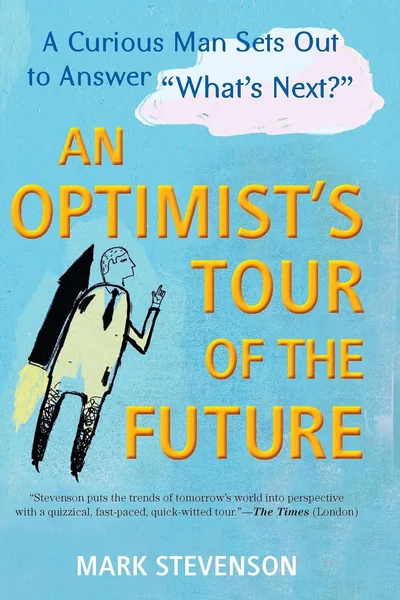
AN Optimist's Tour of the Future: One Curious Man Sets Out to Answer "What's Next?" by Mark Stevenson front cover
An Optimist's Tour of the Future originated, by Stevenson's own account, in a sudden confrontation with his own mortality — a jolt that sent him out into the world asking the deceptively simple question: "What's next?" The resulting non-fiction book, first published in the United Kingdom in January 2011 and in the United States shortly thereafter, is structured as a travelogue. Stevenson travels the globe — from space planes in the Mojave Desert to laboratories working on nanotechnology, biotechnology, genomics, and energy — meeting thought leaders and professionals working at what the record describes as "the scientific horizon." The book is a survey, not a manifesto: it covers cutting-edge medical, scientific, computing, robotics, and environmental trends, with Stevenson acting as a curious, mobile generalist rather than a domain specialist.

Scope, Balance, and the Breadth of the Argument

One of the book's most consistently praised qualities is the range it covers without losing coherence. Wired's Geek Dad called it "a very coherent and entertaining journey through the world of future technology," a verdict that speaks directly to the challenge Stevenson set himself: to move across disciplines — from nanotech to genomics to energy to communications — without the whole thing fragmenting into disconnected chapters. Equally notable is the book's even-handedness. Rather than dismissing anxieties about new technologies as irrational, Stevenson sifts genuine concerns — around nanotechnology's risks, population pressures, climate change, and pandemics — from what he characterises as fear-mongering, and weighs them against the evidence for hope. The Guardian described the result as "a measured effort to take stock of the reasons for hope, and to keep faith with the enlightenment project," a characterisation that captures the book's tone of reasoned, evidence-grounded optimism rather than uncritical boosterism.

Accessibility and the Comedian's Voice

Stevenson's background as a comedian shapes the book's texture throughout. The text is written in a breezy style dotted with one-liners and wry observations, with the stated design intent of making complex scientific material legible to readers without a science background. The Sydney Morning Herald praised "an ability to express even the most complex scientific problems in terms easily understood by a layperson" — a significant achievement given the technical density of fields like synthetic biology and nanotechnology. Brainpickings.org went further, raising the comparison to Bill Bryson's A Short History of Nearly Everything as a potential touchstone for popular-science writing of its generation. That comparison sets a high bar, but it reflects the genuine enthusiasm the book generated among readers and critics who valued its accessibility.

Where the Tone Divides Opinion

The comedian's voice that wins admirers in some quarters is precisely what grates in others, and the critical record is honest about this division. Stuart Kelly, writing in The Scotsman, took issue with what he characterised as Stevenson's "inappropriate, wise-cracking levity throughout" — a pointed critique suggesting that the humour sometimes undercuts the seriousness of the subject matter. Marek Kohn's review in the Financial Times raised a related but distinct objection: that "trivialities get in the way of the important details gathered on his tour." Taken together, these are substantive criticisms worth weighing. Readers who prefer their popular science delivered in a more measured, denser register — closer to a straightforward science book than a comic travelogue — may find the tonal choices a genuine obstacle rather than an asset.

Reception, Reach, and Who This Book Is For

The book received largely positive reviews across the UK, US, and Australian press as well as in the blogosphere and on bookseller sites, and went on to be translated into nine languages, including Dutch, German, Spanish, Turkish, Estonian, Hungarian, Lithuanian, Korean, and Polish — a breadth of translation that reflects the book's international appeal. The Penguin Publishing Group edition under review is a reprint of that original work. The book is best suited to general readers with a curiosity about the near future of science and technology who want an engaging, globe-spanning introduction to the field rather than a deep technical treatment of any single discipline. Those already well-versed in futurism or any of the specific fields Stevenson covers — nanotechnology, synthetic biology, space exploration, energy technology — may find the survey-level treatment less revelatory, but for the scientifically curious non-specialist, it represents exactly the kind of wide-angle, humanising account that the genre rarely delivers with this much wit and reported depth simultaneously.

Sources & Further Reading

The key facts and claims in this review are grounded in the retrieved, verified sources listed below.

  1. Cited in this review
  2. 1
  3. 2
  4. 3
  5. Further reading
  6. 4

    Mark Stevenson, Wikipedia

  7. 5
  8. 6
  9. 7