BOOKS
Published

Read Time

4 min read

Reader rating

4.7

· 1,058 Amazon ratings
reader ratings, not a LuvemBooks score
Curated & edited by

LuvemBooks Editorial

How we create our reviews →
Share This Review

The Subtle Art of Not Giving a F*ck Journal by Mark Manson Review: A Structured Companion to a Bestselling Philosophy

Published by Harper Paperbacks in May 2022, this interactive companion journal translates the core philosophy of Mark Manson's internationally bestselling The Subtle Art of Not Giving a F*ck into hundreds of guided prompts and writing exercises, organized across five thematic sections covering emotions, values, and purpose — designed for readers who want to move from reading Manson's ideas to actively applying them.

LuvemBooks Verdict

Best for

Fans of The Subtle Art of Not Giving a F*ck who found Manson's philosophy resonant but want a structured, writable space to actively interrogate their own values, emotions, and priorities through his framework.

Worth it if

You've already read — and connected with — The Subtle Art of Not Giving a F*ck and want a concrete, prompt-driven tool to translate its counterintuitive philosophy into genuine self-examination on your own terms.

Skip if

You're new to Manson's work, expecting fresh ideas or new arguments from him, or need built-in accountability and structured daily progression to sustain a journalling habit.

Kirkus Reviews praised the source book — on which this journal is squarely built — as "a good yardstick by which self-improvement books should be measured," commending Manson's rejection of empty affirmations in favour of genuinely finely honed values. Brianchristner.io notes that Manson offers "a refreshing perspective on living a meaningful life" by arguing that the relentless pursuit of happiness actually makes us unhappy, and that true meaning comes through overcoming challenges rather than avoiding them.

A good yardstick by which self-improvement books should be measured.

Kirkus Reviews
Sources: Kirkus Reviews, brianchristner.io
4.7from 1,058 Amazon ratings— reader ratings, not a LuvemBooks score

Look inside the book

Preview the actual pages, via Google Books
In This Review
  • What Works & What Doesn't
  • What This Journal Actually Is
  • The Source Material and Manson's Standing
  • Structure, Design Intent, and Flexibility
  • Genuine Strengths and Who Benefits Most
  • Limitations and Realistic Expectations

What Works & What Doesn't

What Works
  • Directly extends Mark Manson's established, widely popular philosophy into an active, writable format for personal application
  • Five thematic sections mirror the structure of The Subtle Art of Not Giving a F*ck, giving the prompts a coherent, purposeful arc
  • Flexible, non-prescriptive design rejects rigid daily schedules, aligning the journal's format with the source book's core anti-perfectionism philosophy
  • Hundreds of prompts and writing exercises address emotions, values, and purpose — the central concerns of Manson's work — with space for extended reflection
  • Written in Manson's distinctive irreverent voice, avoiding the generic wellness tone that undermines many self-help companions
What Doesn't
  • Assumes familiarity with The Subtle Art of Not Giving a F*ck and Everything Is F*cked — readers new to Manson's work will lack the context the structure depends on
  • Offers no new intellectual content or argument; readers seeking fresh ideas from Manson rather than a reflective tool will find little here
  • The open-ended, schedule-free format provides minimal built-in accountability for readers who need structured progression to sustain engagement
A companion journal is only as useful as the framework it builds on — and this one is anchored in one of the best-selling self-help titles of the past decade.

What This Journal Actually Is

Interior page titled "Part I: The Warm-Up" with black ink splatter on orange background.
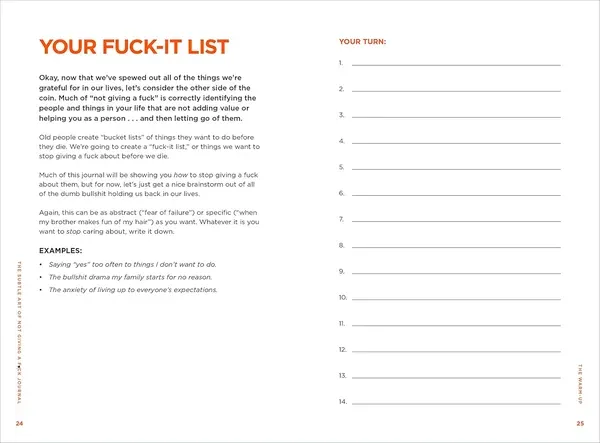
The Subtle Art of Not Giving a Fck Journal is not a standalone memoir, a new argument, or a sequel to Mark Manson's books. It is an interactive companion workbook, published by Harper Paperbacks in May 2022, designed to be used alongside — or after — Manson's internationally bestselling The Subtle Art of Not Giving a Fck. The journal is structured into five sections that mirror the thematic arc of that source book, and it draws additional material from Manson's follow-up New York Times bestseller, Everything Is F*cked. Throughout, Manson supplies guided prompts, writing exercises, observations, and what the publisher describes as "sharp insights in his inimitable voice," all oriented toward the deepest questions around emotions, values, and purpose. Color images appear throughout the interior. The result is a purposefully interactive format — not a passive read, but a structured space for self-examination.
isn't a 'once a day' or 'once a week' thing. You can use it any time. Or not. Leave it and come back. Or not.

The Source Material and Manson's Standing

To understand what gives this journal its foundation, it helps to know where it comes from. Mark Manson is a three-time New York Times bestselling author whose books have sold over 20 million copies in total, been translated into more than 65 languages, and reached number one in more than a dozen countries. The Subtle Art of Not Giving a F*ck — the book this journal is built around — became a cultural phenomenon precisely because it positioned self-improvement not as the relentless pursuit of positivity, but as a reckoning with problems, values, and the acceptance of occasional unhappiness. That counterintuitive premise — blunt, irreverent, and philosophically grounded — gave Manson a distinct and loyal readership, and it is that same voice the journal is designed to extend into personal practice.
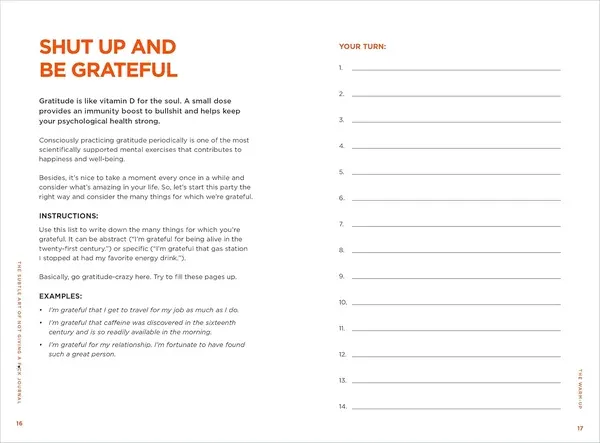
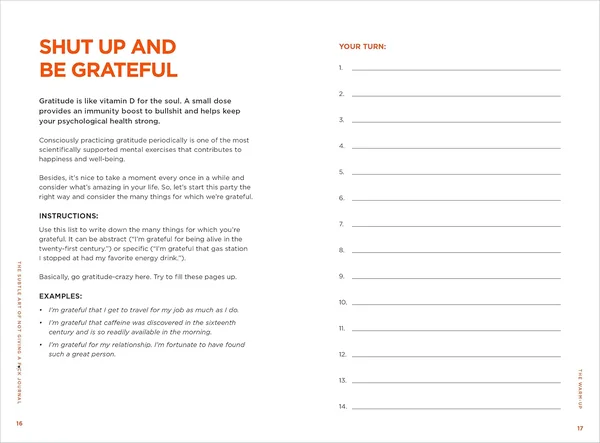
Interior activity page with gratitude prompts and numbered lines for personal reflection exercises.

Structure, Design Intent, and Flexibility

One of the journal's defining structural choices is its deliberate rejection of a rigid daily or weekly schedule. As Manson's own promotional copy puts it, this journal "isn't a 'once a day' or 'once a week' thing. You can use it any time. Or not. Leave it and come back. Or not." That design philosophy aligns with the source book's core argument against performative self-improvement — the journal is built to be used on the reader's own terms, without the guilt-inducing streak mechanics common to many habit-based journals. The five sections provide enough scaffolding to give the prompts direction, while the open-ended format allows readers to engage at whatever depth and pace suits them. The hundreds of prompts and writing exercises are written with the explicit goal of helping readers apply Manson's lessons to their own lives, with space provided for extended reflection on key moments — both difficult and absurd — as opportunities for self-understanding.

Genuine Strengths and Who Benefits Most

The journal's primary strength is its specificity of purpose: it exists to bridge the gap between reading Manson's philosophy and actually interrogating one's own values, emotions, and priorities through it. For readers who found The Subtle Art of Not Giving a F*ck resonant but abstract in its personal application, the journal offers a concrete, structured pathway. Some readers report working through it alongside a partner, finding the shared prompts a useful framework for conversation. The retention of Manson's distinctive voice — direct, irreverent, and resistant to self-help clichés — means the journal does not soften or sanitize the source material's tone into generic wellness-speak. It is, by design, a companion for people who responded to Manson's anti-platitude approach and want more of it in an active, writable format.

Limitations and Realistic Expectations

The journal's value is inseparable from a reader's prior engagement with Manson's worldview. Readers unfamiliar with The Subtle Art of Not Giving a Fck or Everything Is Fcked will lack the context that the five thematic sections assume, and the prompts will carry less weight without that foundation. Additionally, the journal format itself — structured around writing exercises rather than new argument or narrative — means it offers little for those seeking fresh intellectual content from Manson; its purpose is application, not expansion. The deliberate looseness of the "use it anytime" format, while philosophically consistent, also means the journal provides minimal built-in accountability for readers who thrive on structured progression. It is a tool, and its usefulness is proportional to the effort a reader brings to it.

Sources & Further Reading

The key facts and claims in this review are grounded in the retrieved, verified sources listed below.

  1. Cited in this review
  2. 1
  3. 2
  4. 3
  5. Further reading
  6. 4
    Mark Manson — author profileHigh-authority source

    Mark Manson, Wikipedia

  7. 5
  8. 6
  9. 7
  10. 8
  11. 9
  12. 10