BOOKS
Published

Read Time

3 min read

Curated & edited by

LuvemBooks Editorial

How we create our reviews →
Share This Review

The Let Them Theory by Mel Robbins Review: A Viral Mantra Expanded Into Self-Help

The Let Them Theory, co-authored by Mel Robbins and Sawyer Robbins, builds a full self-help framework around two deceptively simple words — "let them" — arguing that releasing the compulsion to control other people's thoughts, feelings, and choices is the foundation for reclaiming personal power, improving relationships, and building genuine confidence.

LuvemBooks Verdict

Best for

Readers who recognise themselves in the exhausting habit of over-investing in other people's opinions and choices, and who want a single, memorable two-part framework — "let them / let me" — to interrupt that pattern across relationships, career, and daily life.

Worth it if

Worth engaging with if you respond well to anecdote-driven, direct self-help in the tradition of Robbins's five-second rule and want a concise, actionable mindset shift rather than a heavily cited behavioral-science text.

Skip if

Skip it if you prefer rigorously sourced psychological research over motivational storytelling, or if the public controversy around the phrase's origins and reported trademark pursuit is something you'd find difficult to set aside while reading.

What readers & critics say

Kirkus Reviews gave the book a broadly positive notice, calling it "a sensible self-help guide" and "a truly helpful treatise on seeing others as they are, and letting that be." Wayward Reviews echoed that view, describing it as "a refreshingly pragmatic take on emotional boundaries, blending common sense with actionable strategies that resonate beyond surface-level advice," while the lone sharply negative voice at Cannonball Read argued the core concept is "something many people could find helpful" but that the remaining pages fail to justify the book's length.

A truly helpful treatise on seeing others as they are, and letting that be — a sensible self-help guide.

Kirkus Reviews
Sources: Kirkus Reviews, Wayward Reviews, Cannonball Read
In This Review
  • What Works & What Doesn't
  • What the Book Is and Where It Comes From
  • Significance and Place in Robbins's Body of Work
  • What the Framework Actually Offers
  • A Real and Documented Tension: Origins and Credit
  • Who This Book Is — and Isn't — For

What Works & What Doesn't

What Works
  • Built around a memorable, two-part framework ('let them' + 'let me') that addresses both acceptance and personal accountability
  • Mel Robbins draws on personal storytelling — including the book's prom-night origin — to make abstract mindset shifts feel concrete and relatable
  • Covers a wide range of applications, from career and creativity to relationships and habit-building, giving the framework broad practical scope
  • Endorsed by Gabor Maté, a New York Times bestselling author, who called it 'among the most straightforward and deepest of the many wisdom books published in recent years'
  • Includes substantive bonus material: a resilience guide developed with Harvard's Dr. Stuart Ablon and a leadership chapter co-authored with business coach David Gerbitz
What Doesn't
  • The book's origins are contested — public discussion about the 'let them' phrase predating Robbins's framework, and reports of a trademark pursuit, have created a credibility undercurrent that some readers find difficult to set aside
  • Readers who prefer rigorously cited behavioral science over anecdote-and-framework self-help may find the approach more motivational in tone than empirically grounded
A self-help book that began as a prom-night epiphany, The Let Them Theory asks a single, pointed question: what could you accomplish if you stopped spending energy trying to manage everyone around you?

What the Book Is and Where It Comes From

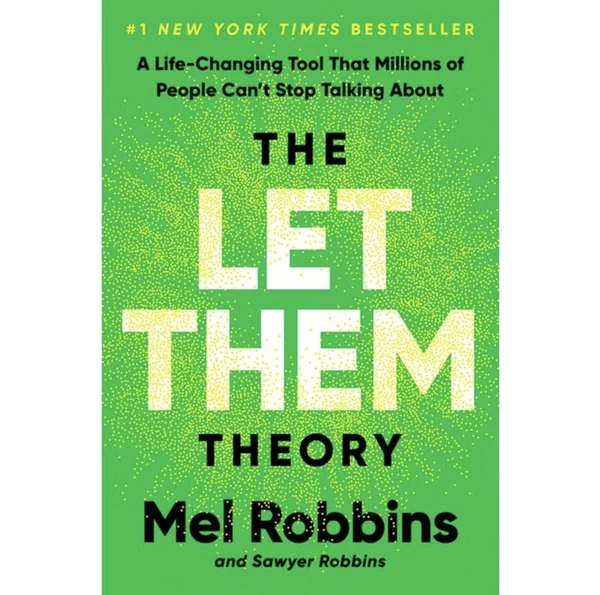
Theory Let Them - Mel Robbins by Mel Robbins front cover
Mel Robbins traces the theory's origin to the night of her son Oakley's junior prom. Overwhelmed by the impending reality that her youngest child was nearly grown, she began micromanaging every detail of the evening — until her daughter Kendall cut through the spiral: "Mom, if Oakley and his friends want to go to a taco bar for pre-prom, let them." That phrase, Robbins recounts in the book, struck her as an instant release valve. She began repeating it whenever she felt stress mounting around other people's decisions and behavior. The concept grew into the book's organizing philosophy: stop wasting energy on what you cannot control and redirect that energy toward yourself. Co-authored with Sawyer Robbins — a detail reflected in updated cover editions — the book extends the theory across career ambition, relationships, habits, creative risk-taking, and personal reinvention.

Significance and Place in Robbins's Body of Work

Robbins is no newcomer to packaging psychological insight as a practitioner's shortcut. Her earlier "five-second rule" — the countdown from five that interrupts hesitation and prompts action — was introduced in a TEDx talk that has accumulated more than 33 million views and anchored her first bestseller. The Let Them Theory is the next chapter in that lineage: a single, memorable mechanism meant to rewire an entrenched habit, this time the habit of controlling others. The book is a New York Times bestseller, and the publisher positions Robbins as one of the world's leading voices on motivation, confidence, and mindset. Physician and author Gabor Maté, himself a New York Times bestselling author, called it "among the most straightforward and deepest of the many wisdom books published in recent years. A revolutionary volume." The book also ships with bonus material, including a 13-page companion resource on building resilience in children, created with Harvard's Dr. Stuart Ablon, Director of Think:Kids at Massachusetts General Hospital, and an additional chapter on leadership co-authored with business coach David Gerbitz.

What the Framework Actually Offers

The core argument rests on a two-part structure. "Let them" is the first move — a conscious decision to stop resisting what other people think, feel, or do. But Robbins is explicit that the theory does not end there. The second, equally essential step is "let me": the pivot toward personal responsibility. As the book puts it, "Let Me is where your real power lies. It's in Let Me that you take responsibility for your next move, for creating the life, relationships, and connection you want." Without that second step, the framework risks collapsing into passivity; with it, Robbins argues, it becomes a genuine engine for self-directed change. The book applies this two-part lens to a wide range of life situations — stalled careers, fraying relationships, creative paralysis, and the ordinary daily friction of wanting others to behave differently.

A Real and Documented Tension: Origins and Credit

No honest account of this book can sidestep the controversy around its origins. Some readers and commentators have noted that the "let them" phrase bears resemblance to an earlier poem by another writer, and the question of credit has generated public discussion. Some reviewers have concluded that while a pre-existing poem may have served as inspiration, the theoretical architecture Robbins builds around the phrase is her own distinct work. Others feel the murkiness around origins diminishes the book's authority. Reports have also surfaced that Robbins pursued trademark protection for "the Let Them Theory," a move that further complicated the conversation. Readers who arrive already aware of this background may find it a persistent undercurrent; those encountering the book cold will encounter it sooner or later in the broader cultural conversation around the title.

Who This Book Is — and Isn't — For

The Let Them Theory is designed for readers who recognize themselves in the exhausting loop of over-investment in others' opinions and choices. It is structured to be accessible and actionable, consistent with Robbins's established style of direct, anecdote-driven guidance. Readers who appreciate the warmth of personal storytelling alongside concrete mental frameworks — particularly those who found traction with the five-second rule — will find familiar terrain here. Readers who prefer deeply researched, citation-heavy behavioral science, or who are put off by motivational-speaker cadence, may find the book's approach more prescriptive than persuasive. The originality controversy is also a genuine factor some readers weigh before or after purchase. For those who engage with it on its own terms, however, the underlying idea — that releasing the need to control others and turning attention back to oneself is both liberating and empowering — has clearly resonated widely.

Sources & Further Reading

The key facts and claims in this review are grounded in the retrieved, verified sources listed below.

  1. Cited in this review
  2. 1
  3. Further reading
  4. 2
    Mel Robbins — author profileHigh-authority source

    Mel Robbins, Wikipedia

  5. 3
  6. 4
  7. 5
  8. 6
  9. 7
  10. 8
  11. 9
  12. 10
  13. 11
  14. 12
  15. 13
Related Reviews

Reviews of books we picked for readers who enjoyed Theory Let Them - Mel Robbins.