BOOKS
Published

Read Time

3 min read

Curated & edited by

LuvemBooks Editorial

How we create our reviews →
Share This Review

The 7 Habits of Highly Effective People by Stephen R. Covey Review: A Landmark Self-Help Classic Still Resonating

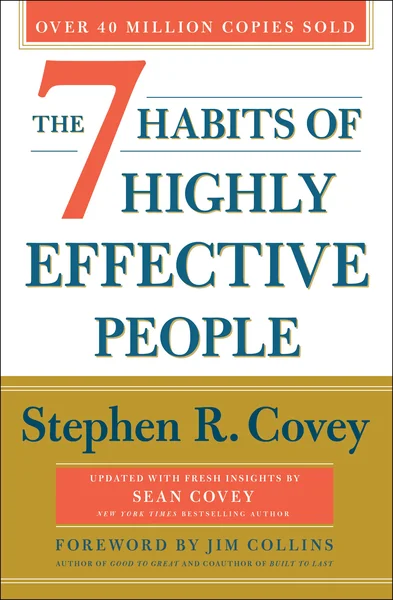
First published in 1989, Stephen R. Covey's The 7 Habits of Highly Effective People remains one of the most widely read business and self-help books ever written — named the #1 Most Influential Business Book of the Twentieth Century and a New York Times bestseller with over 40 million copies sold. Structured around seven sequential habits designed to move individuals from dependence to independence to interdependence, the book argues that lasting effectiveness stems from character ethic rather than personality ethic, and that principled living — not surface-level technique — is the foundation of genuine personal and professional growth.

LuvemBooks Verdict

Best for

Professionals, managers, or anyone seeking a principled, structured framework for lasting personal and interpersonal effectiveness — particularly those willing to engage with dense philosophical ideas rather than quick tactical fixes.

Worth it if

You want a foundational, principle-driven approach to self-improvement that builds from personal independence outward to collaborative leadership, and you're prepared to do the reflective work the framework genuinely demands.

Skip if

You're looking for fast, actionable tips or a deep specialist treatment of a single topic such as conflict resolution or leadership, as the book's philosophical density and broad scope won't satisfy either need.

What readers & critics say

Shortform notes that critics accuse Covey of repackaging common knowledge and falling short on making his advice specific enough to be actionable, while pushbusinesstraining.com describes the habits as "clear and easy to implement" and a reliable reference for leadership trainers. Vocal.media positions the book as one of the most influential self-help and personal development titles ever published, and audible.com records that Time magazine named it one of "The 25 Most Influential Business Management Books" in 2011.

Sources: Shortform, Push Business Training, Vocal.media, Audible
4.8from 16,835 Amazon ratings— reader ratings, not a LuvemBooks score

Look inside the book

Preview the actual pages, via Google Books
In This Review
  • What Works & What Doesn't
  • What the Book Is and What It Argues
  • The Architecture of the Seven Habits
  • Significance and Reception
  • Genuine Strengths
  • Limitations and Who May Struggle With It

What Works & What Doesn't

What Works
  • Named the #1 Most Influential Business Book of the Twentieth Century, with over 40 million copies sold — a reception record that is genuinely exceptional in its genre
  • The sequential structure — moving from personal independence through interdependence to renewal — gives the framework logical coherence rather than a list of disconnected tips
  • Covey's emphasis on character ethic over personality ethic grounds the book in values and principles, distinguishing it from surface-level technique-focused self-help
  • Practical tools such as the personal mission statement and the importance-versus-urgency time matrix are transferable across professional and personal contexts
  • Jim Collins's foreword to the anniversary edition affirms the book's continued relevance in contemporary business and leadership thinking
What Doesn't
  • The philosophical depth and conceptual density make this a poor match for readers seeking quick, tactical takeaways
  • The cultural context — rooted in a particular American corporate and family framework — can require translation for readers in different professional or personal environments
A book that has sold over 40 million copies and been named the #1 Most Influential Business Book of the Twentieth Century earns scrutiny proportionate to its influence — and on most counts, it delivers.

What the Book Is and What It Argues

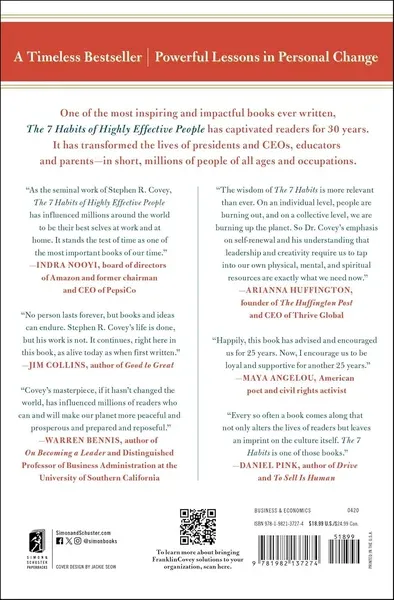
Back cover with title, synopsis, endorsement quotes from business leaders and authors, and barcode.
The 7 Habits of Highly Effective People is a business and self-help book, first published in 1989, in which Stephen R. Covey presents a framework for personal change built around seven habits he identifies as conducive to growth. The book's central argument is that effectiveness depends on character ethic — a commitment to principles such as fairness, integrity, honesty, and human dignity — rather than the personality ethic, which Covey sees as a superficial focus on image and technique. The publisher, Simon & Schuster, describes the book as offering "a step-by-step pathway for living with fairness, integrity, honesty, and human dignity — principles that give us the security to adapt to change and the wisdom and power" to act on it. This is not a book of quick tips; it is a structured argument about how to change who one is, not merely what one does.

The Architecture of the Seven Habits

Covey organizes the seven habits into a deliberate progression. According to Wikipedia, the first three habits — which include being proactive, beginning with the end in mind, and putting first things first — are designed to cultivate personal independence. The following three habits address interdependence: thinking win/win, seeking first to understand then to be understood, and synergizing. The seventh habit, "Sharpen the Saw," is positioned as the maintenance principle that sustains all the others. Within this structure, Covey draws on the work of psychiatrist Viktor Frankl to articulate the idea that between any stimulus and a person's response lies the freedom to choose — a concept that underpins his entire model of proactivity. The "upward spiral" model, explained later in the book, frames growth as a continuous process of conscience-driven improvement rather than a destination.

Significance and Reception

Time magazine listed The 7 Habits in August 2011 as one of "The 25 Most Influential Business Management Books," and Simon & Schuster's own materials record it as the #1 Most Influential Business Book of the Twentieth Century. By the time of Covey's death in 2012, Wikipedia notes the book had sold more than 20 million copies; the publisher's current edition records over 40 million copies sold across its lifespan. Jim Collins, who contributes a foreword to the anniversary edition published by Simon & Schuster, writes: "Stephen R. Covey's life is done, but his work is not. It continues, right here in this book as alive today as when first written." That the book warranted a foreword from Collins — whose own work on organizational excellence is widely respected — signals its continued standing in the business and leadership canon. Sean Covey, Stephen's son, contributes to this edition as well.

Genuine Strengths

The book's most durable strength is its insistence on principle over technique. Where much of the self-help genre offers behavioral shortcuts, Covey's framework demands that readers examine their values before their actions. His use of concrete self-interrogation — "Are you, right now, who you want to be? How do you want to be remembered?" — gives the material an introspective weight that distinguishes it from purely tactical guides. The habit of "beginning with the end in mind" is built around constructing a personal mission statement, which gives readers a transferable tool rather than an abstract idea. Similarly, Covey's time-management matrix — which distinguishes between what is important and what is merely urgent — provides a structural model that readers and organizations have applied across industries for decades. The sequential logic of the habits, moving from personal independence outward to collaborative interdependence, gives the book a coherent internal architecture rather than a loose collection of advice.

Limitations and Who May Struggle With It

The same depth that gives the book its staying power also makes it demanding. Covey's framework is philosophical and principle-heavy, and readers seeking fast, tactical advice may find the pace and the conceptual density a poor fit. The book is structured for sustained engagement with its ideas, not quick application. Some readers note that the language and examples, rooted in a particular mid-to-late twentieth-century American corporate and family context, can feel culturally specific in ways that require translation for different professional or personal environments. The book is also comprehensive in scope — covering personal mission, time management, interpersonal communication, and organizational collaboration — which means no single habit receives the narrow, deep treatment that a dedicated specialist title might offer. Readers who want an in-depth treatment of, say, conflict resolution or leadership alone may find the breadth a constraint rather than a virtue.

Sources & Further Reading

The key facts and claims in this review are grounded in the retrieved, verified sources listed below.

  1. Cited in this review
  2. 1
  3. Further reading
  4. 2

    Stephen R. Covey, Wikipedia

  5. 3
  6. 4
  7. 5
  8. 6
  9. 7
  10. 8
  11. 9
  12. 10
  13. 11
Related Reviews

Reviews of books we picked for readers who enjoyed The 7 Habits of Highly Effective People.