BOOKS
Published

Read Time

3 min read

Curated & edited by

LuvemBooks Editorial

How we create our reviews →
Share This Review

The Four Agreements by Don Miguel Ruiz Review: A Decades-Long Self-Help Phenomenon

Don Miguel Ruiz's The Four Agreements: A Practical Guide to Personal Freedom is a compact self-help book that distills Toltec-inspired spiritual philosophy into four behavioral principles, and its extraordinary staying power — more than a decade on The New York Times bestseller list and approximately 15 million copies sold in the United States alone — makes it one of the most widely read personal-development titles of the modern era.

LuvemBooks Verdict

Best for

Readers drawn to spiritually grounded self-help who want a concise, memorable framework for examining the unconscious beliefs and social "agreements" that shape their inner lives — particularly those new to personal-development literature or open to Toltec-inspired philosophy.

Worth it if

The four agreements — be impeccable with your word, don't take anything personally, don't make assumptions, and always do your best — strike you as genuinely useful daily touchstones rather than too abstract to act on.

Skip if

Skip it if you want rigorous philosophical argumentation, empirical evidence, or scholarly depth on Mesoamerican traditions — the book's slim, aphoristic format and Ruiz's personal interpretive lens on Toltec wisdom are not designed to satisfy those demands.

What readers & critics say

Wikipedia records that the book spent over a decade on The New York Times bestseller list and two years on the Publishers Weekly list, with its profile surging after Oprah Winfrey's endorsement in 2001. The Sober Curator describes it as "a short but powerful book" that distils ancient Toltec wisdom into four accessible, daily-applicable agreements, praising its ability to make complex ideas easy to understand without becoming a "dry, mystical textbook."

A short but powerful book that offers a simple yet profound path to a happier and more peaceful life.

The Sober Curator
Sources: Wikipedia, The Sober Curator
4.7from 120,995 Amazon ratings— reader ratings, not a LuvemBooks score

Look inside the book

Preview the actual pages, via Google Books
In This Review
  • What Works & What Doesn't
  • What the Book Actually Is and Argues
  • Cultural Reach and Significance
  • What the Book Does Well
  • Genuine Limitations and Who It May Frustrate
  • Who This Book Is Genuinely For

What Works & What Doesn't

What Works
  • Spent over a decade on The New York Times bestseller list and two years on the Publishers Weekly list — among the most enduring self-help titles of its era
  • A tightly organized four-chapter structure built around four plainly worded, memorable principles designed for practical internalization
  • Each agreement is supported by linguistic and historical context drawn from Toltec tradition, giving the framework more grounding than purely anecdotal self-help
  • Available in 53 languages and in multiple formats including audiobook, illustrated edition, card deck, and online course — exceptional accessibility across platforms
  • Endorsed by Oprah Winfrey and featured on Super Soul Sunday, reflecting unusually broad mainstream cultural recognition
What Doesn't
  • The book's brevity and aphoristic style mean readers seeking rigorous philosophical argument or empirical support will find the treatment thin
  • The Toltec framework is presented through Ruiz's personal interpretive lens rather than scholarly ethnography, limiting depth for readers with academic interest in Mesoamerican traditions
A self-help title that has sold approximately 15 million copies in the United States and spent over a decade on The New York Times bestseller list is not a trend — it is a fixture of the genre, and The Four Agreements has earned that status through a remarkably focused premise.

What the Book Actually Is and Argues

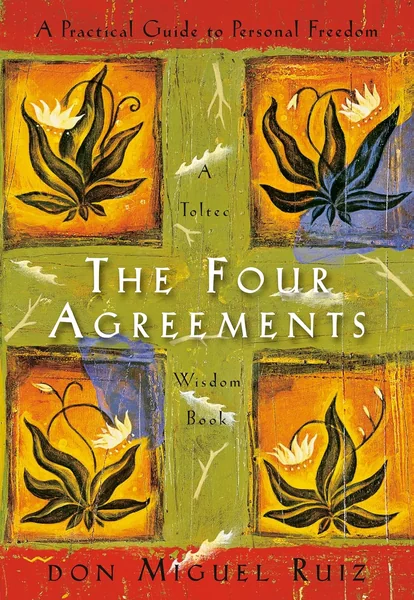
The Four Agreements: A Practical Guide to Personal Freedom by Don Miguel Ruiz front cover
Written by Don Miguel Ruiz with Janet Mills and published in 1997 by Amber-Allen Publishing in San Rafael, California, The Four Agreements: A Practical Guide to Personal Freedom is a self-help book that outlines a code of conduct the author describes as rooted in Toltec teachings. The book's central argument is that a person's life is shaped by agreements — commitments made with oneself, with others, with God, and with society — and that those agreements determine self-image, perceived possibility, behavior, and sense of worth. Ruiz contends that by consciously replacing limiting agreements with four specific ones, a reader can move toward a happier and more successful life. The four agreements are: "Be impeccable with your word," "Do not take anything personally," "Do not make assumptions," and "Always do your best." The book's chapter structure follows this framework directly, with an opening section on what Ruiz calls "the domestication and the dream of the planet," dedicated chapters for each agreement, a section on "the Toltec path to freedom: breaking old agreements," and relevant linguistic and historical context woven throughout.

Cultural Reach and Significance

Few self-help books achieve the kind of sustained cultural visibility that The Four Agreements has. According to Wikipedia, the book spent two years on the Publishers Weekly bestseller list and over a decade on The New York Times bestseller list. Its profile surged after Oprah Winfrey endorsed it on The Oprah Winfrey Show in 2001, and the book received renewed attention when it was featured again on Super Soul Sunday in 2013. In 2001, Ruiz was interviewed by Ellen DeGeneres in O, The Oprah Magazine. The book is currently available in 53 languages and in numerous formats: hardback, paperback, eBook, audiobook, a color-illustrated edition (published by Amber-Allen in 2010 to mark the book's 15th anniversary), a card deck, and an online course. This breadth of adaptation speaks to a readership that has sought the book's ideas across multiple platforms over multiple decades.

What the Book Does Well

The book's primary strength is its structural economy. By organizing its entire argument around four memorable, plainly worded principles, The Four Agreements offers readers a framework that is designed to be internalized and returned to rather than studied once and set aside. Each agreement is given its own dedicated chapter, supported by the linguistic and historical context Ruiz draws from Toltec tradition — a grounding that distinguishes the book from purely anecdote-driven self-help. Barnes & Noble's description identifies Ruiz as a shaman and healer and notes the book's intent to instruct readers in "right conduct," framing it as a work of practical wisdom rather than abstract theory. The agreement on not taking things personally, for instance, is presented as a corrective to what Ruiz calls the "dream of the planet" — the socialized tendency to absorb others' words and actions as reflections of one's own worth — a concept that some readers find both diagnostically sharp and immediately applicable.

Genuine Limitations and Who It May Frustrate

The very concision that makes the book accessible is also its most debated characteristic. At its core, The Four Agreements advances four principles across a slim volume, and readers seeking rigorous philosophical argumentation, empirical support, or nuanced engagement with counterarguments are unlikely to find it here. The book's framing of Toltec wisdom is presented through Ruiz's own interpretive lens rather than as scholarly ethnography, which means readers with an academic interest in Mesoamerican traditions will need to look elsewhere for historical depth. Additionally, the book's aspirational, aphoristic register — while well-suited to its intended audience — can read as insufficiently specific for readers who want structured, step-by-step behavioral guidance beyond the four agreements themselves. Some readers may also note that the agreements, while memorable, are broad enough that applying them to complex real-world situations requires interpretive work the book does not always supply.

Who This Book Is Genuinely For

The Four Agreements is designed for readers drawn to spiritually inflected self-help — those interested in examining the unconscious rules and expectations that govern their inner lives, and who are open to a framework grounded in ancient Toltec philosophy as interpreted by Ruiz. Its concise format and plain-language presentation make it a natural starting point for readers new to personal-development literature, while its longevity and cultural footprint have made it a touchstone that more experienced readers in the genre frequently revisit. Given the breadth of its global readership and the range of formats in which it is available, the book has clearly resonated across widely varying cultural contexts — a reach that, whatever one makes of its ideas, is itself a meaningful part of the record.

Sources & Further Reading

The key facts and claims in this review are grounded in the retrieved, verified sources listed below.

  1. Cited in this review
  2. 1
  3. 2
  4. Further reading
  5. 3

    Don Miguel Ruiz, Wikipedia

  6. 4
  7. 5

    s3.amazonaws.com

  8. 6
  9. 7
  10. 8
  11. 9