BOOKS
Published

Read Time

3 min read

Curated & edited by

LuvemBooks Editorial

How we create our reviews →
Share This Review

Your Money or Your Life by Joe Dominguez & Vicki Robin Review: A Foundational Personal Finance Classic

Your Money or Your Life by Joe Dominguez and Vicki Robin is a landmark personal finance guide built around a nine-step program designed to help readers transform their relationship with money and pursue financial independence — a book widely regarded as the philosophical and practical foundation of the FIRE (Financial Independence, Retire Early) movement.

LuvemBooks Verdict

Best for

Readers who feel their spending habits and deeper values are out of sync — particularly those drawn to the philosophical roots of the FIRE movement rather than its tactical how-to variations — and who want a complete, sequenced program that addresses the "why" of money as much as the "how."

Worth it if

Worth engaging with if you're willing to do inner accounting alongside the outer kind — examining what your hours on earth are actually being traded for — and can supplement the older investment-specific material with more current sources.

Skip if

Skip it if you want a numbers-first, strategy-forward personal finance guide with up-to-date investment tactics and no interest in the values-and-meaning layer that runs through every step of the program.

What readers & critics say

The book is widely described as one of the most well-regarded titles in personal finance and the philosophical and practical foundation of the FIRE movement, with savvynickel.com noting its nine-step program — built around converting spending into "life hours" — creates "a radically different emotional relationship with spending." Zenhabits.net goes further, calling it "perhaps the best book on personal finance ever written," while charellegriffith.com highlights that the revised edition directly addresses earlier criticisms about outdatedness by revisiting the original investment strategy for contemporary readers.

Grant Sabatier credits the book for helping change the course of his life — his high praise finally pushed me to read it myself.

White Coat Investor
Sources: Savvy Nickel, Zen Habits, Charelle Griffith, White Coat Investor, The Physician Philosopher
4.3from 180 Amazon ratings— reader ratings, not a LuvemBooks score
In This Review
  • What Works & What Doesn't
  • What the Book Is and What It Actually Argues
  • Historical Significance and Its Place in the Genre
  • What the Nine-Step Structure Does Well
  • Genuine Limitations and Who May Struggle With It
  • Who This Book Is For Today

What Works & What Doesn't

What Works
  • Introduces the foundational 'life energy' framework that reframes spending decisions in genuinely philosophical terms, giving the nine-step program intellectual depth rare in personal finance guides
  • The nine steps are concrete, sequenced, and cumulative — from calculating lifetime earnings to visualizing the crossover point — providing a full program rather than a collection of tips
  • Widely recognized as the philosophical and practical foundation of the FIRE movement, with sustained praise from major outlets including the Los Angeles Times and Oprah
  • Co-author Joe Dominguez's own story — retiring at 31 on a Wall Street analyst's savings — gives the program real-world grounding, not theoretical prescription
  • Designed to work on readers' values and self-awareness alongside their spreadsheets, making it distinct from transactional budgeting books
What Doesn't
  • The investment-specific guidance in Step Nine reflects the era in which the program was originally developed, and readers seeking current, tactically detailed investment strategy will need supplementary sources
  • The book's philosophical and values-driven tone — while a strength for many — makes it a slower, more introspective read than number-focused personal finance titles, which may frustrate readers wanting purely tactical advice
A book that has shaped how hundreds of thousands of people think about work, spending, and freedom, Your Money or Your Life remains one of the most well-regarded titles in personal finance — not because it teaches tricks, but because it asks a harder question than most books dare.

What the Book Is and What It Actually Argues

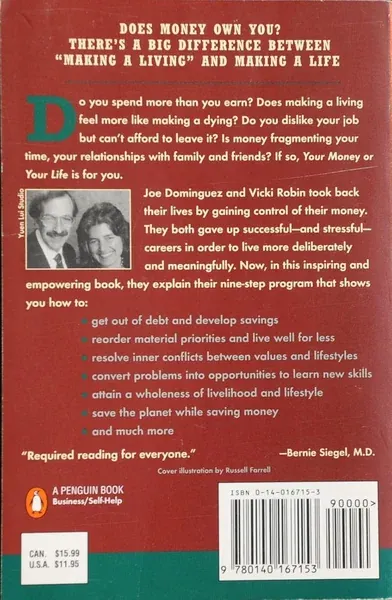
Back cover with synopsis, author photos, endorsement quote, and pricing information.
At its core, Your Money or Your Life — subtitled 9 Steps to Transforming Your Relationship with Money and Achieving Financial Independence — challenges readers to reconsider money not as a goal in itself but as "life energy": something traded in exchange for hours of existence. Robin and Dominguez frame the central question starkly — your money or your life? — but, crucially, the book does not force a binary choice. As one passage from the text reads, "There is a way to go about the task of making a living so that you end up more alive." The nine steps walk readers from making peace with their financial past through tracking monthly spending, calculating the actual hourly cost of their employment (including commute time and job-related expenses), and ultimately identifying a "crossover point" at which investment income exceeds monthly expenses — the threshold of financial independence. The distinction the authors draw between tracking and budgeting is central: tracking builds honest awareness of where life energy actually goes, rather than mapping out intentions in advance.

Historical Significance and Its Place in the Genre

Joe Dominguez, a Wall Street financial analyst, retired at age 31 in 1969 on investment income generated from roughly $70,000 in savings. He spent the years that followed teaching his approach through workshops and cassette tapes before he and Vicki Robin — writer, activist, and co-founder of the New Road Map Foundation — codified it into the nine-step program that became this book, first published in 1992. Dominguez died of cancer in 1997 at age 58, but his framework endured. The book is now broadly recognized as the philosophical foundation of the FIRE movement, having introduced concepts — particularly "life energy" as a lens for evaluating spending — that entire communities of early-retirement advocates have built upon. Oprah called it a book that "can really change your life," and the critics described it as "the seminal guide to the new morality of personal money management." Money Magazine later noted that Robin had become "the millennial money whisperer," reflecting how durably the book's ideas have traveled across generations.

What the Nine-Step Structure Does Well

The program's architecture is one of its genuine strengths. The nine steps are concrete and sequenced: readers begin by calculating their total lifetime earnings and current net worth (Making Peace with the Past), move into real-time tracking of every dollar earned and spent (Being in the Present), apply three clarifying questions to each category of spending, and then work toward visualizing their income and expenses on a single wall chart that makes the crossover point literally visible. Four of the nine steps explicitly invoke the concept of "life energy," which is not repetition for its own sake — it reinforces the book's core reframe: that spending decisions are decisions about how much of one's finite time on earth a purchase is worth. This approach converts what might otherwise be dry ledger-keeping into an exercise with genuine philosophical weight, which is a significant part of why the book has remained relevant far beyond the self-help shelf.

Genuine Limitations and Who May Struggle With It

The book's investment guidance — particularly the material on Step Nine, investing for financial independence — reflects the era in which the program was originally developed. Dominguez's own path to financial independence was built on a 1960s savings and investment context, and some of the specific financial mechanics in the text have been revisited in later editions precisely because markets and instruments have changed substantially. Readers seeking up-to-date, tactically specific investment advice will find the nine-step philosophy more durable than some of the financial prescriptions. The book's tone is also deliberately philosophical and values-driven; readers who prefer a strictly numbers-based, strategy-forward approach to personal finance may find the emphasis on inner alignment and life purpose slower going than more transactional guides in the genre.

Who This Book Is For Today

Your Money or Your Life is designed for readers who sense that their financial life and their actual values are not in alignment — people who feel, as the book frames it, that work consumes the majority of their time while money gets spent chasing weekend and holiday relief from that same work. It is particularly well suited to anyone exploring the FIRE movement from its roots rather than its current tactical variations, and to readers for whom a purely mathematical budget feels unsatisfying without a philosophical why beneath it. Grant Sabatier, author of Financial Freedom, has credited the book with helping change the course of his life, and that kind of reader testimony — alongside the book's multi-decade staying power — points clearly to who finds it most transformative: those willing to do the inner accounting alongside the outer kind.

Sources & Further Reading

The key facts and claims in this review are grounded in the retrieved, verified sources listed below.

  1. Cited in this review
  2. 1
  3. Further reading
  4. 2
  5. 3
  6. 4
  7. 5
  8. 6
  9. 7