


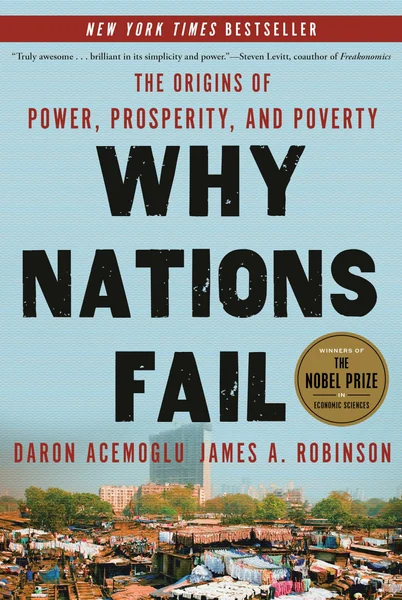
Daron Acemoglu, the Nobel Prize-winning economist behind Why Nations Fail: The Origins of Power, Prosperity, and Poverty, is pushing back hard against Wall Street's artificial intelligence euphoria — and he's doing it with numbers. In a major interview published June 21, 2026, Fortune sat down with Acemoglu to discuss AI productivity claims, the state of capitalism, and the governance challenges facing democratic institutions. His verdict on the prevailing discourse was unsparing: "I find all of this discussion of capitalism so brainless," he told the outlet, redirecting attention instead to what he called an "enormous increase" in corporate power and monopoly.
Acemoglu, who shared the Nobel Memorial Prize in Economic Sciences in 2024 alongside co-author James A. Robinson for the body of scholarship this book represents, estimates only 0.55% total factor productivity gains from AI over the next decade — a figure that stands in stark contrast to the transformative projections routinely issued by technology investors and major financial institutions. The interview makes clear that Acemoglu's skepticism is not a retreat from the AI conversation but a systematic reframing of it: the real question, he argues, is not whether AI is impressive, but who it will serve.
Why Nations Fail's Institutional Lens Gets Applied to Silicon Valley
What makes the Fortune interview particularly notable for readers of Acemoglu and Robinson's work is the explicit application of the book's signature analytical framework to contemporary AI debates. Why Nations Fail, first published in 2012, constructs a sweeping institutional theory of prosperity built around the distinction between inclusive institutions — those that distribute power broadly and protect individual rights — and extractive institutions, which concentrate wealth and authority in the hands of a few. The book draws on historical evidence spanning the Roman Empire, the Mayan city-states, the Soviet Union, and the divergent trajectories of North and South Korea to argue that man-made political and economic institutions, not geography or culture, are the decisive factor in national prosperity.
In the Fortune interview, Acemoglu explicitly invokes this framework to argue that the United States needs serious AI governance centered on wages and worker dignity — not merely on innovation metrics or shareholder returns. The concern is structural: if AI development proceeds without institutional guardrails, it risks functioning as an extractive force, concentrating productivity gains among capital holders while leaving workers behind. This is the exact dynamic Why Nations Fail identifies as the historical precursor to long-run institutional decay.
Institutional Decline, Gen Z Risk, and What Comes Next
The interview arrives at a moment when Acemoglu's framework is receiving unusually direct application to current American politics. Separate reporting notes that a recent Acemoglu piece in the Financial Times envisioned a hypothetical scenario of U.S. institutional failure by 2050 — a thought experiment that, even framed as hypothetical, signals how seriously the economist takes the erosion of inclusive democratic norms in the current environment. The Fortune conversation also touches on what Acemoglu describes as a "Gen Z revolution risk," suggesting that younger generations increasingly distrust the institutional arrangements that the book argues are foundational to long-term prosperity.
For a scholarly work published more than a decade ago, the frequency with which Why Nations Fail is being cited in live policy debates — AI governance, democratic backsliding, monopoly power — reflects the durability of its central argument. The book's insistence that institutions are not merely background conditions but the active determinants of who gains and who loses in any economic transformation looks, in 2026, less like an academic claim and more like an ongoing diagnostic tool. Acemoglu is not merely commenting on AI; he is applying a framework built over fifteen years of original research to one of the most consequential technological transitions of this generation.
Readers encountering Acemoglu's arguments for the first time through the Fortune interview may also find value in Sun Tzu's The Art of War, another foundational text on how the distribution of power and strategy shapes outcomes across institutions — a useful companion for understanding why structural advantage compounds over time. Want the full verdict on Why Nations Fail: The Origins of Power, Prosperity, and Poverty before deciding whether to pick it up? Read our review for a detailed assessment of the book's strengths, scope, and where it sits in the broader canon of political economy.
Frequently Asked Questions
Is Why Nations Fail: The Origins of Power, Prosperity, and Poverty worth buying in 2026?
Given that its co-author Daron Acemoglu is actively applying its institutional framework to AI governance, democratic decline, and monopoly power debates in 2026, the book remains directly relevant to today's most contested policy questions. Its core argument — that inclusive versus extractive institutions determine long-run prosperity — has proven remarkably portable across historical and contemporary contexts. Readers interested in understanding the structural stakes of AI development or democratic backsliding will find it provides unusually durable analytical tools.
What is the main message of Why Nations Fail: The Origins of Power, Prosperity, and Poverty?
The book argues that man-made political and economic institutions — not geography, culture, or climate — are the decisive factor in whether nations prosper or remain poor. Acemoglu and Robinson distinguish between inclusive institutions, which distribute power broadly and protect individual rights, and extractive institutions, which concentrate wealth among a narrow elite. The argument is grounded in extensive historical evidence ranging from the Roman Empire to modern North and South Korea.
Who should read Why Nations Fail: The Origins of Power, Prosperity, and Poverty?
The book is written for a general educated audience and requires no prior background in economics or political science. It will appeal to readers interested in history, development economics, political theory, and current debates about democracy and capitalism. Given Acemoglu's recent public interventions on AI and institutional decline, it is also a useful primer for anyone trying to understand the structural arguments behind today's technology governance debates.
What did Daron Acemoglu say about AI in his 2026 Fortune interview?
In a [Fortune interview published June 21, 2026](https://fortune.com/2026/06/21/nobel-laureate-daron-acemoglu-ai-productivity-capitalism-democracy/), Acemoglu described prevailing AI discourse as "brainless" and estimated only 0.55% total factor productivity gains from AI over the next decade — far below Wall Street projections. He argued that the U.S. needs serious AI governance focused on wages and worker dignity, invoking the inclusive versus extractive institutions framework from Why Nations Fail to make the case.
How does Why Nations Fail: The Origins of Power, Prosperity, and Poverty relate to AI governance debates?
Acemoglu has explicitly drawn on the book's framework to argue that AI development without institutional guardrails risks functioning as an extractive force — concentrating productivity gains among capital holders while leaving workers behind. This mirrors the historical patterns the book identifies as precursors to long-run institutional decay. The framework provides a way to evaluate not just whether AI is productive, but for whom its benefits are distributed.
Why did Daron Acemoglu and James Robinson win the Nobel Prize?
Acemoglu and Robinson were awarded the Nobel Memorial Prize in Economic Sciences in 2024, partly for the body of scholarship that Why Nations Fail represents — specifically their work developing and empirically testing the theory that political and economic institutions are the primary drivers of national prosperity and poverty. Their research spans decades of original work drawing on historical and cross-country evidence.
Reader Discussion
No comments yet
Be the first to share your thoughts!