


9 min read
4.5
· 10,704 Amazon ratingsShare This Review
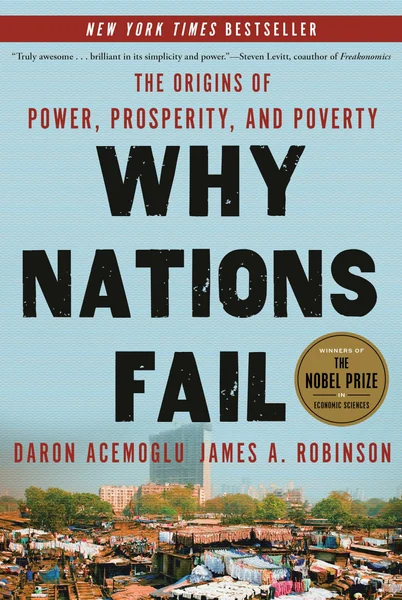
Why Nations Fail by Daron Acemoglu and James A. Robinson Review: A Nobel-Backed Masterwork on Institutional Power
Why Nations Fail: The Origins of Power, Prosperity, and Poverty, first published in 2012 by economists Daron Acemoglu and James A. Robinson, constructs a sweeping institutional theory of why some countries accumulate wealth while others remain trapped in poverty — drawing on fifteen years of original research and historical evidence spanning the Roman Empire, the Mayan city-states, the Soviet Union, North and South Korea, medieval Venice, and Africa. The book argues, against geographic, cultural, and climatic explanations, that man-made political and economic institutions are the decisive factor in national prosperity. A New York Times and Wall Street Journal bestseller, it was named one of the best books of the year by The Washington Post, Financial Times, The Economist, BusinessWeek, Bloomberg, and The Christian Science Monitor. In 2024, Acemoglu and Robinson were awarded the Nobel Memorial Prize in Economic Sciences, partly for the body of scholarship this book represents.
LuvemBooks Verdict
Best for
Readers with an interest in political economy, history, or development who want a sweeping, accessibly written argument — grounded in fifteen years of original research — for why institutions, not geography or culture, determine whether nations prosper or fail.
Worth it if
You want a rigorously argued, historically panoramic framework for understanding global inequality that directly confronts and dismantles rival theories rather than simply asserting its own — and are willing to invest in 500-plus pages of dense case-study to get there.
Skip if
You're an academic economist seeking a technical treatment or a reader wanting a concise theoretical overview — the book's sheer volume of historical accumulation and the standing circularity critique of the inclusive/extractive binary will likely frustrate you without supplementary reading of the authors' journal work.
What readers & critics say
The Guardian's review situates the book within the most urgent questions of global inequality, highlighting its use of vivid geographic contrasts — such as the twin border towns of Nogales — to show why institutions trump location. ResearchGate reviewers describe it as a "richly documented, well-researched, and readily comprehensible" work that "upsets the traditional wisdom regarding development" by placing institutions at the centre of the story and negating popular geographic, cultural, and ignorance-based explanations for world inequality.
“The same people can live in abject poverty in one country, yet be prosperous once they move to another — this question matters, because global inequality generates psychologies of guilt and resentment.”
— The GuardianAge & Reading Level
Recommended age
Adult
Reading level
Adult
who it suits
Skip if you're looking for a concise, technically rigorous theoretical overview rather than an extended historical narrative argument
In This Review
- What Works & What Doesn't
- What the Book Actually Argues
- Scope, Evidence, and Historical Reach
- Significance and Reception
- Genuine Strengths
- Limitations and Who May Find It Challenging
What Works & What Doesn't
What Works
- Builds its institutional theory of prosperity on fifteen years of original research and a genuinely global sweep of historical case studies — from the Roman Empire and Mayan city-states to Korea, the Soviet Union, and Africa
- Directly engages and systematically refutes rival explanations — geographic, cultural, and modernization theories — rather than ignoring them, making the argument more rigorous
- Written accessibly for a broad audience, translating complex political economy into concrete historical narrative without sacrificing analytical substance
- Named one of the best books of the year by multiple major outlets including The Washington Post, Financial Times, and The Economist, and a New York Times and Wall Street Journal bestseller
- Authored by two economists who were awarded the 2024 Nobel Memorial Prize in Economic Sciences for this body of comparative scholarship
What Doesn't
- The inclusive/extractive institutional binary has drawn academic criticism for potentially oversimplifying cases where geography or colonial history shaped the very institutions the framework treats as independent
- At more than 500 pages, the density of case-study accumulation is demanding — readers seeking a concise theoretical overview may find the scope taxing
- The companion blog maintained by the authors has been inactive since 2014, leaving readers without an updated official resource tied to the book
What the Book Actually Argues
Scope, Evidence, and Historical Reach
Significance and Reception
Genuine Strengths
Limitations and Who May Find It Challenging
Frequently Asked Questions
Sources & Further Reading
The key facts and claims in this review are grounded in the retrieved, verified sources listed below.
- Cited in this review
- 1
- 2
en.wikipedia.org
- Further reading
- 3
- 4
ia801506.us.archive.org
- 5
- 6
wer.worldeconomicsassociation.org
- 7
- 8
- 9
- 10
Related Reviews
Reviews of books we picked for readers who enjoyed Why Nations Fail.

Reader Comments
No comments yet
Be the first to share your thoughts!