
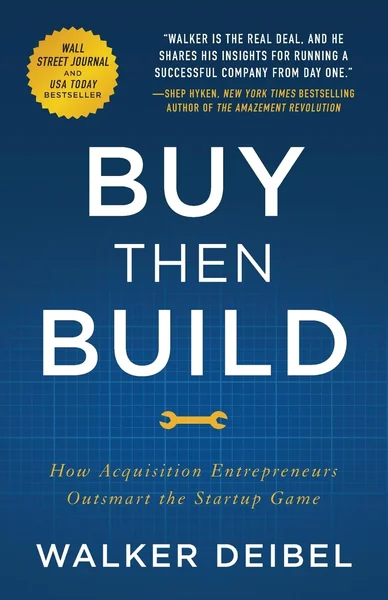
A confluence of demographic and financial forces is quietly reshaping how ambitious professionals think about building wealth — and one 2018 business book appears to have anticipated the moment with unusual precision. According to a recent Under30CEO article citing a Forbes report, "2026 may be the best year in a generation" to acquire a small business, with JPMorgan Chase survey data showing 40% of small business owners plan to retire within a decade. The piece goes further, describing acquisition entrepreneurship as having moved "from a niche MBA idea into a mainstream path" — language that reads almost like a précis of Walker Deibel's Buy Then Build: How Acquisition Entrepreneurs Outsmart the Startup Game.
How Buy Then Build: How Acquisition Entrepreneurs Outsmart the Startup Game Framed the Argument First
Published in 2018, Buy Then Build is a structured, experience-backed case for acquiring an existing business rather than launching one from scratch — walking prospective buyers from initial opportunity-spotting through deal execution and ownership transition. At the time of its release, the field of Entrepreneurship Through Acquisition (ETA) was still largely the domain of business school case studies and a small community of search-fund operators. Deibel's contribution was to democratize the logic: the book made a readable, practitioner-level argument that buying a profitable, established business can offer better risk-adjusted outcomes than the celebrated but statistically brutal startup path. Endorsers positioned it accordingly. Kary Oberbrunner, CEO of Igniting Souls, called it "required reading for anyone aspiring to build, or buy, their own business," and the book's own reception among ETA communities framed it as "a compelling and accessible introduction to the increasingly popular world of Entrepreneurship Through Acquisition."
The Retirement Wave That's Turning Theory Into Opportunity
What makes the current moment significant is the scale of the supply-side shift. The generational retirement of Baby Boomer small business owners has been discussed in business circles for years, but the Under30CEO analysis suggests that 2026 represents the point at which the trend becomes a genuine buyer's market at scale. A large cohort of owners who built durable, cash-flowing businesses over decades now need succession solutions — and many lack family members positioned or willing to take over. That dynamic creates the precise conditions Deibel's framework was designed to exploit: established customer bases, proven operations, and motivated sellers. Crucially, the Under30CEO piece also points to a maturing financing market as a parallel enabler, suggesting the capital infrastructure to support acquisition deals has expanded meaningfully alongside the supply of available businesses.
The cultural shift matters beyond any single book's sales trajectory. For much of the last two decades, entrepreneurial ambition in mainstream media has been synonymous with founding — the pitch deck, the seed round, the mythologized garage startup. Acquisition as a first move has carried an image problem, occasionally dismissed as uncreative or purely financial. What the current data cycle appears to be dismantling is that perception. When a Forbes-cited report declares this the optimal moment for a strategy built on buying before building, it validates not just a tactic but a philosophy — the same philosophy Deibel spent a book arguing deserves serious consideration alongside the founding path. For readers approaching the field now, the book functions as both a strategic primer and a conceptual corrective to startup-centric thinking. Those curious about leadership frameworks that similarly challenge conventional wisdom may also find value in Kevin Cover's The Rhythm Wave: Six Laws to Build a Leadership System Without, which interrogates how operators build durable systems rather than relying on individual heroics.
Buy Then Build makes a structured, experience-backed case for acquiring an existing business rather than launching one from scratch. Want the full verdict? Read our review of Buy Then Build for a detailed assessment of how the book holds up as both a strategic argument and a practical guide.
Frequently Asked Questions
Is Buy Then Build: How Acquisition Entrepreneurs Outsmart the Startup Game worth reading in 2026?
Given the current small business acquisition boom — with a Forbes-cited report describing 2026 as potentially the best year in a generation to buy a business — the strategic case Deibel lays out in Buy Then Build is arguably more relevant now than when the book was published in 2018. The convergence of retiring Baby Boomer owners and a maturing financing market directly mirrors the conditions the book's framework was designed to navigate. Whether it translates into actionable guidance for your specific situation is covered in our full review.
What is the main message of Buy Then Build: How Acquisition Entrepreneurs Outsmart the Startup Game?
The book's central argument is that acquiring an existing, profitable business offers better risk-adjusted outcomes than founding a new venture from scratch. Walker Deibel walks readers through the full acquisition process — from identifying opportunities to executing deals and managing ownership transitions — making a structured case for what he frames as a smarter path to entrepreneurship than the conventional startup route.
Who should read Buy Then Build: How Acquisition Entrepreneurs Outsmart the Startup Game?
The book is most directly aimed at aspiring entrepreneurs who have capital or financing capacity but are weighing whether to start a business or buy one. It has been described as essential reading within Entrepreneurship Through Acquisition communities, and its accessibly written framework makes it relevant to anyone from MBA students to experienced operators considering their next move. The 2026 acquisition market conditions make it particularly timely for professionals actively exploring business ownership.
What is Entrepreneurship Through Acquisition (ETA) and how does Buy Then Build relate to it?
Entrepreneurship Through Acquisition, commonly abbreviated as ETA, is the practice of buying an existing business as the primary vehicle for entrepreneurial ambition rather than founding one. Walker Deibel's Buy Then Build is widely regarded within ETA communities as one of the field's most accessible introductions, translating concepts that were historically confined to business school search-fund programs into a practical, broadly readable guide.
Why is the small business acquisition market particularly active in 2026?
According to a recent Under30CEO article citing a Forbes report and JPMorgan Chase survey data, approximately 40% of small business owners plan to retire within a decade, creating a significant pipeline of established businesses seeking new ownership. Combined with a maturing financing market that has made acquisition deals more accessible, analysts have described 2026 as a generationally favorable moment for buyers — the precise conditions Walker Deibel's Buy Then Build framework was designed to help prospective acquirers navigate.
Should I read Buy Then Build: How Acquisition Entrepreneurs Outsmart the Startup Game before attempting to buy a business?
Buy Then Build covers the full arc from opportunity identification through deal execution and ownership transition, making it a logical starting point for anyone seriously considering a business acquisition. Endorsers in the ETA community have described it as required foundational reading. That said, for a balanced assessment of what the book does and does not cover, our full review offers a more detailed evaluation.
Reader Discussion
No comments yet
Be the first to share your thoughts!