BOOKS
Published

Read Time

3 min read

Curated & edited by

LuvemBooks Editorial

How we create our reviews →
Share This Review

The Let Me Theory by Amelia Hart Review: A Coaching-Voiced Permission-Based Self-Help Guide

Amelia Hart's independently published self-help book, *The Let Me Theory: Unlocking the Courage to Live Life on Your Terms*, is a compact, actionable guide designed to help readers dismantle people-pleasing habits, "should"-driven thinking, and fear-based decision-making in favor of self-permission, personal boundaries, and authenticity. LuvemBooks rates it 3.8 out of 5 stars — a practical courage-building guide with actionable frameworks, though limited for clinical anxiety and occasionally repetitive in execution.

LuvemBooks Verdict

Best for

Readers who are already functioning day-to-day but feel hemmed in by others' expectations, habitual self-silencing, or difficulty asserting boundaries in personal, creative, or professional life — and who want a structured, coaching-style framework rather than motivational hyperbole.

Worth it if

The Permission Protocols' concrete, immediately actionable structure is worth it if you respond well to direct, framework-centred guidance and want a practical method for reclaiming self-permission across multiple life contexts.

Skip if

Skip it if you're looking for clinical or therapeutic tools for diagnosed anxiety disorders, prefer expansive narrative-driven self-help, or are put off by occasional repetition in a compact 103-page volume.

What readers & critics say

No major critical outlets have reviewed this specific title; the Kirkus and Guardian retrievals concern Mel Robbins' similarly named "Let Them Theory" and are not relevant to Hart's book. LuvemBooks' own editorial summary describes it as a practical courage-building guide with actionable frameworks, noting limitations for clinical anxiety and occasional repetitiveness in execution.

Sources: LuvemBooks
In This Review
  • What Works & What Doesn't
  • What the Book Is and What It Sets Out to Do
  • The Central Framework and How It's Structured
  • Writing Style and Authorial Voice
  • Where the Book Delivers and Where It Falls Short
  • Who This Book Is — and Isn't — For

What Works & What Doesn't

What Works
  • Built around a concrete, named framework (the Permission Protocols) described as specific and immediately usable rather than vague or worksheet-filler
  • Deliberately avoids the motivational-speaker tone common in courage-building self-help, adopting a coaching voice that is both supportive and challenging
  • Applies the Let Me Theory across diverse life contexts — including creative pursuits, entrepreneurship, and relationship dynamics — giving the framework practical breadth
  • Available in both paperback and audiobook formats (narrated by Destiny Curtis), extending accessibility for different reading preferences
  • Transparent about its own scope, with a disclaimer in the introduction establishing the limits of the book's approach
What Doesn't
  • Not designed for clinical anxiety or deep-rooted fear patterns — readers with diagnosed anxiety disorders will need professional therapeutic support alongside or instead of this book
  • Press materials note occasional repetitiveness in execution, which is more noticeable given the book's compact length
  • As an independently published title without major-outlet critical review coverage, readers have limited third-party reception data to draw on when evaluating claims
A practical, coaching-voiced self-help guide built around a single empowering concept — with real strengths and real limits worth knowing before you buy.

What the Book Is and What It Sets Out to Do

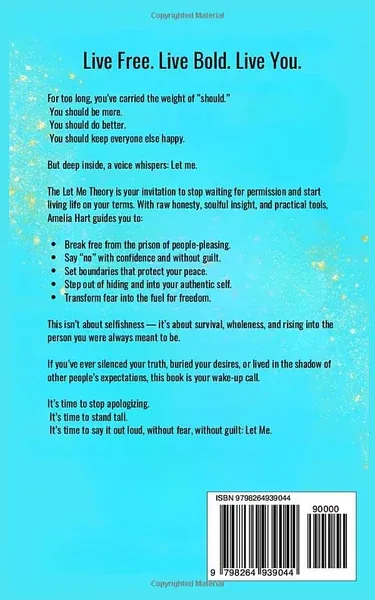
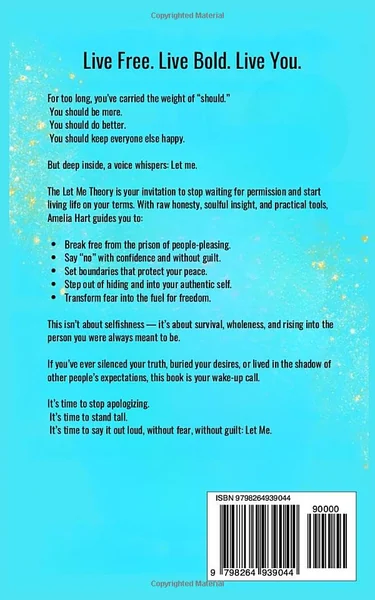
Back cover with title, synopsis, and ISBN barcode on turquoise background.
The Let Me Theory: Unlocking the Courage to Live Life on Your Terms is a self-help title by Amelia Hart, independently published in 2025 and also available as an audiobook narrated by Destiny Curtis. The book's central premise is that most people are living according to invisible rules — accumulated "shoulds," reflexive people-pleasing, and fear — rather than by their own considered choices. Hart's proposed antidote is what she calls the Let Me Theory: a framework built on self-permission, boundary-setting, and personal truth. The guiding phrase is simple and intentional: Let me. As stated in the book's own framing, readers are positioned to live life to the fullest, but on their own terms, as the person they genuinely want to be. The book is part of a self-help series and is structured to take readers from awareness of those invisible rules through to what Hart describes as a "clean, simple, sustainable" way of living aligned with their own values.

The Central Framework and How It's Structured

The book's design philosophy is explicitly practical rather than inspirational in the abstract. One of its named internal components, the Permission Protocols, is described in press materials as organized, specific, and immediately usable — the kind of framework one could hand directly to someone in need of a structured starting point. The book applies the Let Me Theory across a range of life circumstances, including creative pursuits, entrepreneurship, and relationship dynamics, demonstrating the framework's intended breadth. Hart also includes a disclaimer in her introduction (noted in source materials as appearing on page 18) that establishes the scope and limits of the work — a detail that signals the book is designed with a degree of transparency about what it can and cannot address.

Writing Style and Authorial Voice

One of the book's more distinctive qualities, as reflected in press materials, is Hart's deliberate departure from the motivational-speaker register that dominates much of the courage-building self-help genre. Rather than relying on high-energy exhortation, her writing adopts a coaching tone — described as simultaneously supportive and challenging, and as maintaining clarity without sacrificing depth. This positions The Let Me Theory closer to a structured coaching engagement than to a conventional pep-talk format, which will suit readers who find motivational hyperbole hollow. The audiobook edition, narrated by Destiny Curtis, extends this voice into an audio format for readers who prefer to listen.

Where the Book Delivers and Where It Falls Short

The book earns its strengths in the territory it sets out to cover: everyday courage-building, self-permission, and the mechanics of boundary-setting. The Permission Protocols, in particular, are noted for their specificity and usability. However, the book's primary limitation is equally concrete: Hart's methods are not designed for, and do not adequately address, clinical anxiety or deep-rooted fear patterns. Readers managing diagnosed anxiety disorders will find the approach insufficient as a standalone resource without professional therapeutic support — a gap that is real and worth naming plainly for prospective buyers. Additionally, press materials note that the book is occasionally repetitive in execution, which, in a volume of 103 pages, can feel more noticeable than it might in a longer work where ideas have more room to develop before being revisited.

Who This Book Is — and Isn't — For

The Let Me Theory is well-matched to readers who are already functioning but feel constrained by external expectations, habitual self-silencing, or difficulty asserting boundaries in their personal or professional lives. The range of application — from creative and entrepreneurial contexts to relationship dynamics — means the framework is not narrowly targeted, and the coaching voice makes it accessible to readers who learn well from structured, direct guidance. It is a less appropriate fit for readers seeking clinical or therapeutic tools for anxiety, or for those who prefer expansive, narrative-driven self-help over condensed, framework-centered books. For the right reader, it offers a coherent, actionable method; for the wrong one, it may feel limited in depth or therapeutic reach.

Sources & Further Reading

The key facts and claims in this review are grounded in the retrieved, verified sources listed below.

  1. 1
  2. 2
  3. 3