
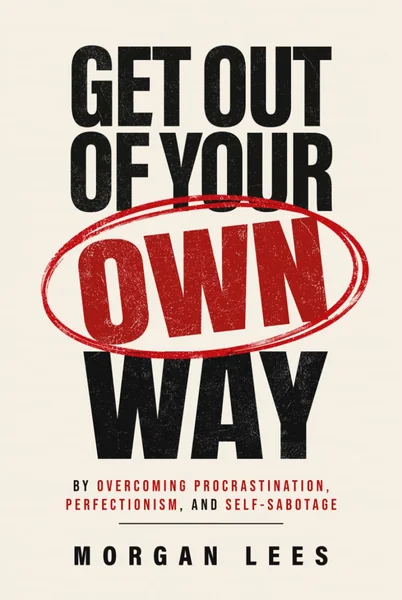
Get Out of Your Own Way: Overcoming Procrastination, Perfectionism, and Self-Sabotage
by Morgan Lees
At a glance
About the Author
Morgan Lees1 book reviewed
Get Out of Your Own Way
Overcoming Procrastination, Perfectionism, and Self-Sabotage
by Morgan Lees
LuvemBooks Verdict
Best for: A reader who recognises procrastination, perfectionism, and self-sabotage as one connected pattern in themselves and wants a short, plainly framed starting point — someone more likely to finish a 140-page hardcover than to start a 400-page manual.
Worth it? Skip it? Read the full verdict →Ask LuvemBooks
Was this helpful?
- Is it worth reading?
- For a specific reader, yes: someone who wants a short, plainly framed starting point on self-defeating habits and values brevity over comprehensiveness. Its compact 140-page length makes it a realistic finish, and treating the three patterns as one connected problem is a reasonable, clearly scoped structure. The significant caveats are that its treatment of three large subjects is necessarily compressed, and its methods are untested here — buyers who weigh author credentials, editorial pedigree, or established reception heavily would be better served by longer-standing titles in the category.
- Similar books
- Readers drawn to this book's territory — self-sabotage, habit change, and self-criticism — have strong established options. Brianna Wiest's The Mountain Is You tackles self-sabotage directly and at greater length, while James Clear's Atomic Habits offers the structured, system-based approach to behaviour change that a 140-page primer can only sketch. Brené Brown's Daring Greatly addresses the shame and self-criticism underlying perfectionism, and Peter Hollins's How to Trick Yourself Into Doing Things You Hate is another compact, practical entry on procrastination. For a more philosophical angle on self-acceptance, The Courage to Be Disliked by Ichiro Kishimi and Fumitake Koga is the category's perennial.
- Who should read this?
- It is best suited to a reader who wants a short, plainly framed starting point on self-defeating habits and who values brevity over comprehensiveness — someone more likely to finish a 140-page book than to start a 400-page one. It particularly fits readers who recognise all three patterns from the subtitle in themselves and want them addressed as one connected problem. LuvemBooks also notes it may suit gift-giving, where a compact hardcover on a near-universal problem is an easy choice.
- What works well in this book?
- Its clearest strength is its tightly scoped premise: procrastination, perfectionism, and self-sabotage are treated as one connected pattern rather than three separate problems, reflecting a widely held view in the genre that they share roots in fear, self-criticism, and avoidance. The 140-page length is a deliberate asset — a realistic finish for readers daunted by longer volumes — and the hardcover format gives it durability as a keep-on-the-desk reference.
- Who should skip this book?
- Skip it if you prioritise an established track record, named professional credentials, or extensive reader reception behind your self-help purchases — as an independently published title, it arrives without the editorial apparatus of a traditional house. Also skip it if you want depth on any single one of its three topics; the compressed treatment means fuller treatments exist elsewhere. And if the title caught your eye because of praise you saw online, check the byline first: endorsements attached to this title overwhelmingly refer to the 1996 Goulston and Goldberg book.
- Is it a good gift book?
- It is a plausible one. LuvemBooks notes the book may suit gift-giving, where a compact hardcover on a near-universal problem — procrastination, perfectionism, self-sabotage — is an easy choice, and the hardcover format gives it some durability as a keep-on-the-desk reference. The one caution for gift buyers is the title collision: make sure the recipient — and the listing — refers to the Morgan Lees book and not the better-known 1996 or 2020 namesakes.
Summarize this book
Follow up
Synthesized from verified book data & published reviews · How we review
Press Enter to ask. Answers come from our editorial Q&A — start typing to see related questions.
Age & Reading Level
Recommended age
Adult
Reading level
Adult
who it suits
Skip if you want a deep, credentialed, evidence-backed treatment of any one of its three topics rather than a compressed 140-page primer.
Editorial Review
Morgan Lees's independently published *Get Out of Your Own Way* is a 140-page hardcover promising help with procrastination, perfectionism, and self-sabotage. Its brevity is an asset, but it shares its title with better-known books, and its methods are untested here.
Read the Full ReviewRelated reading
Adjacent titles worth exploring. We haven't reviewed these yet, so they link out to Amazon.