BOOKS
Published

Read Time

8 min read

Reader rating

4.7

· 26 Amazon ratings
reader ratings, not a LuvemBooks score
Curated & edited by

LuvemBooks Editorial

How we create our reviews →
Share This Review

Get Out of Your Own Way by Morgan Lees Review: A Slim Self-Published Self-Help Primer

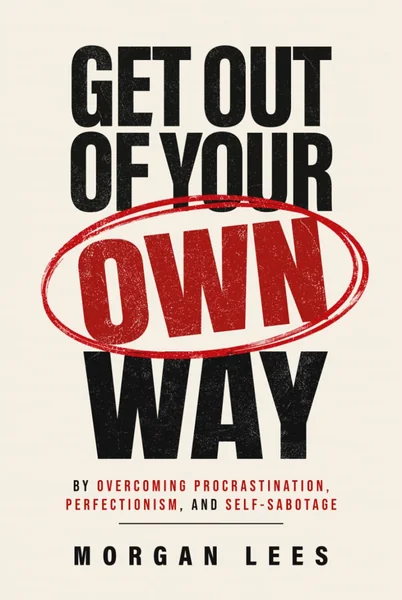
Morgan Lees's independently published Get Out of Your Own Way is a 140-page hardcover promising help with procrastination, perfectionism, and self-sabotage. Its brevity is an asset, but it shares its title with better-known books, and its methods are untested here.
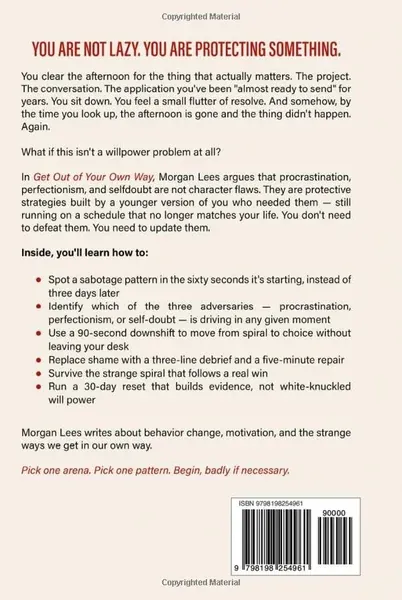
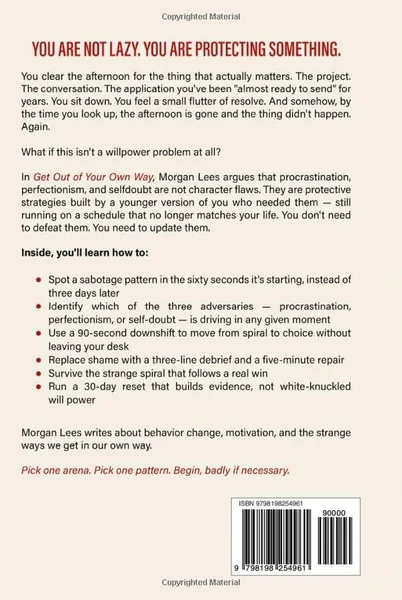
Interior page featuring motivational text and bulleted strategies for overcoming procrastination and self-sabotage.Tap to enlarge

LuvemBooks Verdict

Best for

A reader who recognises procrastination, perfectionism, and self-sabotage as one connected pattern in themselves and wants a short, plainly framed starting point — someone more likely to finish a 140-page hardcover than to start a 400-page manual.

Worth it if

Worth it if you value brevity and a keep-on-the-desk hardcover over comprehensiveness, and you're prepared to judge whether its exercises actually shift entrenched habits by working through them yourself.

Skip if

Skip it if you prioritise an established track record, named professional credentials, or deep treatment of any one of its three subjects — and whatever you buy, check the byline, because this exact title also belongs to better-known books by Goulston & Goldberg and Dave Hollis.

No reception from major review outlets was retrieved for Morgan Lees's book, and the strongest endorsement attached to the title online — Verge Online Mag calling it "a highly recommended guide since its release in 1996" — refers to the Goulston & Goldberg book of the same name, not this one. Summary-site coverage exists (Sobrief lists a 2024, 177-page edition), and the only reader signal in the record is a 4.7/5 average from 26 Amazon ratings, so buyers have little independent critical apparatus to lean on.

Sources: Verge Online Mag, Sobrief
4.7from 26 Amazon ratings— reader ratings, not a LuvemBooks score
Buy on Amazon

Age & Reading Level

Recommended age

Adult

Reading level

Adult

Skip if you want a deep, credentialed, evidence-backed treatment of any one of its three topics rather than a compressed 140-page primer.

In This Review
  • What Works & What Doesn't
  • What the Book Is
  • A Crowded Title, and Why That Matters
  • What It Offers by Design
  • Honest Limitations
  • Who It's For

What Works & What Doesn't

What Works
  • Clear, tightly scoped premise: procrastination, perfectionism, and self-sabotage treated as connected problems
  • Compact 140-page length makes it a realistic finish for readers daunted by longer self-help volumes
  • Hardcover format suited to keeping on hand as a reference
  • Addresses three of the most commonly reported self-defeating patterns in a single volume
What Doesn't
  • Shares its exact title with at least two better-known self-help books (Goulston & Goldberg's 1996 guide and Dave Hollis's 2020 book), creating real confusion risk in search and recommendation lists
  • At 140 pages, its treatment of three large subjects is necessarily compressed
  • Independently published, without the editorial apparatus or established author platform some self-help buyers look for
Verdict: A compact, independently published primer on procrastination, perfectionism, and self-sabotage whose promise is clear from its subtitle — but whose practical value rests on content buyers will need to judge for themselves.

What the Book Is

Get Out of Your Own Way: Overcoming Procrastination, Perfectionism, and Self-Sabotage is a self-help title by Morgan Lees, independently published and listed in hardcover at 140 pages. As the subtitle states, the book is organised around three of the most commonly intertwined self-defeating patterns: putting things off, holding oneself to punishing standards, and undermining one's own progress. It sits in Amazon's Self-Esteem category, which signals its intended shelf position — personal change aimed at readers who feel stuck rather than clinical or academic treatment of the subject.
A note on scope is appropriate here, because this is a functional book whose worth lies in use. This review is based on the book's published listing data, its stated premise, and publicly available commentary — not on hands-on application of its methods. Whether its exercises and advice produce results in practice is a question only a reader working through the material can answer, and no reception from major review outlets was part of the record available for this assessment.

A Crowded Title, and Why That Matters

Buyers should be aware that Get Out of Your Own Way is one of the most reused titles in the self-help category. The best-known bearer of the name is the 1996 book by Mark Goulston and Philip Goldberg, a long-running guide to self-defeating behaviour built around forty common patterns such as procrastination, envy, self-pity, and compulsion — the volume that most summary sites and recommendation lists mean when they cite the title. Dave Hollis also published a Get Out of Your Own Way in 2020. None of these is the book under review.
This matters practically. Search results, summaries, and "highly recommended since 1996" endorsements attached to the title online refer overwhelmingly to the Goulston and Goldberg work, not to Morgan Lees's book. A reader who has seen the title praised somewhere should confirm the author's name before purchasing; the substance and reputation of the older books cannot be transferred to this one, and vice versa.

What It Offers by Design

On its own terms, the book's design has a clear logic. Procrastination, perfectionism, and self-sabotage are frequently treated as separate problems, but the framing of the subtitle reflects a widely held view in the genre — echoed across self-help commentary on the subject — that these behaviours share roots in fear, self-criticism, and avoidance, and are best addressed together. A single volume that treats them as one connected pattern is a reasonable structure for a reader who recognises all three in themselves.
Interior page featuring motivational text and bulleted strategies for overcoming procrastination and self-sabotage.
At 140 pages, it is also deliberately brief. For readers who have abandoned longer self-help books halfway through — an ironic but common fate for titles about procrastination — a short, focused volume has genuine appeal as an entry point or a reset. The hardcover format gives it some durability as a keep-on-the-desk reference.

Honest Limitations

The same brevity that makes the book approachable is also its main structural constraint. Three substantial subjects in 140 pages means each necessarily receives a compressed treatment; readers wanting depth on any one of the three — the psychology of perfectionism, say, or structured procrastination systems — will find fuller treatments elsewhere in the category.
The title collision described above is a second, shopper-level drawback: the book enters a market where its name already belongs, in readers' minds, to established works with decades of accumulated recommendation. And because this is a functional title, the central question — do its methods actually help someone change entrenched habits — is one this review cannot answer. Independent publication means the book arrives without the apparatus of a traditional house behind it, so readers who weigh author credentials and editorial pedigree heavily should factor that into their expectations.

Who It's For

Get Out of Your Own Way is best suited to a reader who wants a short, plainly framed starting point on self-defeating habits and who values brevity over comprehensiveness — someone more likely to finish a 140-page book than to start a 400-page one. It may also suit gift-giving, where a compact hardcover on a near-universal problem is an easy choice. Readers who prioritise an established track record, named professional credentials, or extensive reader reception behind their self-help purchases would be better served by the category's longer-standing titles — taking care, given the shared name, to check the byline on whichever one they pick up.

Sources & Further Reading

The key facts and claims in this review are grounded in the retrieved, verified sources listed below.

  1. Cited in this review
  2. 1
  3. Further reading
  4. 2
  5. 3