BOOKS
Published

Read Time

3 min read

Curated & edited by

LuvemBooks Editorial

How we create our reviews →
Share This Review

Beyond Blind Blaming by Kevin St.Clergy Review: A Root-Cause Framework for Stuck Entrepreneurs

Beyond Blind Blaming: Stop Solving the Wrong Problem is a self-help and business book by entrepreneur Kevin St.Clergy, published in November 2025 by Blind Blaming LLC, that argues most driven professionals aren't failing — they're expertly solving the wrong problem. Drawing on St.Clergy's personal journey and decades of work with entrepreneurs and organizations, the book introduces a framework he calls "Beyond Blind Blaming™," designed to help readers identify the real root causes behind persistent stagnation rather than the surface-level symptoms they've been attacking.

LuvemBooks Verdict

Best for

Entrepreneurs and business leaders who are already working hard but have plateaued — and suspect the problem they're trying to solve may not be the real one.

Worth it if

You respond well to framework-driven business writing and want a concise, named diagnostic model for identifying misattributed root causes in your work or organisation.

Skip if

You're looking for a research-heavy, peer-reviewed, or sector-agnostic treatment of root-cause analysis — the book's scope is deliberately narrow to entrepreneurship and its framework is proprietary rather than independently validated.

What readers & critics say

The Nonfiction Book Club awarded the book a silver book award, noting its premise that readers are "succeeding at solving the wrong problems." The book has attracted an endorsement from Jack Canfield (Chicken Soup for the Soul), quoted on blindblaming.com as saying it "doesn't read like your typical self-help manual" and that St.Clergy "skips the fluffy motivational language."

Sources: Nonfiction Book Club, blindblaming.com
4.9from 195 Amazon ratings— reader ratings, not a LuvemBooks score
In This Review
  • What Works & What Doesn't
  • What the Book Actually Argues
  • Premise and Position in the Genre
  • Strengths: A Practitioner's Voice and a Testable Core Idea
  • Scope and Audience Fit
  • Honest Limitations

What Works & What Doesn't

What Works
  • Addresses a genuinely underserved problem: competent, high-achieving professionals who are stuck despite effort, not because of its absence
  • Built on St.Clergy's reported decades of applied work with entrepreneurs and organizations, grounding the framework in practitioner experience
  • The named 'Blind Blaming™' concept gives readers a concrete diagnostic lens rather than generic motivational advice
  • At 176 pages, the book is scoped for the busy executive audience it targets — focused and purposeful rather than padded
  • Recognized with a silver book award per the book's promotional record
What Doesn't
  • Published by the author's own imprint (Blind Blaming LLC), meaning it has not gone through a major trade editorial process
  • The proprietary 'Beyond Blind Blaming™' framework is St.Clergy's own model without the independent peer review that would accompany academic or widely-adopted methodologies
  • Readers outside entrepreneurship — or those seeking sector-specific or research-heavy treatments of root-cause analysis — may find the scope too narrow
A concise, practitioner-focused business self-help book, Beyond Blind Blaming is built on a single counterintuitive premise: the people most in need of its message are already succeeding — just at the wrong things.

What the Book Actually Argues

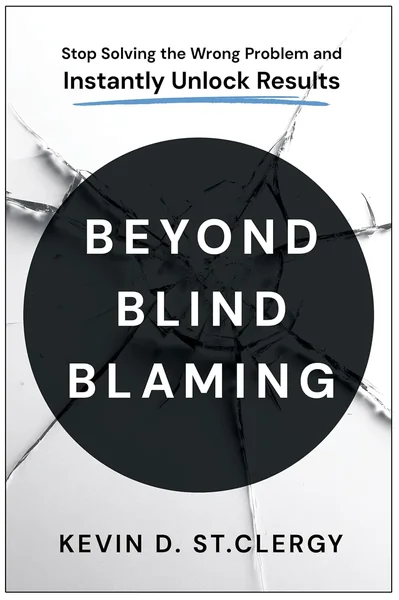
Beyond Blind Blaming: Stop Solving the Wrong Problem and Instantly Unlock Results (Beyond Blind Blaming Series Book 1) by Kevin St.Clergy front cover
At its core, Beyond Blind Blaming is a diagnosis-before-prescription book. St.Clergy's central thesis, as stated across the book's own promotional record and publisher synopsis, is that high-achieving entrepreneurs and business leaders get stuck not because they lack effort or intelligence, but because they are unconsciously attributing their problems to the wrong causes — a pattern he names "Blind Blaming." The real issues, he argues, remain hidden precisely because the drive and competence that made these individuals successful also makes them confident they've already correctly identified the problem. The book is structured around uncovering that gap: between the problem a leader believes they're solving and the root cause that's actually holding them back.

Premise and Position in the Genre

The business self-help shelf is crowded with books about mindset and leadership, but St.Clergy's entry carves out a specific lane: it targets the paradox of competent stagnation — the revenue plateau, the organizational spin cycle, the personal frustration that persists despite harder work. Barnes & Noble's product description positions the book squarely at "successful business leaders [who] feel stuck despite working harder than ever," which is a meaningfully narrower audience than generic productivity literature. The book is the first in a two-volume Beyond Blind Blaming series, suggesting St.Clergy intends the framework to be expansive enough to warrant continued development. A silver book award is noted in the book's promotional record, though the specific awarding body is not named in the verified sources.

Strengths: A Practitioner's Voice and a Testable Core Idea

St.Clergy brings a dual credential to the material: his own "powerful personal journey," as described by the publisher, combined with what the record describes as decades of applied work with thousands of individuals and organizations. That combination — lived experience plus large-scale practitioner exposure — gives the framework a grounding that purely academic treatments of root-cause analysis often lack. The core idea is also genuinely testable at the individual level: readers are given a named concept ("Blind Blaming") and, according to the book's positioning, a method for surfacing hidden root causes. Award-winning entrepreneur Jared Erni, quoted in the book's own promotional materials, states that within ten minutes of engaging with St.Clergy's material, the real obstacle behind his revenue plateau became clear, and that the approach produced measurable sales results within weeks — a concrete, attributed testimonial rather than vague endorsement.

Scope and Audience Fit

The book's 176-page print length positions it as a focused, single-sitting or short-series read rather than an exhaustive reference manual — a structural choice well suited to busy executives and founders who are the stated target audience. The Kindle edition includes enhanced typesetting and Word Wise support, and the format as a whole is designed for accessibility on digital devices. Readers who respond well to framework-driven business writing — books that introduce a named model and walk through its application — are the natural audience here. Those seeking deep academic theory, longitudinal research citations, or sector-specific case studies beyond entrepreneurship may find the scope deliberately narrow.

Honest Limitations

Because the book is freshly published (November 2025) and reader reviews are not yet substantial enough in the verified record to draw on with confidence, reception beyond the promotional testimonials cannot be assessed here. What can be noted from the structural facts is that the "Blind Blaming™" framework is proprietary branding — which means readers are engaging with St.Clergy's specific diagnostic vocabulary rather than a methodology with broad independent peer review. Whether that framework translates effectively across industries beyond entrepreneurship, or whether the two-volume series design means the first book deliberately leaves threads open, are considerations prospective readers may want to weigh. The book is also published by Blind Blaming LLC — St.Clergy's own imprint — which is a common path for practitioner-authors but does mean the editorial process differs from that of a major trade house.

Sources & Further Reading

The key facts and claims in this review are grounded in the retrieved, verified sources listed below.

  1. Cited in this review
  2. 1
  3. Further reading
  4. 2
  5. 3
  6. 4
  7. 5
Related Reviews

Reviews of books we picked for readers who enjoyed Beyond Blind Blaming.