BOOKS
Published

Read Time

6 min read

Our Rating

3.5

Reviewed by

LuvemBooks

Share This Review

The Rational Universe: Einstein's Best Idea by Ralph Bourne – Review

Our Rating

3.5

Ralph Bourne's *The Rational Universe* makes a thoughtful case for Einstein's philosophical rationalism as his most enduring contribution, but uneven treatment of quantum mechanics and a tendency to avoid its own harder questions keep it from reaching the first rank of popular science writing.

In This Review
  • What Works & What Doesn't
  • The Central Argument: A Universe Governed by Reason
  • The Science Behind the Philosophy
  • Einstein's Legacy and the Rationalist Tradition
  • Prose That Is Clear, If Occasionally Flat
  • Strengths, Limitations, and Who This Is For
  • Where to Buy

What Works & What Doesn't

What Works
  • Frames Einstein's legacy as a philosophical argument, not just a physics lesson
  • Clear, accessible explanations of relativity and space-time for non-specialist readers
  • Thoughtful contextualisation within the rationalist intellectual tradition, including the Spinoza connection
  • Well-structured and free of unnecessary jargon
What Doesn't
  • The quantum mechanics sections feel underdeveloped relative to the book's central argument
  • Prose is clear but rarely distinctive or memorable
  • The broader claim that the universe *is* rational slides past philosophical scrutiny
  • Limited engagement with contemporary physics, which would strengthen the book's relevance

The Central Argument: A Universe Governed by Reason

THE RATIONAL UNIVERSE: EINSTEIN'S BEST IDEA_main_0
A focused philosophical argument about Einstein's rationalism that holds up better than most entries in a crowded field — though it skirts the hardest questions. Is Ralph Bourne's The Rational Universe: Einstein's Best Idea worth reading if you're looking for a clear, intelligent take on one of the most celebrated scientific minds in history? That depends on what you already know — and what you hope to walk away with. Bourne's book positions itself within a well-populated field. Works like Einstein: His Life and Universe by Walter Isaacson and Carlo Rovelli's Seven Brief Lessons on Physics have set a high bar for popular science writing that bridges rigour and accessibility. Bourne's approach here appears to take a different angle: less biography, more philosophical argument. The book's central claim seems to be that Einstein's greatest contribution was not just the theory of relativity, but a way of thinking — a commitment to the idea that the universe is, at its core, rational and comprehensible.
That is a compelling thesis. It is also one that requires careful handling, because it sits at the intersection of physics, philosophy, and intellectual history. Bourne takes that challenge seriously.

The Science Behind the Philosophy

The book's strength lies in how it frames Einstein's ideas as more than equations. Rather than leading with the mathematics — which would alienate most general readers — Bourne focuses on what drove Einstein's thinking. The notion that physical laws should be elegant, universal, and logically consistent was not just a working assumption for Einstein. It was close to a metaphysical conviction. Bourne unpacks this with care, tracing how that conviction shaped everything from the special theory of relativity to Einstein's long and ultimately frustrated search for a unified field theory.
This framing is genuinely useful. For readers curious about why Einstein matters beyond E=mc², it offers a conceptual entry point that most physics books avoid. The science is explained in plain language without being dumbed down — a balance that popular science writers often struggle to strike. Bourne handles the key ideas, including space-time, the speed of light as a constant, and the equivalence of mass and energy, with enough precision to be informative but enough clarity to remain readable.
Where the book is less confident is in its treatment of quantum mechanics. Einstein famously resisted the probabilistic nature of quantum theory, insisting that "God does not play dice." Bourne addresses this tension, but the quantum mechanics sections feel noticeably thinner than the relativity discussions. Given that Einstein's resistance to quantum theory is one of the most debated aspects of his legacy, this is a notable gap.

Einstein's Legacy and the Rationalist Tradition

Bourne situates Einstein within a long tradition of rationalist thinking, drawing connections to earlier thinkers who believed the universe operated according to discoverable laws. This is the book's most ambitious move, and it largely pays off. Placing Einstein in intellectual context — alongside figures like Spinoza, whose pantheistic rationalism deeply influenced Einstein's own worldview — gives the book a philosophical depth that sets it apart from straightforward science writing.
The discussion of Spinoza is particularly illuminating. Einstein was open about his admiration for Spinoza's view of nature, and Bourne uses this to argue that Einstein's scientific programme was, in part, a continuation of an older philosophical project. This is a credible and interesting argument, and it is handled with appropriate nuance. Bourne does not overstate the connection or flatten the differences between philosophical tradition and modern physics.
Where the argument becomes more speculative is in its broader claims about the rationality of the universe itself. Bourne sometimes moves from "Einstein believed the universe was rational" to "the universe is rational" without fully acknowledging the philosophical leap involved. That slide, from a scientist's working assumption to a metaphysical truth, deserves more scrutiny than it receives.

Prose That Is Clear, If Occasionally Flat

The writing throughout is clean and direct. Bourne avoids the worst habits of popular science prose: there is little breathless hype, no exaggerated chapter-ending cliffhangers, and the explanatory passages are patient rather than rushed. Sentences are well-constructed and generally free of jargon.
That said, the prose rarely rises to the level of the ideas it is discussing. Some passages feel workmanlike rather than inspired — serviceable but not memorable. Readers who came to popular science through writers like Richard Feynman, Brian Greene, or Rovelli may find the voice a little flat in places. The ideas carry the book more than the writing does, which is not a fatal flaw but is worth noting.
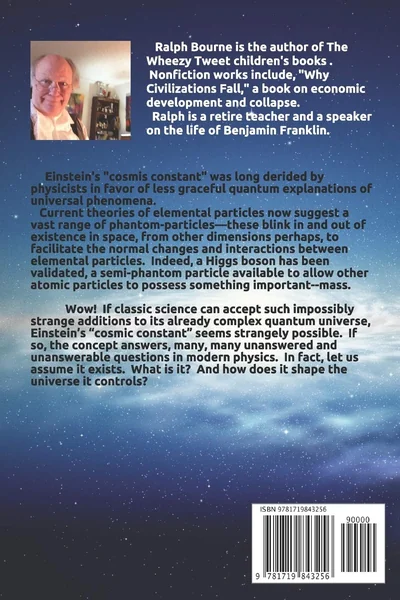
The cover design reflects this balance between the scientific and the philosophical — cosmological imagery that suggests both depth and order, appropriate for a book arguing that the universe plays by comprehensible rules.

Strengths, Limitations, and Who This Is For

Compared to the sweeping biographical treatment in Isaacson's Einstein biography, Bourne's book is narrower in scope and more focused in argument. That is a reasonable trade-off. Not every reader wants a 600-page life story. Some want a tighter intellectual argument about what made a scientist's thinking distinctive. The Rational Universe serves that second audience well.
The main weakness is a tendency to preach to the converted. Readers who already believe that scientific rationalism is the highest form of human inquiry will find the book satisfying. Those who come with harder questions — about the limits of reason, about what quantum indeterminacy means for the rationalist project, or about whether Einstein's philosophical commitments ultimately held him back — may find the book too comfortable in its conclusions.
There is also limited engagement with more recent physics. String theory, loop quantum gravity, and the ongoing search for a unified theory are the direct heirs to the programme Einstein pursued. A brief examination of how Einstein's rationalist legacy shapes those efforts would have grounded the argument in current science and added relevance for technically minded readers.
Readers with a general interest in the history and philosophy of science will find this an engaging and intelligent book. It asks a genuinely good question — what was Einstein's best idea, and why does it still matter — and answers it with care and intellectual honesty. It is most rewarding for those who want to understand the conviction behind Einstein's physics rather than the equations themselves; readers who want a harder look at where that conviction ran aground should pair it with a sharper account of the quantum debate.
---

Where to Buy

If you want to understand the philosophical engine behind Einstein's science — and you're happy with a book that champions that vision more than it interrogates it — The Rational Universe earns its place on the shelf. The Amazon link in the sidebar has the current price.

Product Gallery

THE RATIONAL UNIVERSE: EINSTEIN'S BEST IDEA by RALPH BOURNE front cover
THE RATIONAL UNIVERSE: EINSTEIN'S BEST IDEA by RALPH BOURNE book cover