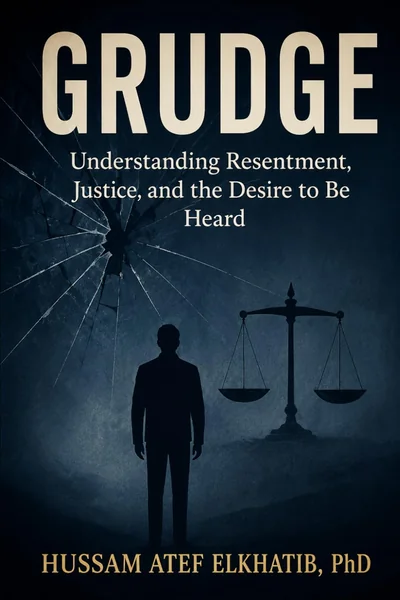
Grudge: Understanding Resentment, Justice, and the Desire to Be Heard
by Dr. Hussam Atef Elkhatib
At a glance
About the Author
Dr. Hussam Atef Elkhatib1 book reviewed
Grudge
Understanding Resentment, Justice, and the Desire to Be Heard
by Dr. Hussam Atef Elkhatib
LuvemBooks Verdict
Best for: A general reader who recognises a persistent resentment in their own life — or wants to understand someone else's — and is looking for a short, sympathetic framework for making sense of it before deciding what to do about it.
Worth it? Skip it? Read the full verdict →Ask LuvemBooks
Was this helpful?
- Is it worth reading?
- It depends on what a reader brings to it. For someone who recognises a persistent resentment in their own life and wants a short, sympathetic framework for understanding it, the justice-and-being-heard lens is genuinely more productive than hollow 'just forgive and move on' advice, and the 117-page format keeps the barrier low mid-grievance. But readers wanting depth — case studies, research apparatus, structured exercises, or grounding in a named therapeutic methodology — should calibrate expectations, because the review found the treatment necessarily brief. The review also stresses it assessed the book's framing and positioning, not hands-on results from applying its guidance.
- Similar books
- Readers drawn to Grudge's focus on difficult emotions and self-examination have several stronger-established options. Harriet Lerner's The Dance of Anger is the classic on anger as a signal in relationships, and Marshall B. Rosenberg's Nonviolent Communication addresses the unmet-need-to-be-heard theme directly. Joseph Burgo's Why Do I Do That? offers accessible psychological self-defence mechanisms, Kristin Neff's Self-Compassion provides the research-backed compassion angle Grudge gestures toward, and Fred Luskin's Forgive for Good is the standard structured programme on forgiveness.
- Who should read this?
- Grudge is built for lay readers, not clinicians — specifically, general readers wrestling with a grudge of their own, or trying to understand someone else's. It particularly suits people who have found 'just let it go' advice hollow and want a framework that takes their sense of violated justice seriously. The single-author, single-subject focus also suits readers who want depth of attention on one emotion rather than a broad emotional-health survey. It is not positioned as a professional reference for therapists or a comprehensive forgiveness programme.
- Is it for people tired of 'just let it go' advice?
- Yes — that is arguably its core intended reader. The book's distinguishing move is refusing to treat a grudge as a character flaw to be scolded away; instead it treats sustained resentment as a signal that something remains unresolved about fairness, acknowledgement, or voice. Readers who have found 'just forgive and move on' advice hollow will recognise exactly the problem the book sets out to address. The publisher's description emphasises a compassionate rather than prescriptive tone toward emotional pain.
- Is this a good book club pick?
- It can prompt conversation, but with caveats. Its short length and single clear thesis make it easy for a group to read and debate, and the resentment-justice-being-heard triad gives discussion a concrete spine. However, the review notes it lacks case studies, structured exercises, or discussion apparatus, so a club would need to generate its own prompts. Groups wanting richer material might pair it with a more established title like The Dance of Anger.
Summarize this book
Follow up
Synthesized from verified book data & published reviews · How we review
Press Enter to ask. Answers come from our editorial Q&A — start typing to see related questions.
Age & Reading Level
Recommended age
Adult
Reading level
Adult
who it suits
Skip if you want a comprehensive, research-backed treatment of resentment with case studies, structured exercises, or a named therapeutic methodology — at 117 pages this is a reflective entry point, not a clinical protocol.
Editorial Review
Dr. Hussam Atef Elkhatib's Grudge: Understanding Resentment, Justice, and the Desire to Be Heard is a short, independently published self-help book about why people hold onto emotional pain.…
Read the Full ReviewBooks like Grudge
Curated picks for readers who enjoyed Grudge, with our reasoning for each match.
If you liked Grudge