Why Nations Fail: The Origins of Power, Prosperity, and Poverty
by Daron Acemoglu and James A. Robinson
At a glance
About the Author
Daron Acemoglu and James A. Robinson1 book reviewed
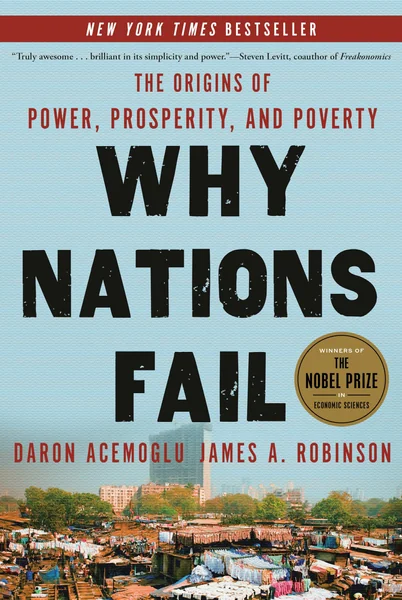
Why Nations Fail
The Origins of Power, Prosperity, and Poverty
by Daron Acemoglu and James A. Robinson
LuvemBooks Verdict
Best for: Readers with an interest in political economy, history, or development who want a sweeping, accessibly written argument — grounded in fifteen years of original research — for why institutions, not geography or culture, determine whether nations prosper or fail.
Worth it? Skip it? Read the full verdict →Ask LuvemBooks
Was this helpful?
- Is it worth reading?
- For readers with a serious interest in political economy, history, or global development, Why Nations Fail is widely considered a benchmark work. It was named one of the best books of the year by The Washington Post, Financial Times, The Economist, BusinessWeek, Bloomberg, and The Christian Science Monitor, and its authors were awarded the 2024 Nobel Memorial Prize in Economic Sciences — partly for the body of scholarship this book most accessibly represents. The main caveat is its demanding length and the academic debate around whether the inclusive/extractive binary oversimplifies cases where colonial history or geography shaped the very institutions the framework treats as independent.
- Similar books
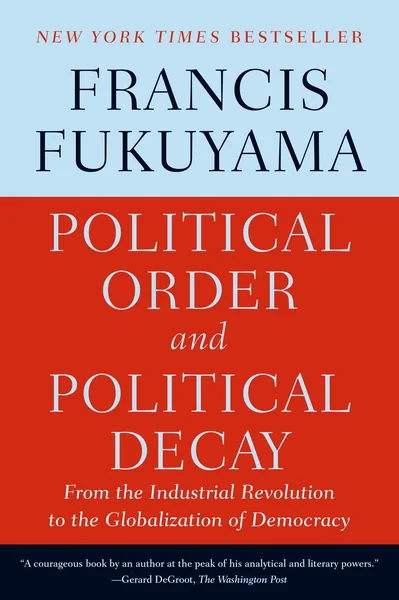
- Readers who found Why Nations Fail compelling have several natural next steps. Guns, Germs, and Steel: The Fates of Human Societies by Jared Diamond offers a geographic counter-theory of civilisational divergence — the very framework Acemoglu and Robinson directly engage and dispute. Francis Fukuyama's Political Order and Political Decay and The Origins of Political Order provide a complementary institutional history of state formation from prehuman times to the present. Adam Smith's The Wealth of Nations is the foundational text on the relationship between institutions, markets, and national prosperity that underpins much of the modern debate. And Alexis de Tocqueville's Democracy in America remains an essential companion for understanding how political institutions shape economic and social outcomes.
- Who should read this?
- Why Nations Fail is essential reading for anyone seriously engaged with political economy, global history, international development, or contemporary policy — from students and academics to policy professionals and engaged general readers. Its accessible prose makes it viable for non-specialists, but it rewards readers willing to invest in over 500 pages of dense historical argumentation. Those curious about why North Korea and South Korea diverged so dramatically, why ancient Rome or Venice rose and fell, or whether America faces institutional risks today will find the framework directly illuminating.
- What's the core argument?
- The central thesis of Why Nations Fail is that man-made political and economic institutions — not geography, climate, or culture — are the decisive determinant of national prosperity. Acemoglu and Robinson draw a foundational distinction between inclusive institutions, which distribute power broadly and enable wide economic participation, and extractive institutions, which concentrate power and wealth in a narrow elite. The Korea example anchors this argument most starkly: North and South Korea share the same geography, climate, and much of the same cultural and historical background, yet their divergent institutional paths after partition produced radically different economic outcomes — a single-variable illustration the authors use to dismiss geographic and cultural explanations.
- Which rival theories does the book challenge?
- Why Nations Fail enters into direct intellectual confrontation with several major schools of thought. It takes sharpest aim at geographic theories of development, particularly those of Jared Diamond and Jeffrey Sachs, arguing that geography cannot account for cases like the Korean peninsula where geography is held constant but institutional outcomes diverge radically. It also engages Abhijit Banerjee and Esther Duflo's emphasis on elite ignorance, Seymour Martin Lipset's modernization theory, and cultural theories advanced by David Landes, David Fischer, and Max Weber — systematically refuting each rather than ignoring them, which makes the institutional argument more rigorous.
- What's the book's connection to the Nobel Prize?
- In 2024, Daron Acemoglu and James A. Robinson (alongside Simon Johnson) were awarded the Nobel Memorial Prize in Economic Sciences for their contributions to comparative studies of prosperity between nations. Why Nations Fail is the most accessible representation of that body of scholarship — synthesising Acemoglu's theoretical work on economic growth with Robinson's fieldwork on African and Latin American economies and research from the broader new institutional economics tradition. The prize cemented the book's long-term importance and the influence of the institutional framework it popularised.
Summarize this book
Follow up
Synthesized from verified book data & published reviews · How we review
Press Enter to ask. Answers come from our editorial Q&A — start typing to see related questions.
Age & Reading Level
Recommended age
Adult
Reading level
Adult
who it suits
Skip if you're looking for a concise, technically rigorous theoretical overview rather than an extended historical narrative argument
Editorial Review
Why Nations Fail: The Origins of Power, Prosperity, and Poverty, first published in 2012 by economists Daron Acemoglu and James A. Robinson, constructs a sweeping institutional theory of why some countries accumulate wealth while others remain trapped in poverty — drawing on fifteen years of original research and historical evidence spanning the Roman Empire, the Mayan city-states, the Soviet Union, North and South Korea, medieval Venice, and Africa.…
Read the Full ReviewBooks like Why Nations Fail
Curated picks for readers who enjoyed Why Nations Fail, with our reasoning for each match.
If you liked Why Nations Fail