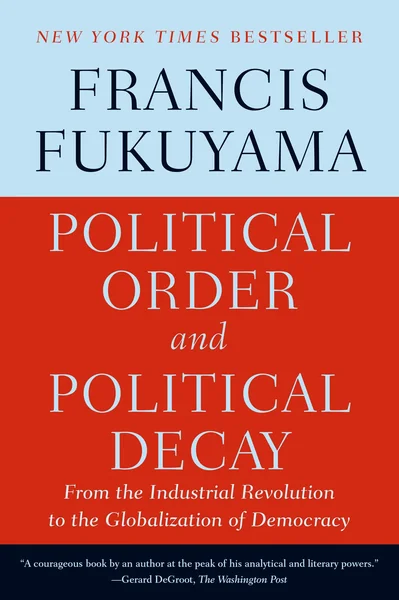
Political Order and Political Decay: From the Industrial Revolution to the Globalization of Democracy
At a glance

Political Order and Political Decay
From the Industrial Revolution to the Globalization of Democracy
LuvemBooks Verdict
Best for: Readers with a grounding in political science or comparative history who want a rigorous, historically sweeping diagnosis of how liberal democracies decay from within — particularly those who have already read The Origins of Political Order and want to complete Fukuyama's two-volume project.
Worth it? Skip it? Read the full verdict →Ask LuvemBooks
Was this helpful?
- Is it worth reading?
- For readers with a serious interest in political science, comparative history, or the current state of democratic institutions, Political Order and Political Decay rewards the investment handsomely. The publisher describes it as 'destined to be a classic,' and the critical reception to the series has been substantial — Michael Lind called the first volume 'a major achievement by one of the leading public intellectuals of our time,' while David Gress described it as 'magisterial in its learning and admirably immodest in its ambition.' The book's frank pessimism about institutional decay and its precise analytical framework make it directly relevant to debates that continue to dominate public life well beyond its 2014 publication date. The chief caveat is structural: those who have not read The Origins of Political Order will encounter the theoretical framework without its full foundational development.
- Similar books
- Readers drawn to Fukuyama's comparative approach to institutions and political development will find strong companions in Daron Acemoglu and James A. Robinson's Why Nations Fail: The Origins of Power, Prosperity, and Poverty, which similarly argues that inclusive versus extractive institutions determine whether societies prosper or decline. Alexis de Tocqueville's Democracy in America is a natural pairing given Fukuyama's pointed treatment of American democratic development and its patronage-driven origins. For those interested in the mechanisms by which states and media can be captured by powerful interests, Edward S. Herman and Noam Chomsky's Manufacturing Consent: The Political Economy of the Mass Media offers a complementary diagnosis of institutional decay in democratic societies. Fukuyama's own first volume, The Origins of Political Order, is the essential precursor to this book, and Jared Diamond's Collapse: How Societies Choose to Fail or Succeed addresses the broader question of why complex societies deteriorate — a theme that runs throughout Political Order and Political Decay.
- Who should read this?
- Political Order and Political Decay is aimed squarely at readers with a serious interest in political science, comparative history, or the health of contemporary democratic institutions. Those who have already read The Origins of Political Order will get the most from it, since this volume builds directly on that framework. Policy-minded readers, academics, and engaged citizens concerned with questions of institutional decay, democratic paralysis, and the global prospects for liberal democracy will find it particularly rewarding. Casual readers looking for a narrative or accessible introduction to political history may find its comparative breadth and analytical density demanding.
- About Francis Fukuyama
- Francis Yoshihiro Fukuyama is an American political scientist, political economist, and international relations scholar.
- What are the main themes?
- The book's central themes are institutional development and decay, the conditions required for liberal democracy to flourish, and the internal mechanisms that erode it. Fukuyama argues that a functioning modern state requires three pillars in careful balance: a capable executive state, genuine rule of law (as distinct from mere rule by law), and democratic accountability. A recurring theme is the danger of 'repatrimonialization' — the capture of state institutions by patronage networks and entrenched elites — which he diagnoses as the primary driver of political decay in otherwise advanced democracies. The book also engages with the future of democracy in the face of a rising global middle class and the paralysing effects of vetocracy.
- Where to start with Fukuyama?
- For readers approaching Fukuyama for the first time, The Origins of Political Order is the essential starting point — it establishes the three-pillar framework (state capacity, rule of law, and democratic accountability) that Political Order and Political Decay takes as its foundation. Reading the first volume first means arriving at this book with the theoretical scaffolding fully in place, which the review identifies as the key structural prerequisite for getting the most from the argument. Those already familiar with Fukuyama's broader body of work, including his 1989 essay 'The End of History?', will appreciate how this volume marks a significant evolution in his thinking, from celebrating liberal democracy's triumph toward diagnosing its vulnerabilities.
Summarize this book
Follow up
Synthesized from verified book data & published reviews · How we review
Press Enter to ask. Answers come from our editorial Q&A — start typing to see related questions.
Age & Reading Level
Recommended age
Adult
Reading level
Adult
who it suits
Skip if you are looking for a narrative or accessible introduction to political history rather than rigorous comparative political science
Editorial Review
Francis Fukuyama's work Political Order and Political Decay is the second volume in his landmark series on the history of the modern state, picking up where The Origins of Political Order left off and tracing how state institutions developed — and began to erode — from the French Revolution to the present. Ambitious in geographical scope and deeply grounded in comparative political history, it is essential reading for anyone seeking to understand why liberal democracy succeeds in some settings and stagnates in others.
Read the Full ReviewBooks like Political Order and Political Decay
Curated picks for readers who enjoyed Political Order and Political Decay, with our reasoning for each match.
If you liked Political Order and Political Decay