At a glance

LuvemBooks Verdict
Best for: General educated readers drawn to big-history thinking who want a single, environmentally grounded explanation for global inequality — and who are willing to pursue the scholarly counter-literature alongside it.
Worth it? Skip it? Read the full verdict →Preview the book
Ask LuvemBooks
Was this helpful?
- Is it worth reading?
- For readers curious about the deep structural roots of global inequality, Guns, Germs, and Steel remains a foundational and genuinely provocative text — Kirkus Reviews called it 'an impressive achievement' in synthesis, and its Pulitzer Prize reflects its broad cultural impact. The book's environmental argument against racial hierarchy is presented with a clarity and moral purpose that continues to resonate. The key caveat is that substantive scholarly critics — anthropologist Jason Antrosio, geographer James Morris Blaut, and economist Joel Mokyr among them — have identified real weaknesses in the deterministic framework, particularly its flattening of human agency. LuvemBooks' view is that it is most valuable when read alongside those critiques rather than in isolation.
- Similar books
- Readers who engaged with Diamond's sweeping civilisational scope will find natural companions in several works curated below. Yuval Noah Harari's Sapiens: A Brief History of Humankind covers comparable deep-history terrain from a cultural and cognitive angle. Peter Frankopan's The Silk Roads: A New History of the World recentres global history away from a Western European axis. David Graeber's The Dawn of Everything: A New History of Humanity directly challenges deterministic big-history narratives — including Diamond's — and foregrounds human agency and social diversity. Howard Zinn's A People's History of the United States similarly pushes back against top-down structural history by restoring the voices of those left out of dominant narratives.
- Who should read this?
- Guns, Germs, and Steel is designed for the general educated reader rather than the specialist — its structure moves from Yali's concrete origin question through progressively broader arguments about agriculture, disease, technology, and political organisation, and no prior background in history, biology, or anthropology is required. Readers drawn to big-history thinking — the kind that seeks unified explanations for civilisational patterns — will find it a foundational text. Those who come to it expecting nuanced accounts of individual agency, internal cultural dynamics, or the lived experiences of colonised peoples will need to supplement it with the counter-literature from Antrosio, Blaut, and others.
- About Jared Diamond
- Jared Mason Diamond is an American scientist, historian, and author.
- What are the main themes?
- The book's central themes are the environmental roots of global inequality, the role of geography and biology in shaping civilisational outcomes, and the explicit rejection of racial or genetic explanations for why some societies came to dominate others. Diamond traces a linked chain from domesticable plant and animal species through agricultural surplus, population density, and epidemic disease to the political and military advantages that allowed Eurasian civilisations to expand. A secondary but important theme is the moral stakes of historical explanation itself — Diamond's argument is as much a refutation of racist historiography as it is a positive theory of civilisational development.
- Tell me about the adaptation
- Guns, Germs, and Steel was adapted into a National Geographic documentary series, which extended the book's reach well beyond its already substantial readership. The documentary follows Diamond's core argument through the same geographic and historical terrain covered in the book — the Fertile Crescent, the spread of agriculture, and the role of epidemic disease — using location filming and interviews to bring the argument to a visual format. For viewers coming to the series first, it serves as an accessible introduction to Diamond's thesis, though the book's full scope of synthesised scholarship is naturally harder to convey on screen.
Summarize this book
Follow up
Synthesized from verified book data & published reviews · How we review
Press Enter to ask. Answers come from our editorial Q&A — start typing to see related questions.
Age & Reading Level
Recommended age
Adult
Reading level
Adult
who it suits
Skip if you want a history that foregrounds human agency, individual decisions, or the lived experiences of colonised peoples.
Editorial Review
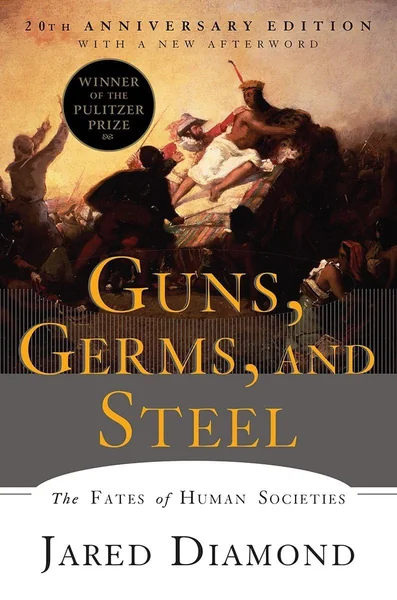
Jared Diamond's Guns, Germs, and Steel: The Fates of Human Societies is a transdisciplinary nonfiction work that set out to answer one of history's most charged questions — why did some civilizations come to dominate others? — and won the Pulitzer Prize for general nonfiction in 1998 doing it.…
Read the Full ReviewBooks like Guns, Germs, and Steel
Curated picks for readers who enjoyed Guns, Germs, and Steel, with our reasoning for each match.
If you liked Guns, Germs, and Steel