10 min read
4.6
· 744 Amazon ratingsShare This Review
Democracy in America by Alexis de Tocqueville Review: A Timeless Classic of Political Thought
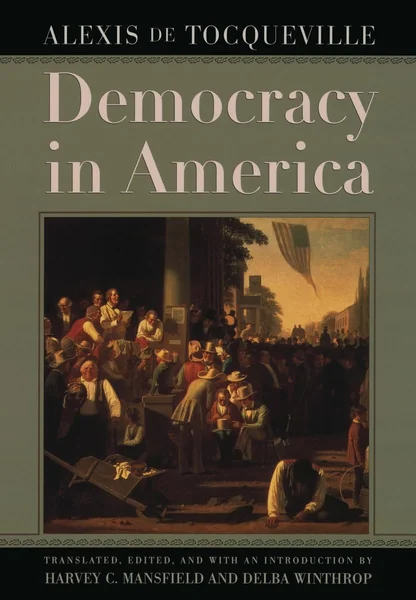
The University of Chicago Press edition of Democracy in America, translated by Harvey C. Mansfield and Delba Winthrop, presents Tocqueville's foundational two-volume work in what the press.uchicago.edu site describes as the finest and most definitive translation yet produced — one that Gordon S. Wood, writing in the New York Review of Books, called "an impeccable new edition and translation." Originally published in Paris in 1835 and 1840, Tocqueville's examination of American democracy, equality, religion, and the social costs of democratic life remains the most often cited work on the United States and on democracy as a form of government.
LuvemBooks Verdict
Best for
Serious students and scholars of political science, history, or the social sciences who want the most rigorous and faithful English translation of Tocqueville's landmark text, complete with scholarly apparatus for university-level study.
Worth it if
You are willing to engage attentively with 722 pages of dense political philosophy and bring — or are prepared to build — some grounding in nineteenth-century European and American history.
Skip if
Casual readers seeking a light introduction to American political history will likely find Tocqueville's layered, generalisation-heavy method demanding without supplementary context.
What readers & critics say
The University of Chicago Press edition of the Mansfield-Winthrop translation was "lauded in all quarters" upon release, with press.uchicago.edu quoting Gordon S. Wood's assessment that "it would be difficult to think of a greater service to the study of Tocqueville." The Guardian identifies the work's enduring cross-ideological appeal as its "marvellous characteristic," noting that left-leaning readers find in it a prescient endorsement of community values while conservatives prize its analysis of individual liberty and the limits of government.
“This is the marvellous characteristic of Democracy in America: it is still relevant, and everyone can find something in it that is recognisably correct.”
— The GuardianAsk LuvemBooks
Was this helpful?
- Is it worth reading?
- For readers willing to engage seriously with a dense, philosophically rigorous text, Democracy in America is indispensable. The University of Chicago Press describes it as the best work ever written on democracy and the best ever written on America — and Gordon S. Wood, reviewing the Mansfield-Winthrop translation in the New York Review of Books, wrote that 'it would be difficult to think of a greater service to the study of Tocqueville' than what Mansfield and Winthrop accomplished. Its cross-ideological relevance — claimed as a foundational text by both left and right — gives it a longevity rare among political works. The caveat, as The Guardian notes, is that extracting what the book has to offer requires a willingness to meet Tocqueville on his own terms.
- Similar books
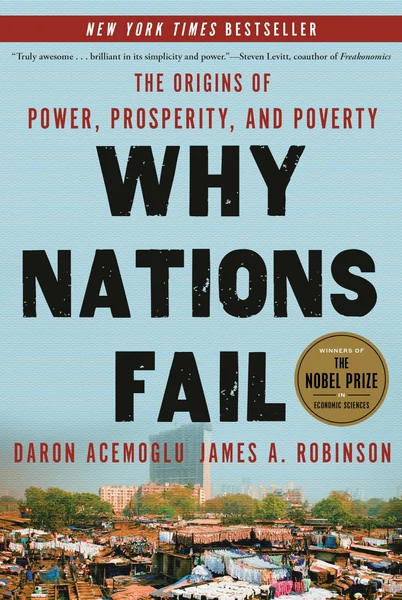
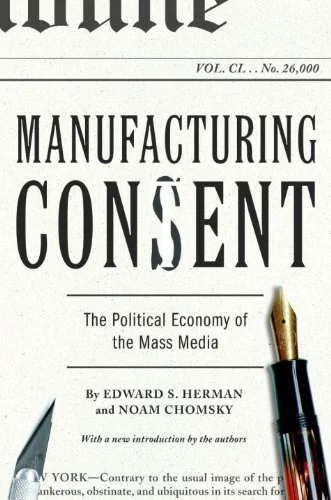
- Readers drawn to Democracy in America's analysis of political institutions and historical forces will find strong companions in the LuvemBooks catalogue. Francis Fukuyama's Political Order and Political Decay and The Origins of Political Order pursue similarly sweeping questions about how political systems form, decay, and endure across history. Why Nations Fail by Daron Acemoglu and James A. Robinson offers a comparable cross-disciplinary argument about the institutional roots of democratic success and failure. Manufacturing Consent by Edward S. Herman and Noam Chomsky speaks to Tocqueville's concerns about the pressures democratic societies place on public opinion and information. For another Tocqueville work, his later The Old Regime and the Revolution applies similar analytical rigour to the French experience of political transformation.
- Who should read this?
- Democracy in America in the Mansfield-Winthrop edition is the preferred choice for university students and scholars in political science, history, and the social sciences, where its scholarly apparatus and translation fidelity carry real weight. Serious general readers with an interest in the foundations of American democracy, or in the broader history of democratic thought, will find it equally rewarding — provided they are prepared for a 722-page, philosophically rigorous text. Its rare cross-ideological appeal makes it genuinely useful to readers across the political spectrum. Those without background in nineteenth-century political history are advised to approach it with supplementary material.
- About Alexis de Tocqueville
- French aristocrat and political thinker Alexis Charles Henri de Tocqueville transformed how the world understood democracy through his keen observations of 19th-century America.
- What are the main themes?
- Democracy in America spans an unusually wide range of themes within a single sustained argument. At its core, the work examines equality of conditions as the defining feature of American — and by extension, modern democratic — society. From there, Tocqueville moves across the structure of American political institutions, the role of voluntary associations in civic life, the dangers of the 'tyranny of the majority,' the influence of Puritan religious history on American entrepreneurial and egalitarian culture, and the psychological costs that democratic restlessness and social mobility impose on individuals. He also applies critical scrutiny to the treatment of Native Americans and the institution of slavery, and considers democracy's long-term effects on art, literature, and private life.
- Why do both left and right claim this book?
- The Guardian identifies this cross-ideological appeal as one of Democracy in America's most 'marvellous characteristics.' Left-leaning readers find in it a prescient endorsement of community values and a critique of the unchecked individualism that can accompany capitalism, while conservatives prize Tocqueville's analysis of individual liberty and the limitations of government. Political theorists value its sweeping generalizations; historians value its panoramically detailed portrait of early nineteenth-century America. The book does not flatter any particular camp, which is precisely why it has remained the most often quoted work about the United States for nearly two centuries.
Summarize this book
Follow up
Synthesized from verified book data & published reviews · How we review
Press Enter to ask. Answers come from our editorial Q&A — start typing to see related questions.
Age & Reading Level
Recommended age
Adult
Reading level
Adult
2 content notes · who it suits
Content to know about
Skip if you're looking for a narrative-driven or accessible introduction to American history rather than sustained political philosophy.
Our Review
What the Book Is and Where It Came From
Significance and Place in the Canon
The Mansfield-Winthrop Translation's Contribution
Genuine Strengths of Tocqueville's Argument
Who This Edition Is For — and Where It Demands Patience
Sources & Further Reading
The key facts and claims in this review are grounded in the retrieved, verified sources listed below.
- Cited in this review
- 1
teachdemocracy.org
- 2
press.uchicago.edu
- 3
- Further reading
- 4
Alexis de Tocqueville, Wikipedia
- 5
en.wikipedia.org
- 6
- 7
theguardian.com
- 8
- 9
- 10
- 11
americanliterature.com
- 12
- 13
forthewriters.com
- 14
oceanwriterreads.com
- 15
- 16
Books like Democracy in America
Curated picks for readers who enjoyed Democracy in America, with our reasoning for each match.
If you liked Democracy in America