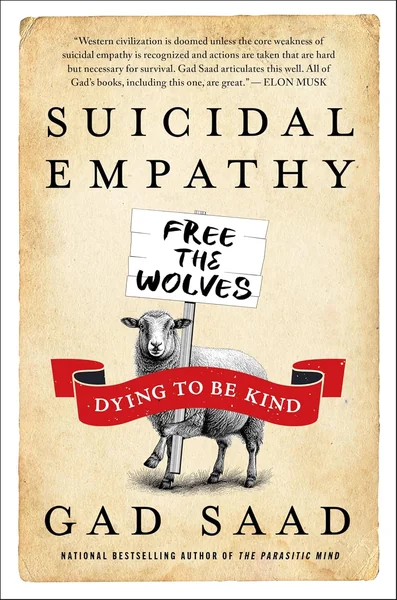
Suicidal Empathy: Dying to Be Kind
by Gad Saad
Gad Saad argues that excessive, misdirected empathy is corroding Western institutions and silencing honest discourse in this cultural critique rooted in evolutionary psychology.
Read our full reviewAt a glance
LuvemBooks Verdict
Best for: Readers already persuaded by Saad's The Parasitic Mind who want a more targeted diagnostic framework applying its core ideas to immigration, criminal justice, and cultural hierarchy.
Worth it? Skip it? Read the full verdict →Ask LuvemBooks
Was this helpful?
- Is it worth reading?
- Whether Suicidal Empathy is worth reading depends almost entirely on the reader's prior political orientation. For those who found The Parasitic Mind compelling, the book delivers a focused, aphoristic argument with a single memorable diagnostic framework that unifies a wide range of conservative cultural critiques under one label. For readers without prior sympathy for Saad's worldview, the book's examples are likely to feel selected to confirm its thesis rather than test it, and the line between evolutionary behavioral analysis and culture-war advocacy is not clearly maintained throughout. The Bulwark's Cathy Young has described the central phrase as 'becoming a right-wing buzzword,' and its association with Great Replacement rhetoric will be disqualifying for a wide range of readers.
- Similar books
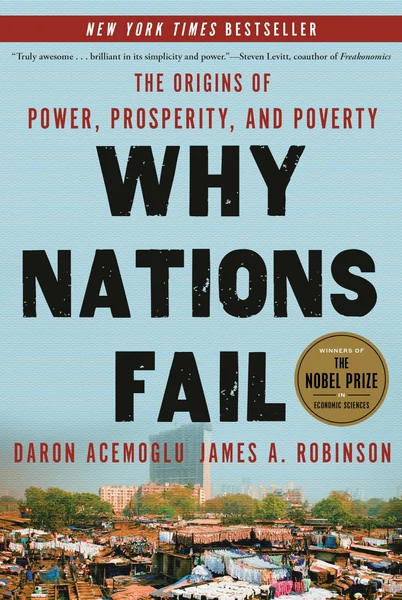
- Readers drawn to Suicidal Empathy will find natural companions in several works that examine societal institutions, cultural decline, and political order with varying degrees of ideological alignment. The Coddling of the American Mind by Greg Lukianoff and Jonathan Haidt explores related anxieties about emotional reasoning overtaking rational discourse in American culture. Douglas Murray's The Strange Death of Europe: Immigration, Identity, Islam shares Saad's concern with Western civilizational decline, particularly around immigration. For readers interested in the deeper structural and historical forces shaping political decay, Francis Fukuyama's Political Order and Political Decay: From the Industrial Revolution to the Globalization of Democracy and Daron Acemoglu and James A. Robinson's Why Nations Fail: The Origins of Power, Prosperity, and Poverty offer rigorous, less polemical frameworks for understanding how societies succeed or collapse.
- Who should read this?
- Suicidal Empathy is designed for readers who found The Parasitic Mind compelling and are ready for a more targeted application of its arguments to immigration, criminal justice, and cultural hierarchy. It will also appeal to readers who appreciate polemical nonfiction written with urgency, structured around a bold central metaphor, and addressed to an audience that already shares the author's broad suspicions about progressive cultural norms. Readers seeking an interdisciplinary, peer-reviewed treatment of empathy's social costs, or those who find the book's association with Great Replacement rhetoric disqualifying, are likely to find it a frustrating read.
- About Gad Saad
- Gad Saad was born on 13 October 1964 in Beirut, Lebanon, and is a Canadian marketing professor at the John Molson School of Business at Concordia University. He has argued for applying evolutionary psychology to marketing and consumer behaviour, and is known as a writer and producer as well as an academic. He is the bestselling author of The Parasitic Mind and Suicidal Empathy: Dying to Be Kind.
- What's the Elon Musk connection?
- The term 'suicidal empathy' gained significant mainstream traction when Elon Musk used it in a 2025 interview with podcaster Joe Rogan, describing 'civilizational suicidal empathy' as the corrosion of American culture. Critics noted a public alignment between Musk and Saad, and that celebrity amplification simultaneously expanded the book's audience and intensified scrutiny of its claims. The association has made the book more visible, but has also deepened concerns — raised by writers including The Bulwark's Cathy Young — that 'suicidal empathy' is functioning primarily as a right-wing buzzword rather than a rigorous analytical concept.
- What are the key arguments?
- The book's central argument is that Western civilization is imperiling itself by elevating empathy above logic and long-term consequence — a condition Saad diagnoses as 'suicidal empathy.' Chapter 2, 'Forbidden Knowledge,' challenges what Saad sees as the suppression of inconvenient truths, while Chapter 3, 'Cultural Theory of Mind,' advances the controversial claim that not all cultures are equal in their outcomes or values. The book's design intent, as signaled by a publisher's blurb, is to provide readers with a single diagnostic framework that links phenomena such as DEI initiatives, the fetishization of victimhood status, and failures in drug and homelessness policy to one underlying cause. Whether one accepts that synthesis or not, the book's confrontational style is captured in a representative line from Chapter 2: 'Reality does not abide by your feelings. Knowledge is either true or false, irrespective of your level of offense.'
- What are the main criticisms?
- The book faces two principal criticisms. First, the 'suicidal empathy' concept has been described by The Bulwark's Cathy Young as 'becoming a right-wing buzzword,' and Wikipedia's reception summary notes that critics have linked the framework to Great Replacement rhetoric, given that both posit Western societies facing destruction from immigration — associations that shape how the book is received before a reader opens the cover. Second, the book is structured as persuasion aimed at a pre-aligned audience rather than as a falsifiable academic argument: readers without prior sympathy for Saad's political orientation are likely to find that examples are selected to confirm the thesis rather than test it, and that the line between evolutionary behavioral analysis and culture-war advocacy is not clearly maintained.
Summarize this book
Follow up
Synthesized from verified book data & published reviews · How we review
Press Enter to ask. Answers come from our editorial Q&A — start typing to see related questions.
Age & Reading Level
Recommended age
Adult
Reading level
Adult
2 content notes · who it suits
Content to know about
Skip if you're looking for a politically neutral or peer-reviewed academic treatment of empathy and social policy.
Editorial Review
In this hardcover from Broadside Books (May 2026), evolutionary behavioral scientist and marketing professor Gad Saad mounts a sweeping critique of what he terms "suicidal empathy" — the thesis that Western societies are destroying themselves by allowing misdirected compassion to override rational self-interest. A natural successor to his international bestseller The Parasitic Mind, the book will energize readers already aligned with its worldview while drawing pointed criticism from those who find its framing reductive or its political valence troubling.
Read the Full ReviewBooks like Suicidal Empathy
Curated picks for readers who enjoyed Suicidal Empathy, with our reasoning for each match.
If you liked Suicidal Empathy