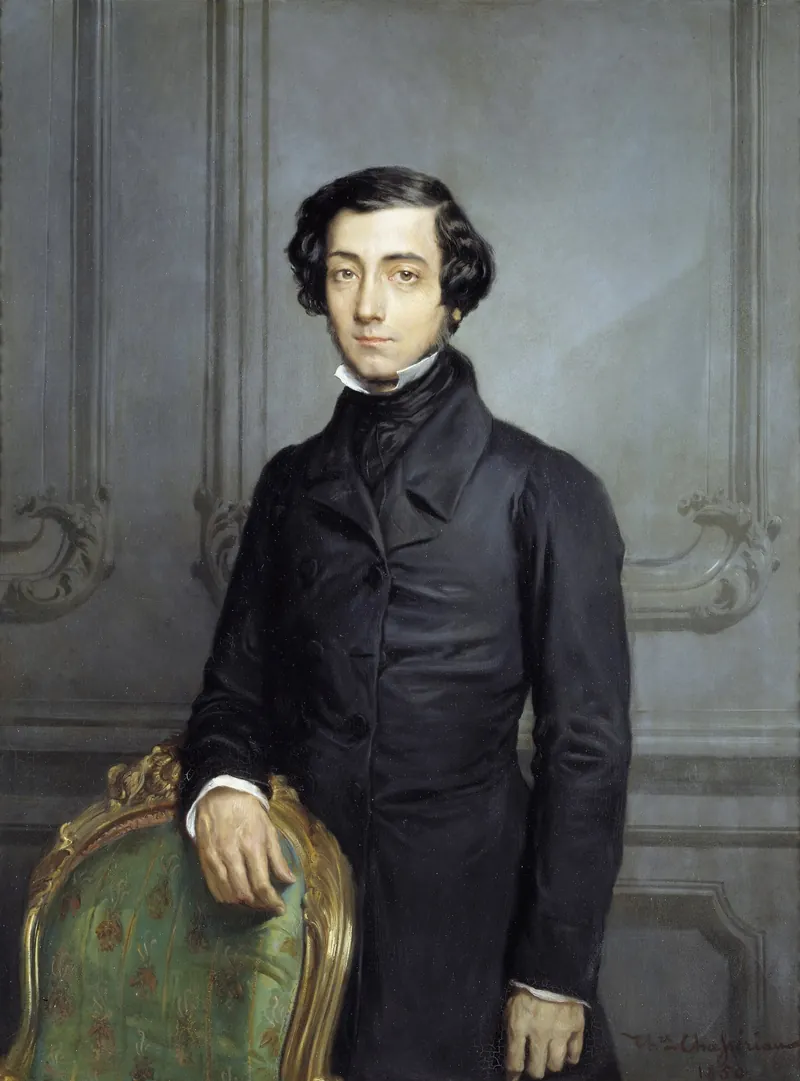
Alexis de Tocqueville
1
Books ReviewedAsk LuvemBooks about Alexis de Tocqueville
- Where should I start?
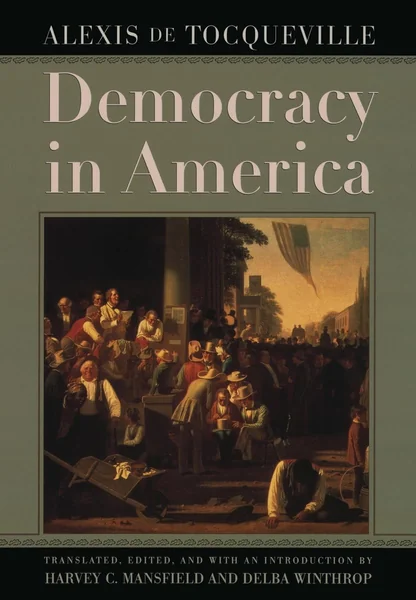
- Democracy in America is the natural — and only — starting point among titles LuvemBooks has reviewed, and it happens to be the right answer regardless. Volume I, published in 1835, is the more accessible entry: it focuses on political structures, federalism, and the role of juries and local associations, and reads as a structured argument rather than a philosophical treatise. Volume II (1840) is denser and more psychological, exploring how democratic culture shapes thought and feeling, so readers who find the first volume rewarding should continue there. A modern translation by Harvey Mansfield and Delba Winthrop, or Arthur Goldhammer's version for the Library of America, will make the prose considerably more readable than older Victorian translations.
- What's their writing style?
- Tocqueville writes as a comparative sociologist before the discipline existed: he builds arguments through systematic observation, then tests them against historical counterexamples drawn from England, France, and America. His prose in Democracy in America is formal but rarely abstract — he habitually grounds general claims in concrete social details, such as the behaviour of juries, the proliferation of newspapers, or the character of township governance. He is also notably self-aware about his own aristocratic vantage point, and this self-consciousness gives his admiration for democratic energy a tension that purely celebratory or purely critical writers lack. Readers accustomed to polemical political writing often find his measured, analytical tone requires adjustment but rewards patience.
- Books we've reviewed
- LuvemBooks has reviewed one title by Tocqueville: Democracy in America, his foundational study of how democratic institutions, customs, and psychology function in practice, rated 4.6/5 across 744 Amazon reader ratings — a score that reflects both its canonical status and its continued active readership among general audiences, not just academics.
- What genre does Tocqueville write?
- Democracy in America sits within the Politics & Society genre, but that label understates its range. It combines comparative political analysis, sociological observation, historical argument, and what we might now call cultural criticism, all within a single sustained work. Readers drawn to political philosophy (Mill, Montesquieu), early sociology (Weber, Durkheim), or narrative non-fiction about political systems will find it sits naturally alongside works in all three traditions. It is emphatically non-fiction, though it reads with an essayistic quality that distinguishes it from purely academic political science.
- What should I read after Democracy in America?
- If Tocqueville's analysis of revolution and historical continuity interests you, his own The Old Regime and the Revolution is the logical next step — it applies a similar comparative method to France and argues that 1789 was as much a continuation as a rupture. For readers who want contemporary extensions of his arguments, Robert Putnam's Bowling Alone updates his concern with civic association in the context of late 20th-century America, and Fareed Zakaria's The Future of Freedom engages directly with Tocqueville's warnings about illiberal democracy. John Stuart Mill, who reviewed Democracy in America enthusiastically on publication, is also a natural companion — particularly On Liberty.
Who is Alexis de Tocqueville?
Follow up
Synthesized from verified book data & published reviews · How we review
Press Enter to ask. Answers come from our editorial Q&A — start typing to see related questions.
Authors Like Alexis de Tocqueville

Friedrich Nietzsche
Friedrich Wilhelm Nietzsche was a German philosopher and writer who started his career as a classical philologist and turned to philosophy early in his academic career.
1 book reviewed

Massimo Pigliucci
Massimo Pigliucci is a professor at The City College of New York who has published 194 technical papers in science and philosophy and is the author or editor of 23 books. He is best known for the bestselling How to Be a Stoic: Using Ancient Philosophy to Live a Modern Life (Basic Books). He holds a PhD in evolutionary biology and has also worked as a producer, director, and writer.
1 book reviewed
Lucius Annaeus Seneca
Lucius Annaeus Seneca the Elder, also known as Seneca the Rhetorician, was a Roman writer, born of a wealthy equestrian family of Corduba, Hispania.
1 book reviewed
Jackson Ridge
The Philosophy School

James Madison
James Madison, the pen name of Charles Aronstein (August 27, 1870 – March 27, 1943), was an American theatre manager, writer, and publisher, best known for writing and publishing the periodical *Madison's Budget*.
1 book reviewed