BOOKS
Published

Read Time

7 min read

Curated & edited by

LuvemBooks Editorial

How we create our reviews →
Share This Review

Provocative Philosophical Questions That Inspire Deep Thinking and Deeper Living by Atlas Britton Review: Accessible Entry Point Into Timeless Philosophy

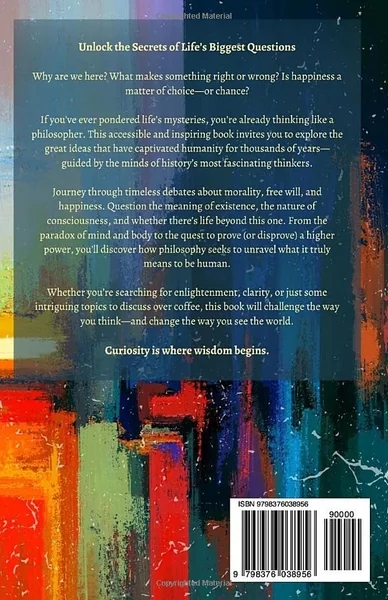
Atlas Britton's independently published guide frames philosophy as a living, practical pursuit by presenting thought experiments and big questions drawn from history's most celebrated thinkers — designed for curious readers with no prior academic background.
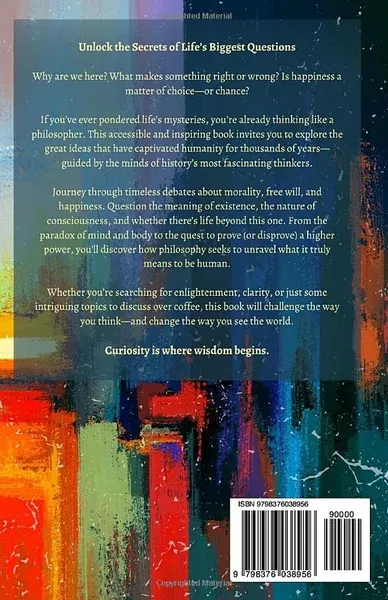
Back cover with synopsis text, tagline, and barcode on colorful abstract background.Tap to enlarge

LuvemBooks Verdict

Best for

Curious readers who have long been drawn to life's big questions but have bounced off dense academic philosophy texts and want an accessible, dip-in-and-out entry point that works equally well for solo reflection or conversation.

Worth it if

You want philosophical thought experiments served in plain language — something you can pick up, explore a single question, put down, and return to without needing to hold a continuous argument in your head.

Skip if

You come to philosophy wanting close engagement with primary sources, competing scholarly interpretations, or the footnotes and further-reading apparatus that academic introductory texts provide.

Listener responses on Audible highlight the book's plain-language approach as a standout quality, with reviewers noting its thought-provoking subject matter and smooth audio delivery by narrator Joshua Johnson.

Sources: Audible
In This Review
  • What Works & What Doesn't
  • What the Book Actually Is
  • Scope, Structure, and Accessibility
  • Significance and Intended Use
  • Genuine Strengths
  • Limitations and Who May Be Frustrated

What Works & What Doesn't

What Works
  • Designed for accessibility — written in plain language that makes major philosophical ideas approachable without prior background
  • Organised around thought experiments and questions, giving the book a reusable, dip-in-and-out quality
  • Dual-use framing suits both serious contemplation and social conversation, broadening its practical reach
  • Available in audiobook format narrated by Joshua Johnson, extending accessibility beyond the print edition
What Doesn't
  • Not suited for readers seeking academically rigorous coverage of philosophical traditions or primary-source engagement
  • As an independently published work, it lacks the scholarly apparatus — footnotes, bibliographies, further-reading guides — found in academic introductions
A philosophy book built around accessible questions rather than dense theory, this independently published title positions itself as a genuine on-ramp for readers who have wondered about life's big ideas but never known where to start.

What the Book Actually Is

Published in February 2023, Provocative Philosophical Questions That Inspire Deep Thinking and Deeper Living is a non-fiction philosophical exploration by Atlas Britton. Rather than surveying the discipline through its historical schools or biographical portraits alone, the book is organised around questions and thought experiments — the kind that, as its publisher description puts it, have "captivated humanity for thousands of years." The premise is straightforward: if a reader has ever pondered life's mysteries, they are already thinking philosophically, and Britton's book is designed to formalise and deepen that instinct. The questions are framed as tools for both rigorous contemplation and, the book's own subtitle makes clear, practical deeper living — a dual ambition that sets the tone throughout.
it explains everything in plain English instead of talking above my head

Scope, Structure, and Accessibility

The book's most deliberate structural choice is accessibility. Britton writes in plain language, connecting readers to the ideas of history's most significant thinkers without the gatekeeping vocabulary that often characterises academic philosophy. The audiobook version — narrated by Joshua Johnson and available on Audible — has drawn listener responses noting that "it explains everything in plain English instead of talking above my head," a reaction that reflects the design intent of the print edition as well. The thought experiments are presented as discrete, returnable units: some Audible listeners report planning to revisit specific sections repeatedly, which suggests the book is structured for dipping in and out rather than demanding a single linear read-through. This makes it function as much as a reference and conversation resource as a cover-to-cover reading experience.

Significance and Intended Use

What distinguishes this title from comparable introductory philosophy books is its explicit dual-use framing. Britton positions the questions as capable of serving two quite different purposes: serious intellectual inquiry — examining one's place in the world and confronting foundational questions about existence, ethics, and knowledge — and lighter social engagement, described in the book's own promotional copy as potential "conversation starters over coffee." That range is a genuine differentiator. The book does not confine itself to the seminar room or the armchair philosopher; it acknowledges that philosophical thinking happens in kitchens and cafés as much as in libraries. Some Audible listeners describe Britton's work as challenging them "to contemplate their place in the world and consider new perspectives," which aligns with that broader ambition.
Back cover with synopsis text, tagline, and barcode on colorful abstract background.

Genuine Strengths

The book's core strength, as reflected consistently across available listener responses, is its tone: intellectually serious without being exclusionary. Readers drawn to philosophy who have previously bounced off dense primary texts or jargon-heavy introductions are the audience this book is most clearly designed for. The audiobook version also benefits from narration by Joshua Johnson, whose performance has been described by listeners as having a smooth flow with a clear, captivating voice — a meaningful consideration given that accessible audio delivery reinforces the book's plain-language ethos. The thought-experiment format, rather than a purely historical or argumentical structure, keeps individual sections self-contained and inherently engaging, since each question carries its own built-in tension.

Limitations and Who May Be Frustrated

Readers seeking a rigorous, academically structured survey of philosophical traditions are unlikely to find what they are looking for here. The book's accessibility-first design is a genuine strength for its target audience, but it is the same quality that will give pause to readers who come to philosophy wanting close engagement with primary sources, competing scholarly interpretations, or the kind of sustained argument-building found in dedicated academic introductions. As an independently published title, it also does not carry the editorial apparatus — footnotes, bibliographies, guided further reading — that academic presses typically attach to introductory philosophy texts. Readers who want those scaffolds will need to supplement accordingly. The book is best understood as an invitation into philosophical thinking rather than a comprehensive map of the field.

Sources & Further Reading

The key facts and claims in this review are grounded in the retrieved, verified sources listed below.

  1. Cited in this review
  2. 1
  3. Further reading
  4. 2
  5. 3
Related Reviews

Reviews of books we picked for readers who enjoyed Provocative Philosophical Questions That Inspire Deep Thinking and Deeper Living.