8 min read
4.4
· 2,007 Amazon ratingsShare This Review
The Consolations of Philosophy by Alain De Botton Review: Witty, Accessible Popular Philosophy with Trade-offs
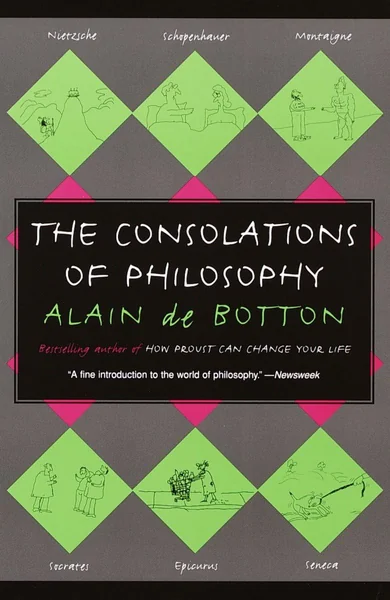
Alain de Botton's The Consolations of Philosophy is a non-fiction work structured around six philosophers — Socrates, Epicurus, Seneca, Montaigne, Schopenhauer, and Nietzsche — each paired with a common human affliction, from unpopularity and financial anxiety to heartbreak and suffering. Originally published by Hamish Hamilton in 2000 and subsequently reissued by Penguin Books, it drew glowing praise from major outlets for its charm, playfulness, and accessibility, while a minority of academic critics argued its popularising approach came at the cost of philosophical rigour. It remains one of the more widely read and discussed attempts to bring ancient and modern philosophy into the orbit of everyday emotional life.
LuvemBooks Verdict
Best for
Readers with little or no background in philosophy who want a structured, lively, and historically grounded introduction to how thinkers like Epicurus, Montaigne, and Nietzsche might speak directly to everyday difficulties such as financial worry, self-doubt, or heartbreak.
Worth it if
You're drawn to the idea that philosophy can be practically useful and want an entertaining, well-organised entry point to six major thinkers — read one chapter at a time, matched to whatever human problem feels most pressing.
Skip if
You're already versed in academic philosophy and expect rigorous close engagement with primary texts, scholarly apparatus, or original philosophical argument — the treatment is, by design, a popular commentary rather than a work of intellectual depth.
What readers & critics say
Kirkus Reviews called the book "congenial, refreshing, original — and mercifully succinct," suggesting de Botton "may well achieve the impossible by making philosophy popular," praising him as "an able and companionable guide." The Eurasian Review described it as "a delightful book" in which de Botton "skillfully linked the ideas of great philosophers to the challenges of life," while the nateshivar.com review highlighted his "clear writing and thoughtful approach," though noting he "can be a bit contemplative and earnest." A dissenting note — referenced in the review body — came from Edward Skidelsky in The New Statesman, who argued the popularising approach trivialises philosophy rather than genuinely illuminating it.
“Congenial, refreshing, original — and mercifully succinct — de Botton may well achieve the impossible by making philosophy popular.”
— Kirkus ReviewsAsk LuvemBooks
Was this helpful?
- Is it worth reading?
- For readers with little or no background in philosophy who are curious whether thinkers like Epicurus, Montaigne, or Nietzsche have anything direct to say about financial worry, self-doubt, or grief, The Consolations of Philosophy is a genuinely worthwhile and entertaining entry point. Humphrey Carpenter in The Sunday Times described it as a "brisk, playful tour" in which "few discussions on the great philosophers can have been so entertaining," while other critics called it "congenial, refreshing, original — and mercifully succinct." The honest caveat, raised by Edward Skidelsky in The New Statesman, is that the popularising approach involves real compression — readers seeking close engagement with primary texts in their full complexity will need to look elsewhere.
- Similar books
- Readers who respond to de Botton's approach will find strong companions in several directions. For ancient Stoic thought in primary-source form, Seneca's own Letters from a Stoic and Marcus Aurelius's Meditations offer the unmediated philosophical voice that The Consolations of Philosophy interprets. Viktor E. Frankl's Man's Search for Meaning occupies a comparable space — accessible, humane, and arguing that philosophy and meaning-making have direct bearing on how we endure suffering. For readers new to philosophy who want a narrative introduction, Jostein Gaarder's Sophie's World provides a story-driven tour of Western philosophical history.
- Who should read this?
- The Consolations of Philosophy is designed for adults with little or no background in philosophy who are drawn to the idea that thinkers like Epicurus, Montaigne, or Nietzsche might have something direct and useful to say about financial worry, self-doubt, heartbreak, or suffering. It will also appeal to general readers who enjoy intellectually engaged popular non-fiction with historical breadth — drawing on ancient Stoic, Epicurean, Renaissance, and nineteenth-century thought within a single, readable volume. Those seeking scholarly depth, close engagement with primary texts, or rigorous philosophical apparatus should look to the original works or academic commentary.
- What are the main themes?
- The book's central theme is the practical utility of philosophy — the argument that ancient and modern thinkers offer genuine, actionable consolation for everyday emotional difficulties, not merely abstract intellectual frameworks. The six human predicaments it addresses — unpopularity (Socrates), financial anxiety (Epicurus), frustration (Seneca), inadequacy (Montaigne), heartbreak (Schopenhauer), and suffering (Nietzsche) — are chosen precisely because they are universal. A secondary theme is the historical argument that philosophy's separation from practical wisdom is a relatively modern phenomenon and that an older model, in which philosophers were seen as natural authorities on pressing human questions, is worth reclaiming.
- Where should I start with Alain de Botton?
- The Consolations of Philosophy is widely considered one of de Botton's most accessible and structurally coherent works, making it a natural starting point for readers new to him. Its chapter-by-chapter format — each pairing a philosopher with a human problem — also makes it one of his most immediately practical books. Readers who respond to its approach will find that de Botton applies a similar blend of popular interpretation and humanist argument across his wider body of work, including How to Think More About Sex, which applies a comparable philosophical lens to a different domain of human experience.
- Is the popularising approach a problem?
- This is the book's central critical fault line, and it deserves a direct answer. Edward Skidelsky, writing in The New Statesman, argued that de Botton had "merely trivialised" philosophy, "smoothing the discipline into a series of silly sound bites," and that the conception of philosophy the book promotes is a "decadent one" that could mislead readers about the discipline's true nature. Humphrey Carpenter, while broadly positive, acknowledged the book is "a commentary rather than a work of original thought." The majority of critics — across The Sunday Times, The Sunday Telegraph, The Spectator, The Irish Times, The Literary Review, and The New York Review of Books — found the trade-off worthwhile, but whether it constitutes a problem depends entirely on what the reader is looking for.
Summarize this book
Follow up
Synthesized from verified book data & published reviews · How we review
Press Enter to ask. Answers come from our editorial Q&A — start typing to see related questions.
Age & Reading Level
Recommended age
Adult
Reading level
Adult
who it suits
Skip if you want rigorous philosophical analysis with close engagement with primary texts, scholarly counterarguments, and academic apparatus.
Our Review
What the Book Actually Is and Does
The Central Argument and Its Cultural Stakes
What Critics Found Genuinely Strong
The Genuine Limitation: Popularisation vs. Rigour
Who This Book Is Genuinely For
Sources & Further Reading
The key facts and claims in this review are grounded in the retrieved, verified sources listed below.
- Cited in this review
- 1
alaindebotton.com
- 2
en.wikipedia.org
- Further reading
- 3
- 4
Books like The Consolations of Philosophy
Curated picks for readers who enjoyed The Consolations of Philosophy, with our reasoning for each match.
If you liked The Consolations of Philosophy