BOOKS
Published

Read Time

8 min read

Curated & edited by

LuvemBooks Editorial

How we create our reviews →
Share This Review

Greatest Stoic Quotes of All Time by Daniel Bulmez Review: A Compact Stoic Wisdom Collection

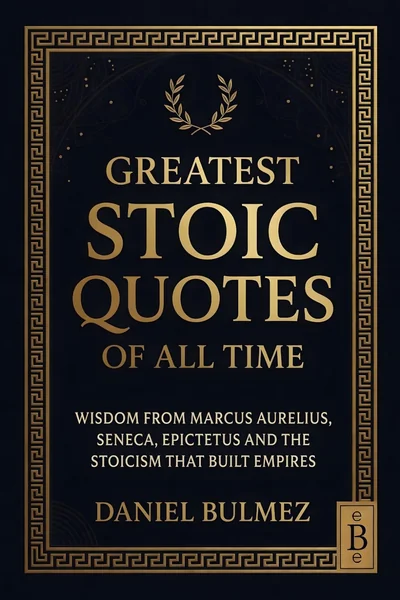
Daniel Bulmez's Greatest Stoic Quotes of All Time gathers the most enduring words of Marcus Aurelius, Seneca, and Epictetus into a single compact reference, framed around the philosophical tradition of Stoicism that shaped Roman emperors and thinkers for centuries. This review covers the book's content and structure as described by published sources, not hands-on use.

Back cover with title, descriptive text about the book's content and structure, publisher logo, and barcode.Tap to enlarge

LuvemBooks Verdict

Best for

Readers approaching Stoicism for the first time who want a portable, thematically organized anthology of canonical wisdom from Marcus Aurelius, Seneca, and Epictetus — without having to navigate dense primary texts.

Worth it if

You want a compact, topic-indexed reference to return to during moments of difficulty or reflection, and you value breadth and accessibility over sustained philosophical analysis.

Skip if

You are already well-versed in the Meditations, Seneca's letters, or Epictetus's Discourses, or you want historical context, close reading, and philosophical argument alongside the quotations.

External sites aggregating Stoic quotations consistently highlight the enduring relevance of Marcus Aurelius, Seneca, and Epictetus to modern readers — mindofastoic.com notes ongoing amazement at "just how these thoughts from the greatest Stoic philosophers from ancient times are still relevant today," while ofmindandbody.com describes the trio's collected wisdom as "profound, timeless" material that "has inspired generations." No dedicated critical reviews of this specific volume were retrieved.

Sources: Mind of a Stoic, Of Mind and Body

Age & Reading Level

Recommended age

Adult

Reading level

Adult

Skip if you want sustained philosophical analysis, historical context, or close readings of individual Stoic quotations.

In This Review
  • What Works & What Doesn't
  • What the Book Contains and How It Is Structured
  • The Stoic Tradition Behind the Quotes
  • Strengths: Accessibility and Thematic Range

  • Limitations and Honest Considerations
  • Who This Book Is For

What Works & What Doesn't

What Works
  • Draws on three of the most historically significant and widely read Stoic philosophers — Marcus Aurelius, Seneca, and Epictetus — offering a canonical core.
  • Organized around concrete life themes (death, love, ego, judgment, resilience), making it easy to locate relevant quotations by topic.
  • Compact format is designed to make Stoic philosophy accessible to readers who find full primary texts daunting.
  • Serves as Book 1 of a 3-volume series, positioning it as an entry point into a broader curated Stoic collection.
What Doesn't
  • As an anthology format, it does not provide sustained philosophical analysis, historical context, or close reading of individual quotations.
  • Readers already fluent in Stoic literature — particularly the *Meditations*, Seneca's letters, or Epictetus's *Discourses* — may find the selections familiar rather than revelatory.
A concise reference anthology, this volume distills millennia of Stoic thought into a single portable collection — making it a practical entry point for readers new to the tradition and a quick-reference companion for those already familiar with it.

What the Book Contains and How It Is Structured

Greatest Stoic Quotes of All Time is the first volume in Daniel Bulmez's three-book Stoic Wisdom series, published by The Book Publishers. The book draws its core material from three of the most celebrated Stoic philosophers: Marcus Aurelius, Seneca, and Epictetus. These three figures represent distinct vantage points on the same philosophical tradition — Marcus Aurelius as a sitting Roman emperor whose Meditations were composed as private reflections on duty, impermanence, and virtue; Seneca as an adviser to Emperor Nero whose essays and letters addressed ethics, self-control, and the value of adversity; and Epictetus as a formerly enslaved philosopher whose teachings centered on the radical distinction between what is and is not within human control. The book organizes quotations around themes that span the full arc of human experience: death, love, honesty, ego, judgment, and the pursuit of a meaningful life.

The Stoic Tradition Behind the Quotes

Stoicism itself is a philosophy with roots stretching back to Zeno of Citium, who founded the Stoic school in Athens around 300 BC. By the time of the Roman Empire, the tradition had evolved into one of the ancient world's most influential practical philosophies, producing thinkers whose words shaped governance, literature, and personal conduct alike. The three philosophers at the heart of Bulmez's collection represent its Roman apex. Marcus Aurelius ruled Rome from AD 161 to 180 and is regarded as one of antiquity's most thoughtful leaders; Seneca, active from roughly 4 BC to AD 65, left behind a vast body of ethical writing; and Epictetus, who lived through much of the same era, became one of the most quoted voices in the entire tradition. Gathering their key statements into one volume reflects a long-standing popular appetite — Stoic ideas have seen a pronounced modern resurgence, with readers turning to these ancient texts for guidance on resilience, equanimity, and purposeful living.

Strengths: Accessibility and Thematic Range

The book's primary design intent is accessibility. Rather than presenting complete primary texts — which require readers to navigate dense philosophical prose — it curates individual quotations and organizes them by theme, allowing readers to locate relevant wisdom on specific concerns quickly. The thematic range is genuine: the collection addresses not only grand philosophical abstractions but also the texture of everyday life, including how to meet adversity, manage the ego, and think about mortality. For readers who find the full Meditations or Seneca's collected letters daunting as starting points, a curated anthology structured this way serves a clear navigational function. The subtitle's framing — "wisdom that built empires" — positions the material not as academic philosophy but as applied guidance, underscoring the book's intent to make Stoic thought immediately usable.
Back cover with title, descriptive text about the book's content and structure, publisher logo, and barcode.

Limitations and Honest Considerations

A quotes anthology by nature is a secondary format: it selects and presents rather than interprets or contextualizes. Readers who want sustained philosophical argument, historical commentary on each thinker's life, or close analysis of how individual quotations fit within a larger body of work will find this format limiting. The book runs to 131 pages, which means breadth and brevity are built into the design — a deliberate trade-off that suits some readers and frustrates others. Those already well-versed in Stoic literature may find the selection familiar ground rather than new discovery. Additionally, as with any quotation collection, the value of individual entries depends in part on translation choices and curatorial judgment, neither of which can be evaluated without firsthand use of the text.

Who This Book Is For

Greatest Stoic Quotes of All Time is designed for readers approaching Stoicism for the first time, as well as those who want a curated, thematically organized reference to return to during moments of difficulty or reflection. The three philosophers at its center — Marcus Aurelius, Seneca, and Epictetus — represent the Stoic canon most likely to resonate with a contemporary general audience, and their relevance to modern concerns around resilience, purpose, and equanimity is well established across centuries of readership. As the opening volume in a three-book series, it also positions itself as an introduction to a broader project of Stoic curation rather than a standalone comprehensive treatment.

Sources & Further Reading

The key facts and claims in this review are grounded in the retrieved, verified sources listed below.

  1. 1
  2. 2