Overprotection in the Real World
Haidt argues that modern society has drastically overprotected children in the physical world while failing to protect them from harms online.

8 min read
4.6
· 13,592 Amazon ratings
Our review
The Anxious Generation by Jonathan Haidt Review: A Provocative, Contested Case for Kids
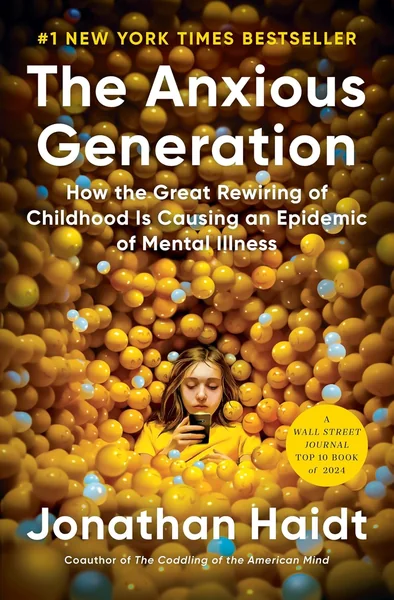
Jonathan Haidt's The Anxious Generation (Penguin Press, March 2024) is a work of social-science argument that attributes a documented rise in teen mental illness to the spread of smartphones, social media, and what Haidt calls the shift from a "play-based" to a "phone-based" childhood. It is one of the most widely discussed nonfiction books of 2024, praised by many parents and educators as an urgent call to action — and challenged by researchers who question whether its causal claims hold up to scientific scrutiny. This review is based on the book's contents as described by the publisher and published critical sources, not hands-on application.
Best for
Parents, school administrators, pediatricians, and policymakers who want the most fully developed single-volume case for restricting youth smartphone access, complete with a concrete policy agenda for families, schools, tech companies, and governments.
Worth it if
You want a structured, well-argued entry point into the youth mental-health-and-technology debate and are willing to pair it with the peer-reviewed literature — including Candice Odgers's Nature critique — to stress-test its causal claims.
Skip if
You're looking for a balanced survey of the research that includes findings cutting against the "great rewiring" thesis — taken alone, this book does not provide that, and its core causal argument remains actively contested among researchers.
What readers & critics say
The New York Times's own review page describes the book as "erudite, engaging, combative, crusading," setting the tone for broadly positive mainstream coverage, while Bookmarks Reviews aggregates an overall "Positive" rating across six critics. However, the Wikipedia reception entry records a sharp scientific counter-current: critics, including Candice Odgers writing in Nature, argue that the book's repeated claim that digital technologies are rewiring children's brains and causing an epidemic of mental illness "is not supported by science," with some contending Haidt is "telling a scary story that many parents are primed to believe."
“Erudite, engaging, combative, crusading — sets the tone for a national debate about children and devices.”
— nytimes.comWas this helpful?
Summarize this book
Follow up
Synthesized from verified book data & published reviews · How we review
Answers come from our editorial notes on this book. If we haven't covered something, we'll say so.
Readers often ask
We review the evidence: published critics, reader verdicts and BookTube reviews, gathered and weighed with AI assistance and edited by LuvemBooks, rather than one reader's first-hand take.
The key facts and claims in this review are grounded in the retrieved, verified sources listed below.
penguinrandomhouse.com
Jonathan Haidt, LuvemBooks
en.wikipedia.org
pmc.ncbi.nlm.nih.gov
anxiousgeneration.com
thegospelcoalition.org
Recommended age
Adult
who it suits
Skip if you want a balanced, neutral survey of the research literature that weighs evidence both for and against the smartphone-harm thesis.
Social psychologist Jonathan Haidt discusses 'The Anxious Generation' on CBS Saturday Morning, examining the impact of smartphones and overprotective parenting on youth mental health.
Uploaded by CBS Mornings, 2024 · Watch on YouTube
Haidt argues that modern society has drastically overprotected children in the physical world while failing to protect them from harms online.
Haidt explains that children can only become autonomous, capable adults by practicing independence, but parental paranoia has created an unhealthy cycle of incompetence.
Haidt warns that brain circuitry develops based on feedback from physical interactions, and replacing tactile play with constant screen use fundamentally distorts neural inputs.
Haidt notes that taking away devices is not enough on its own; children must also be granted the freedom to explore the physical world.
Be one of the first readers to answer.
Read it? Was it right for you?
Curated picks for readers who enjoyed The Anxious Generation, with our reasoning for each match.
More from the same writers
If you liked The Anxious Generation